iWorld
How OTT players re-calibrate OOH advertising during social distancing

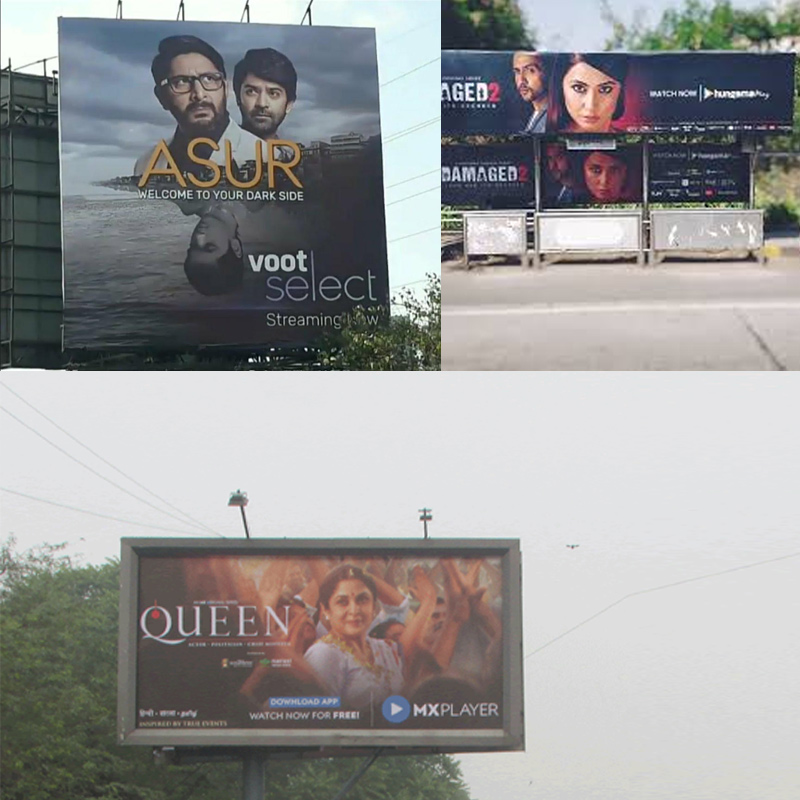
MUMBAI: The world continues to grapple with the COVID-19 pandemic, an unprecedented crisis in living memory that has almost crippled our everyday lives and left the whole country deserted. And the reality has been unpalatable to the media and entertainment industry, especially the outdoor advertising segment, which is bearing the brunt of the stay-at-home/social distancing stipulations.
The out-of-home (OOH) medium has been one of the go-to points for OTT services in India so much so that leading streaming platforms had started outdoing even retail brands in OOH advertising. Now, with that option totally shut, streaming services are looking at ways to re-calibrate their ad spends.
In this new series, we explore how the OTT industry is coping with its communication strategies amidst the COVID-19 pandemic. We start off with the OOH industry.

As people have suddenly been forced to shift to seek entertainment online, digital advertising has gained traction. However, none of the platforms denies the importance of OOH in the media mix.
ALTBalaji marketing, analytics & direct revenue SVP Divya Dixit says that the platform has been at the forefront of executing creative and innovative OOH formats for its varied shows. However, she mentions that their strategies have always been a mix of varied tools, and in times such as these, they seek to explore the rest of them with innovation and uniqueness.
"For marketers, with OOH advertisement being suspended, it does create a dent in the overall marketing outreach. As all of us exercise the mandatory stay-at-home-stay-safe measure during the lockdown, audiences across the country are now consuming content digitally every part of the day. In such a situation, digital marketing, buoyed by social media, influencer marketing, meme marketing, OBD calls, SMS and email blasts etc., can prove to be the best bet for brands right now. Especially for a digital-first platform like ours, it promises to play a crucial role in the overall marketing mix, seeing 50 per cent of the allotted marketing budget," she adds.
Hungama Digital Media COO Siddhartha Roy comments that the stay-at-home measure has enabled the TV and digital media to find captive audiences while the audience for OOH and other forms of outdoor and experiential marketing has decreased dramatically. "As a platform, we realised a long time ago that our audience is present on the digital medium; hence, our marketing strategy, even in the past, has been heavily skewed towards digital and social platforms," he says.

Broadcaster-led platforms, like VOOT, ZEE5, etc., whose traditional business has also been bullish on OOH, accept it as a key component of the media mix. Voot Select and Viacom18 youth, music and English entertainment head Ferzad Palia says that outdoor is very important when a new service is launching, especially in markets like Mumbai. But he also adds that they have never been over-indexed on outdoor; hence, cutting back on this area is not a huge change. While having an outdoor option could have been an advantage, he mentions the OOH spends are being shifted to a mix of TV and digital ads.
ZEE5 India SVOD marketing head Reilly Rebello also echoes Palia's thoughts. While terming OOH as a key component of its advertising mix, he does not forget to mention that there are a lot of other mediums that have been used regularly. Rebello also says that they are focusing a lot on digital and TV. ZEE5 India is doing heavy targetted advertising on the ZEE5 app while focusing on other digital mediums. A major part of ZEE5's OOH cost has moved to the digital medium.
However, TheSmallBigIdea CEO and co-founder Harikrishnan Pillai has a different take. He is of the view that outdoor was never a pivot platform for OTT. According to Pillai, while OOH builds perception and is a great reminder medium, it is seldom the core medium. "What outdoor helped OTT do is place itself alongside broadcast television in terms of scale. Over the years, TV has built a perception on the back of the outdoors. So for OTT, which is digital-first, absence of outdoor doesn't matter much in these times, since TV, too, isn't making much use of it," he says.
"Given the stay-at-home, stay-safe mandate, a lot of outdoor media has had to be removed from the marketing media mix, but at MX Player, we firmly believe that all else can wait, but your daily dose of entertainment must go on. We've gone live with eight shows just in the month of March and the first week of April," MX Player marketing and business partnerships head Abhishek Joshi states.
While OOH hoardings stay barren for now, the hope is that the industry will be back on track after this crisis passes us.







iWorld
Micro-Dramas Surge in India, Redefining Mobile Content Habits
Meta-Ormax study maps rapid rise of short-form storytelling among 18–44 audiences.
MUMBAI: Micro-dramas aren’t just short, they’re the snack that ate Indian entertainment, and now everyone’s bingeing between the sofa cushions. Meta, in partnership with Ormax Media, has released ‘Micro Dramas: The India Story’, a comprehensive study unveiled at the inaugural Meta Marketing Summit: Micro-Drama Edition. The report maps how the vertical, bite-sized format is reshaping content consumption for mobile-first audiences aged 18–44 across 14 states.
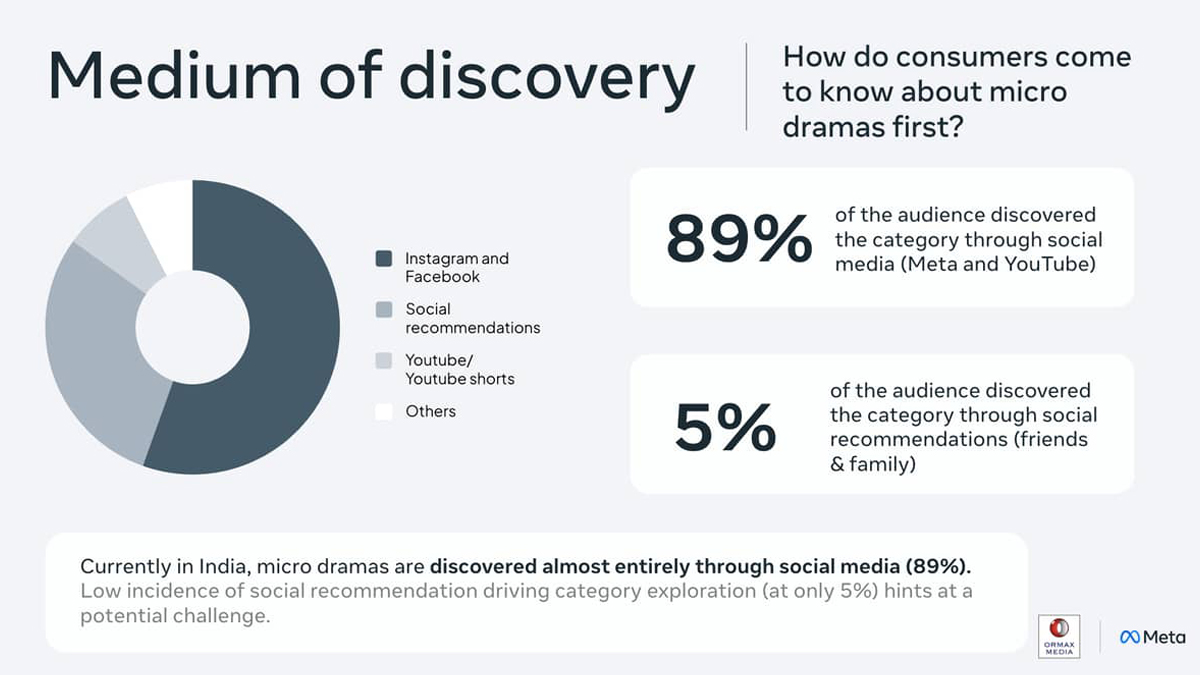
Conducted between November 2025 and January 2026 through 50 in-depth interviews and 2,000 personal surveys, the research reveals that 65 per cent of viewers discovered micro-dramas within the last year proof of explosive adoption. Nearly 89 per cent encounter the format through social feeds and recommendations, making algorithm-driven discovery the primary engine rather than active search.
Key viewing patterns show a median of 3.5 hours per week (about 30 minutes daily) spread across 7–8 short sessions. Consumption peaks between 8 pm and midnight, with additional spikes during commutes and work breaks classic “in-between moments” that the format fills perfectly. Around 57 per cent of viewing happens in ambient mode (while doing something else), and 90 per cent is solo, enabling more intimate, personal storytelling.
Romance, family drama and comedy lead genre preferences. Audiences show growing openness to AI-generated content, 47 per cent find it unique and creative, while only 6 per cent say they would avoid it entirely. Regional languages are surging after Hindi and English, Tamil, Telugu and Kannada dominate consumption.
Meta, director, media & entertainment (India) Shweta Bajpai said, “Micro-drama isn’t a passing trend, it’s rewriting the rules of Indian entertainment. In under a year, an entirely new category of platforms has emerged, built audience habits from scratch, and created a business vertical that is scaling fast.”
Ormax Media founder-CEO Shailesh Kapoor added, “Micro-dramas are beginning to show the early signs of becoming a distinct content category in India’s digital entertainment landscape. When a format aligns closely with how audiences naturally engage with their devices, it has the potential to scale very quickly.”
The study proposes ecosystem-wide responsibility, universal signposting of commercial intent, shared accountability among advertisers, platforms, creators, schools and parents, built-in safeguards, and formal media literacy in schools.
In a feed that never sleeps and a day that never stops, micro-dramas have slipped into the cracks of every spare minute turning 30-second stories into the new national pastime, one vertical swipe at a time.







