iWorld
How is OTT redefining media: CASBAA announces summit in Singapore

MUMBAI: CASBAA, the Association for digital multichannel TV, content, platforms, advertising and video delivery in Asia, has announced its 4th OTT Summit, Asia’s OTT industry marquee annual event. A series of panels comprising the region’s leading experts will explore in detail how traditional media is responding to the digital challenges of OTT.
“We are delighted to be returning to Singapore for the fourth edition of CASBAA’s OTT Summit,” said CASBAA CEO Christopher Slaughter. “While traditional media incumbents remain dominant, there’s no denying the growing impact of over-the-top (OTT) video services, and how they are transforming viewing habits throughout the region. We have been saying it for years, but it’s now increasingly apparent that OTT is truly a big part of pay TV’s future.”
The spectacular success, both critical and commercial, of such diverse video platforms as Netflix, Hooq and Spuul have established OTT services as real competitors to mainstream broadcasters. According to a survey by BCG, OTT services are growing by more than 20 per cent annually and winning share over traditional TV.1 Traditional media must respond fast to this existential crisis.

The real challenge for incumbents is how to rethink their business strategies in light of such drastic industry transformation. Are legacy business models holding traditional media back as they contemplate the OTT challenge?
CASBAA has convened a select field of industry thought leaders, senior executives and market practitioners, including:
Ajit Mohan, CEO Hotstar
AravindVenugopal, VP – Media Partners Asia
Winradit Kolasastraseni, SVP Innovation – Discovery Networks Asia Pacific
Simon Vella, Head of Asia, MPP Global
Oliver Wilkinson, MD, PwC
Alan Soon, Founder & CEO, Splice Newsroom
Shad Hashmi, VP – Digital Development, Global Markets &Operations Asia,BBC Worldwide
Lam Swee Kim, CMO, Dimsum& Star Online Malaysia
PremKamath, Deputy MD, A+E Networks Asia
Alexandre Muller, MD APAC, TV5MONDE
Jonas Engwall, CEO, RTL CBS Asia
Virat Patel, MD, Pioneer Consulting
Monica Bhatia, Regional Digital Director, APAC, Maxus
Genny Yang, Group Account Director, Kantar Milward Brown
David Schonfeld, Director Technical Operations, A+E Networks Asia
Alex Merwin, VP International, SpotX
Luke Gaydon, VP of OTT Solutions, Brightcove
Yu-Chuang Kuek, Managing Director APAC, Netflix
Ravi Vora, CMO, Hooq
S Mohan, Co-Founder & COO, Spuul
Lindsay Servian, Head of ONTAPtv.com, PCCW Global
Maya Hari, MD –SEA & India, Twitter
Tim Martin, CEO RugbyPass
Michael Greco, VP APAC,Vindicia
CK Lee, VP, Sports Business – Content Group, ASTRO
Unmish Parthasarathi, Head of Digital Sales, International Cricket Council & Founder, Picture Board
Craig Johnson, MD Media, SEA & India, Nielsen
Priya Khatri, GM Sales & Business Development, SEA Eyeota
Jay Shah, CEO, OpenDNA
James Miner, CEO, Miner Labs
Roger Harvey, Regional Director, Irdeto
Mike Kerr, MD Asia, BEIN
Joe Welch, SVP Government Relations APAC, 21st Century Fox
HianGoh, Partner, NSI Ventures
Yinglan Tan, Venture Partner, Sequoia
Marcel Fenez, President, Fenez Media
The industry’s essential platform to explore how OTT is transforming the broadcasting landscape, the CASBAA OTT Summit 2017 will take a deep dive on a range of topics, includingtrends in Asian viewership, whether OTT is a game changer in sports, how traditional media is adapting, the synergy between OTT and multiscreen, and how to use data as metrics for success.
The CASBAA OTT Summit 2017 has been recommended for all those involved at the senior level in media and broadcasting, from content providers and broadcasters to investors and regulators.
CASBAA OTT Summit 2017 is supported by the presenting sponsor Brightcove, and sponsors including Adobe, Diagnal, Irdeto, Mediamorph, MPP Global, PCCW Global and Vindicia.






iWorld
Micro-Dramas Surge in India, Redefining Mobile Content Habits
Meta-Ormax study maps rapid rise of short-form storytelling among 18–44 audiences.
MUMBAI: Micro-dramas aren’t just short, they’re the snack that ate Indian entertainment, and now everyone’s bingeing between the sofa cushions. Meta, in partnership with Ormax Media, has released ‘Micro Dramas: The India Story’, a comprehensive study unveiled at the inaugural Meta Marketing Summit: Micro-Drama Edition. The report maps how the vertical, bite-sized format is reshaping content consumption for mobile-first audiences aged 18–44 across 14 states.
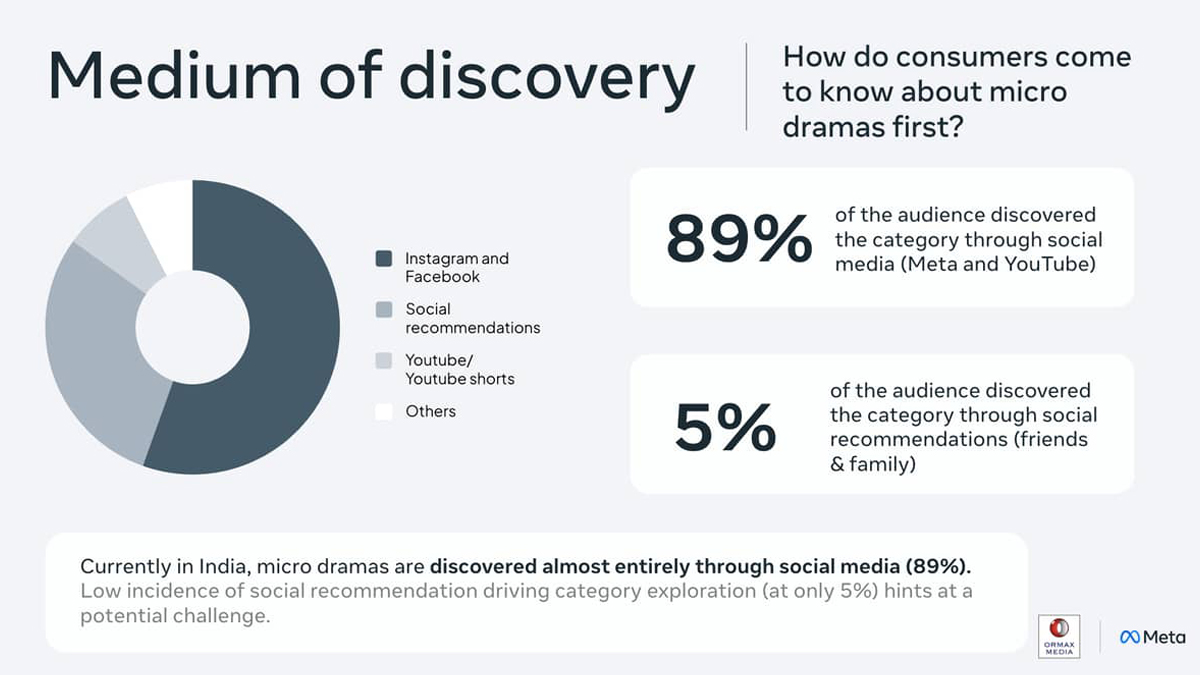
Conducted between November 2025 and January 2026 through 50 in-depth interviews and 2,000 personal surveys, the research reveals that 65 per cent of viewers discovered micro-dramas within the last year proof of explosive adoption. Nearly 89 per cent encounter the format through social feeds and recommendations, making algorithm-driven discovery the primary engine rather than active search.
Key viewing patterns show a median of 3.5 hours per week (about 30 minutes daily) spread across 7–8 short sessions. Consumption peaks between 8 pm and midnight, with additional spikes during commutes and work breaks classic “in-between moments” that the format fills perfectly. Around 57 per cent of viewing happens in ambient mode (while doing something else), and 90 per cent is solo, enabling more intimate, personal storytelling.
Romance, family drama and comedy lead genre preferences. Audiences show growing openness to AI-generated content, 47 per cent find it unique and creative, while only 6 per cent say they would avoid it entirely. Regional languages are surging after Hindi and English, Tamil, Telugu and Kannada dominate consumption.
Meta, director, media & entertainment (India) Shweta Bajpai said, “Micro-drama isn’t a passing trend, it’s rewriting the rules of Indian entertainment. In under a year, an entirely new category of platforms has emerged, built audience habits from scratch, and created a business vertical that is scaling fast.”
Ormax Media founder-CEO Shailesh Kapoor added, “Micro-dramas are beginning to show the early signs of becoming a distinct content category in India’s digital entertainment landscape. When a format aligns closely with how audiences naturally engage with their devices, it has the potential to scale very quickly.”
The study proposes ecosystem-wide responsibility, universal signposting of commercial intent, shared accountability among advertisers, platforms, creators, schools and parents, built-in safeguards, and formal media literacy in schools.
In a feed that never sleeps and a day that never stops, micro-dramas have slipped into the cracks of every spare minute turning 30-second stories into the new national pastime, one vertical swipe at a time.