English Entertainment
How 2020 turned out for Zee English cluster

MUMBAI: Despite the challenging business environment, 2020 was a year of adaptability, growth and innovation. During the lockdown, television came across as a trusted medium. There was significant growth in TV viewership, led by more walk-ins as well as more time spent on television. The Zee English cluster of channels grew by 93 per cent (BARC data week 12-week 22 vs week 1 to week 11).
&flix, the Hollywood blockbuster movies channel had one of the most engaged audiences in megacities, with 56 minutes (BARC data week 12-week 22) average weekly time spent on the channel. This, given the context of the lockdown, tells us that viewers find content on television compelling and comforting, said ZeeL premium channels business head Kartik Mahadev.
English entertainment (movies + GEC) on television caters to 216 million+ viewers (BARC data All India Period: week 01’20-week 49’20). The lockdown has shown broadcasters that people choose to watch television for the curated content experience it provides, not just to individuals but the entire family. Mahadev shared that the English entertainment viewership grew by 45 per cent as compared to last year (BARC data @ All India 2+ U+R data, week 12-week 22’20 vs week 12-week 22’19).

This year, Zee English cluster introduced tactical changes in the programming with specially curated properties to suit the entertainment needs of a steady subscriber base. For instance, Zee Café added 300+ hours of new content, which includes the latest season of dramas such as Grey’s Anatomy, Nancy Drew and Evil along with iconic sitcoms such as Seinfeld and I Dream of Jeannie along with the original airings of the celebrity chat show Starry Nights GEN Y. Recently, the channel launched its first-ever original production Dance With Me with celebrity dance experts Shakti Mohan and Mukti Mohan. According to Mahadev, the show added to the merriment of the festive season coupled with a unique and interactive format via exciting weekly hook step challenges. The year 2020 also marked the milestone celebration of 20 years for Zee Café.
Khul Ke Nacho because @MohanShakti and @thisIsMukti are bringing you the coolest, the most interactive and a Dhamakedar dance show.#DanceWithMe on Zee Cafe starts 25th October, Sundays 10 PM and from 1st November, Sundays 10 AM on @ZeeTV.
Title track: @MayurJumani pic.twitter.com/DG1nYEvVwZ
— Zee Café (@ZeeCafe) October 15, 2020
Moreover, with the growing popularity of Hollywood movies across India, the network launched ‘Flix for All’ on &flix, which played blockbuster movies in English, Hindi, Tamil and Telugu. With this, the channel witnessed a 41 per cent jump in viewership. The ‘Pick your Flix’ initiative found consumer resonance with immense traction across &flix’s social handles, with 2X engagement and 3.5 million reach.
While the supply was sporadic, the demand for movies in regional languages also grew. Thus, the network spearheaded the launch of ‘Ticket to Hollywood’, a pan network offering where it combined the might of Zee to broaden access to Hollywood movies across the width and breadth of the country through a multi-channel, multi-language offering.
“In addition, our fastest to TV premieres with the First Day First Show at Home of blockbusters like Jumanji: The Next Level and Bad Boys For Life enthralled audiences through the year while delivering value to our brand partners. A true testimony to this is the premiere of Jumanji: The Next Level on &flix and a simulcast on Zee Cinema clocking a whopping 34 million impressions,” Mahadev said.
*(BARC; TG : NCCS AB 15-40, Megacities, pre-Flix For All Period- week 45’19- week 14’20, during Flix For All Period- week 15’20 – WK 37’20).
English GECs are facing tough times but at a macro level, interest in English content is growing. There is a whole set of audiences moving from regional to English content as they become more comfortable with English as a professional, conversational language. Mahadev has designed unique offerings such as world television premieres, multi-language block, Flix for All on &flix and locally nuanced content on Zee Café, that will stand out as enablers of bringing an aspirational, English-comfortable audience onboard.
Don’t sleep on the party of a billionaire. Come and celebrate Sir Richards’ birthday with us this TONIGHT at 9 PM. #Greed #FirstDayFirstShowAtHome #FlixFirstPremiere pic.twitter.com/a42jEzKBM5
— @andflix (@AndFlix) December 27, 2020
On television, he has witnessed a trend in audience preferences towards light-hearted content, superhero flicks and adventure as a genre. Moreover, ‘nostalgia’ clearly emerged as a big theme across shows, with several successful examples in Hindi GEC.
There was a growth in non-prime time viewing as well, and hence to keep viewers entertained throughout the day, Zee Café introduced back-to-back episodes of MasterChef Australia S8, Nancy Drew and Evil, Everybody Hates Chris, and The Big Bang Theory S12. There is also an increasingly leaning towards genres like action, animation and horror.
As for the network’s distribution strategy, its strengths and weaknesses across time bands, Mahadev revealed that post lockdown, there has been a growth in English content viewership led by both reach and a more engaged audience across dayparts. Zee Café introduced 'Café Film Club' which features blockbusters from Hollywood in the afternoon time band, leading to cutting-edge English GEC content in the prime-time band.
He highlighted that the youth-focused premium brands can choose from a repertoire of high-quality content to drive association with and reach a premium subscriber base, given a sharply segmented audience that English entertainment on television attracts while similar content on digital is behind a paywall. Said he: “Over the years, we have delivered value to some of the most reputed brands who have partnered with us in our endeavour to engage an evolved audience with the latest in international content. At present, some of the top categories active across Zee English cluster include FMCGs, auto, BFSI and insurance, OTT, smartphone brands, and e-commerce.”
The rapid flux in the traditional media landscape and rising levels of digital sophistication in consumers has led to the emergence of multiple mediums to engage with the consumer. Context has also emerged as a key factor in any integrated marketing strategy. With the Covid2019 outbreak, there has been a surge in television viewership alongside brands engaging on digital through live video formats. In the English cluster, Mahadev has adopted digital engagement alongside television as part of the channel marketing strategy. He quipped, “For instance, our First Day First Show at Home campaign featuring comic José Covaco garnered an overwhelming response with nine million views on YouTube.
Mark your calendars! We’ll end this year with the best in entertainment.#BreakfastToBedBinge 9 AM onwards.#WeTimeWithZeeCafé pic.twitter.com/N6BfUg7P6i
— Zee Café (@ZeeCafe) December 26, 2020
For Zee English cluster, the primary target audience for &flix include Hollywood enthusiasts from metros. They are brand-conscious, tech-savvy, and in sync with the latest trends. When it comes to Zee Café, the viewers are evolved, motivated and have a global outlook. &PrivéHD, on the other hand, is for the non-conformists and cinephiles who appreciate nuanced content.
During the pandemic, we saw a shift in consumer trends toward OTT platforms, and it has confirmed that the digital video platforms are here to stay. However, today we live in an ‘and’ world, not an ‘or’ world. Studies reveal that consumption of overlapped content between TV and OTT grew on television from 59 per cent pre-NTO to 82 per cent contribution post-NTO for sitcom, drama, reality genres. It naturally follows that navigation between screens is seamless and consumption on TV and digital is complementary in nature.
“When it comes to OTT, content discovery is and will continue to pose a challenge to viewers looking to unwind with quality content. This is where television channels that understand their consumer and curate well, delight the viewer. With content availability growing across platforms leading to fragmented viewing, it has led to a greater and a more central role for television. Curation of content on television that lends to co-viewing, making TV for a great community experience for family and friends,” added Mahadev.
All in all, he believes the network has certainly moved the needle to a noticeable degree this year and the future too looks promising.







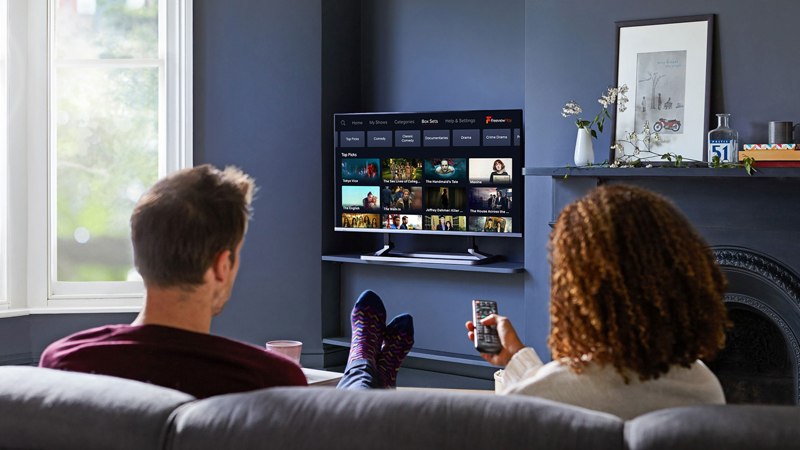
UK: The aerial is losing its grip. As broadband becomes the default way Britons watch television, the UK is edging towards a decisive, and divisive, question: should Freeview be switched off by 2034? The issue, highlighted in reporting by The Guardian, has exposed deep fault lines over access, affordability and the future of public service broadcasting.
For nearly 25 years, Freeview has delivered free-to-air television from the BBC, ITV, Channel 4 and Channel 5 to almost every corner of the country. Even now, it remains the UK’s largest TV platform, used in more than 16m homes and on around 10m main household sets. Yet the same broadcasters that built it are now pressing for its closure within eight years.
Their case rests on a structural shift in viewing. Smart TVs, superfast broadband and the Netflix-led streaming boom have pulled audiences online. Advertising economics have followed. By 2034, the number of homes using Freeview as their main TV set is forecast to fall from a peak of almost 12m in 2012 to fewer than 2m, making digital terrestrial television, or DTT, increasingly costly to sustain.
But critics say the rush to switch off risks abandoning those least able, or least willing, to move online.
“I don’t want to be choosing apps and making new accounts,” says Lynette, 80, from Kent. “It is time-consuming and irritating trying to work out where I want to be, to remember the sequence of clicks, with hieroglyphics instead of words. If I make a mistake I have to start again.”
Lynette is among nearly 100,000 people who have signed a “save Freeview” petition launched by campaign group Silver Voices. She fears the government is about to “take [Freeview] away from me and others who either don’t like, can’t afford, or can’t use online versions”.
Official figures underline the fault lines. A report commissioned by the Department for Culture, Media and Sport estimates that by 2035, 1.8m homes will still depend on Freeview. Ofcom’s analysis shows those households are more likely to be disabled, older, living alone, female, and based in the north of England, Wales, Scotland and Northern Ireland.
Freeview is owned by the public service broadcasters through Everyone TV, which also operates Freesat and the newer streaming platform Freely. After two years of review, DCMS is expected to set out its position soon, drawing on three options proposed by Ofcom: a costly upgrade of Freeview’s ageing technology; maintaining a bare-bones service with only core PSB channels; or a full switch-off during the 2030s.
The broadcasters have rallied behind the third option. They argue that 2034 is the logical cut-off, when transmission contracts with network operator Arqiva expire. By then, they say, the cost of broadcasting to a dwindling audience will far outweigh the returns from TV advertising.
Ofcom agrees a crunch point is approaching. In July, the regulator warned of a “tipping point” within the next few years, after which it will no longer be commercially viable for broadcasters to carry the costs of DTT.
Others see risks beyond economics. Questions remain over whether internet TV can reliably deliver emergency broadcasts, such as the daily Covid updates, in the way that universally available DTT can. The UK radio industry has also warned that an internet-only future for TV could push up distribution costs and force some radio stations off air if PSBs no longer share Arqiva’s mast network.
“It is a political hot potato,” says Dennis Reed, founder of Silver Voices, who says he has “dissociated” his organisation from the government’s stakeholder forum, which he believes is “heavily biased” towards streaming.
The Future TV Taskforce, representing the PSBs, counters that moving online could “close the digital divide once and for all”. “We want to be able to plan to ensure that no one is left behind,” a spokesperson says, adding that rising DTT costs could otherwise mean cuts to programme budgets.
The numbers show the scale of the challenge. Of the 1.8m Freeview-dependent homes projected for 2035, around 1.1m are expected to have broadband but not use it for TV. The remaining 700,000 are forecast to lack a broadband connection altogether.
Veterans of the analogue switch-off, completed in 2012 after 76 years, recall similar fears of “TV blackout chaos”. Around 6 per cent of households were labelled “digital refuseniks”, yet a targeted help scheme and a national campaign, fronted by a robot called Digit Al voiced by Matt Lucas, delivered a largely smooth transition.
This time, the BBC is less keen to foot the bill. Tim Davie, the outgoing director general, has said the corporation should not fund a comparable support programme for a Freeview switch-off.
Research for Sky by Oliver & Ohlbaum suggests that with early awareness campaigns and digital inclusion measures, only about 330,000 households would ultimately need hands-on help ahead of a 2034 shutdown.
Meanwhile, viewing habits continue to fragment. Audience body Barb says 7 per cent of UK households no longer own a TV set, choosing to watch on other devices. In December, YouTube overtook the BBC’s combined channels in total UK viewing across TVs, smartphones and tablets, albeit measured at a minimum of three minutes.
That shift may accelerate. YouTube has recently blocked Barb and its partner Kantar from accessing viewing session data, limiting transparency just as online platforms consolidate power.
“When the government chose British Satellite Broadcasting as the ‘winner’ in satellite TV it was Rupert Murdoch’s Sky instead that came out on top,” says a senior TV executive quoted by The Guardian. “There already is such an outsider ready to be the winner in the transition to internet TV; it is YouTube.”
Freeview’s future now hangs on a familiar British dilemma: modernise fast and risk exclusion, or protect universality and pay the price. Either way, the aerial’s days as king of the living room look numbered.