News Broadcasting
HC postpones cable case hearing to 23 April

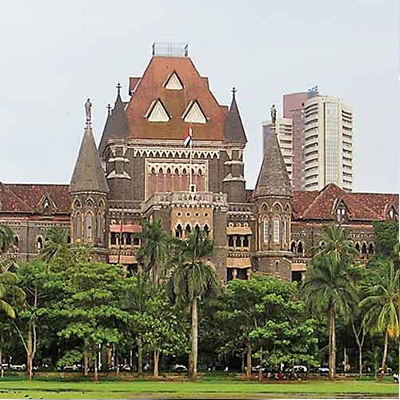
MUMBAI: It was some kind of an anticlimax considering the number of people who had assembled at the Mumbai High Court today!
A division bench of the Mumbai High Court comprising chief justice CL Thakker and Dr DY Chandrachud will hear cable-related petitions on 23 April 2003. Till then, the previous ruling of 7 March 2003 will be applicable despite the fact that the lawyers of the MSOs (multi-system operators) protested that collections have dropped considerably due to the ruling.
Several cable operators, MSO representatives, media and lawyers were eagerly waiting for the court to take up item number 17 in court no 46 of the Mumbai High Court. Lawyer Chaitanya Dhruve Mehta (of Dhruve Liladhar & Co) representing BJP MP (member of parliament) Kirit Somaiya’s group started the proceedings by saying that they needed time as three affected parties had filed their responses just yesterday.

Mehta added that the involved parties needed more clarification on the fact that the government-piloted task force on conditional access is likely to recommend to the government a revised rate of Rs 71.33 (exclusive of taxes) as the price of the basic tier, which has the support of a majority of the panel members. The new figure had been put to vote in a task force meeting yesterday in New Delhi.
While speaking to indiantelevision.com, Mehta says: “Prasar Bharati, Star India and Mumbai Cable Operators Federation (MCOF) president Nandan Basu filed their replies yesterday. We have sought time to study the responses before filing our replies. Also, we expect that the CAS task force will get a fix on the pricing of the free-to-air channels within a week. It would make sense to postpone the hearing till then.”
When questioned about the previous order (dated 7 March), Mehta said that it was victory for the consumers who managed to see the cricket World Cup without any disruptions or blackouts by the cable operators.”The FTA price of Rs 71.3 plus taxes will work out below the range of Rs 150 per month per subscriber that Kirit Somaiya has been demanding. We shall strive to ensure that the rights of the consumers are protected!”
Consumer Action Network president lawyer Ahmad M Abdi added: “Yesterday’s CAS task force recommendation is a new development and we welcome the price of Rs 71.33 per month per subscriber. We are also happy that the High Court has persisted with its earlier order prohibiting arbitrary disconnection. Ever since the hearing has begun, consumers have benefited a lot.”
Maharashtra state government additional solicitor-general SB Jaisinghani, representing Doordarshan raised the point about the cable operators indulging in under-declarations. He also added that the government had already given the cable trade a time period of six months starting January 2003 to pave the way for CAS in July 2003.
On 7 March, the court order had accepted one of the petitioner’s Seven Star cable’s undertaking that there would be no disconnection or stoppage of broadcasting of programmes except in individual cases of nonpayment of regular charges.
However, the order stated that the above statement doesn’t prevent arguments on behalf of the MSOs. At that time, Seven Star officials claimed that the above mentioned statement is binding on all the MSOs (multi-system operators) in Mumbai.
However, the counsels of the other MSOs had argued that the decision is binding only on Seven Star (which gave the undertaking) and not necessarily on the other MSOs. They also claim that the existing agreements between the cable operators and the MSOs are still valid. They also point out that Seven Star had already hiked its rates in late 2002 and the trade/consumers had protested against these rate hikes then. Today, lawyers representing MSOs stated that consumers were refusing to pay the new rates applicable from 1 January 2003 due to improper communication and false perceptions. They sought clarifications from the HC on this issue.
The High Court ruling also directed the cable associations named respondents (Mumbai Cable Operators Federation – MCOF – amongst others) to avoid disconnection’s as the counsel for the petitioners had served notices and undertook the process of filing affidavit of services.
The other cable associations in the city who are not affiliated to MCOF say that the HC ruling is not binding on them.
All eyes will be on the final decision of the I&B ministry and the subsequent High Court hearing on 23 April 2003.





News Broadcasting
Network18 channels lead YouTube news viewership in March 2026
CNN-News18, News18 India and CNBC channels top categories with record views
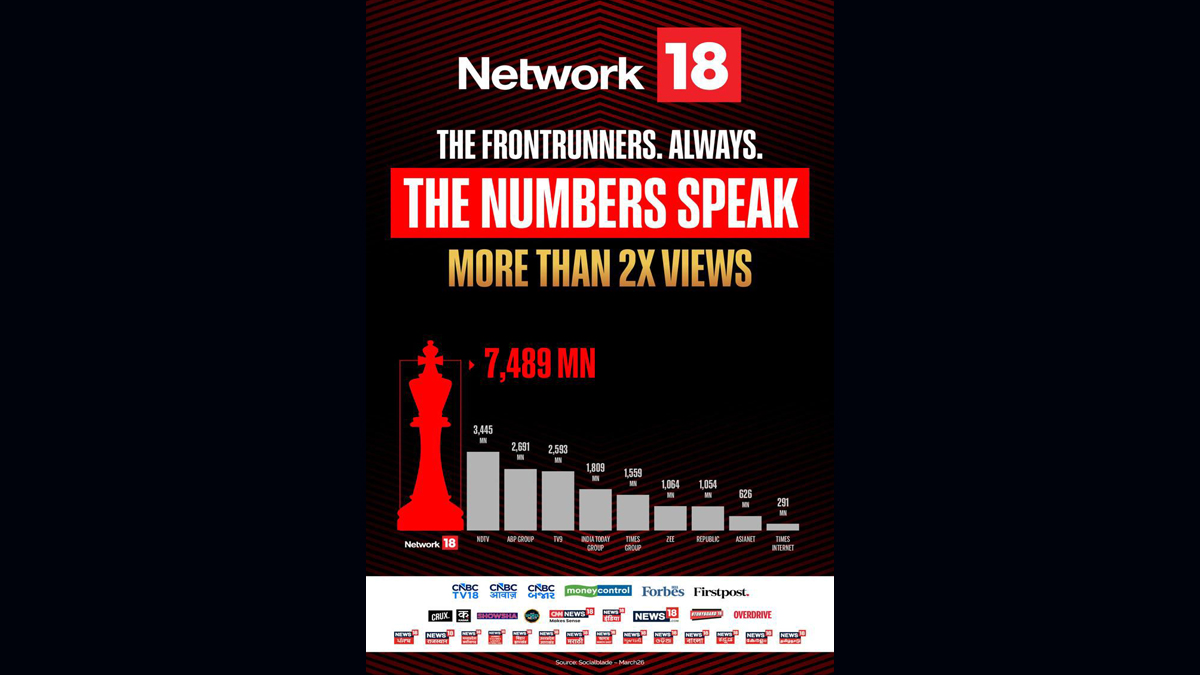
MUMBAI: When the world hit refresh on breaking news, Network18’s channels were already streaming ahead. As geopolitical tensions and war-driven headlines fuelled a surge in global news consumption, the network’s digital playbook delivered big clocking record Youtube viewership across English, Hindi and business news categories in March 2026.
At the forefront was CNN-News18, which emerged as the clear leader in the English news segment with 130 million live and video-on-demand views. The channel edged past competitors such as Times of India (126.5 million), Times Now (101.1 million), India Today (88.2 million) and NDTV (77.5 million), according to Databeings data for March.
In the Hindi news arena, News18 India delivered a commanding performance, racking up a staggering 3,297 million views on YouTube. The channel comfortably outpaced NDTV India, which recorded 3,119 million views, underlining its deep reach and consistent engagement with mass audiences, as per Playboard data.
The network’s dominance wasn’t confined to general news. In the Hindi business segment, CNBC Awaaz topped the charts with 92 million views, narrowly ahead of Zee Business (90 million) and well ahead of ET Now Swadesh (57 million). Meanwhile, its English counterpart CNBC-TV18 posted a strong 58 million views, reinforcing the network’s cross-category strength.
The spike in viewership reflects a broader shift in audience behaviour, with viewers increasingly turning to digital platforms particularly Youtube for real-time updates and in-depth coverage during high-intensity news cycles. For Network18, the numbers signal more than just scale; they underline the effectiveness of a multi-platform strategy that blends speed, credibility and continuous coverage.
In a month where the news never paused, it seems viewers chose to stay tuned where the stream never stopped.






