News Broadcasting
HBO spices up Friday nights with ‘Double Bill’ programme initiative


HBO is all set to add juice to weekend entertainment this month by introducing HBO Friday Double Bill .Two films will be shown back to back under the programme initiatives She-Heroes at 9:30 pm, followed by After Dark.
In May, the She-Heroes programme initiative will be replaced with Kung-Fu Knights.
Interestingly, arch rival Star Movies used to have a Double Bill programme initiative on Wednesdays some time back. Two films starring one actor were shown back to back every Wednesday. The initiative was discontinued as the channel felt it would be better to concentrate on a genre each night at 9:30 pm with the exception of Fridays, when the channel telecasts premieres.

She Heroes deals with female protagonists saving the day in a variety of situations. Barb Wire sees Pamela Anderson of Baywatch fame enter the action film genre. Anjelina Jolie uses the help of a paralysed Denzel Washington to track a serial killer in The Bone Collector. Tanya Roberts plays a young girl raised by a mystical African woman using her ability to talk to animals and knowledge of jungle lore against high tech weapons of mercenaries in Sheena.
The After Dark programme initiative sees action films with a noirish feel take centrestage. Films include Second Skin with Natasha Henstridge and Angus MacFadyen, The Arena with Karen McDougal & Lisa Dergan.
Body Double deals with an actor getting involved with a murder plot in the thriller. It stars Melanie Griffith, Craig Wasson and Gregg Henry.
The Double Bill schedule
She-Heroes ( Fridays 9:30 pm)
5 April The Bone Collector
12 April The Assassin
19 April Barb Wire
26 April Sheena
After Dark
5 April Body Double 12:00 am
12 April The Arena 11:45 pm
19 April Second Skin 11:30 pm
26 April Wild Things 11:45 pm






News Broadcasting
Network18 channels lead YouTube news viewership in March 2026
CNN-News18, News18 India and CNBC channels top categories with record views
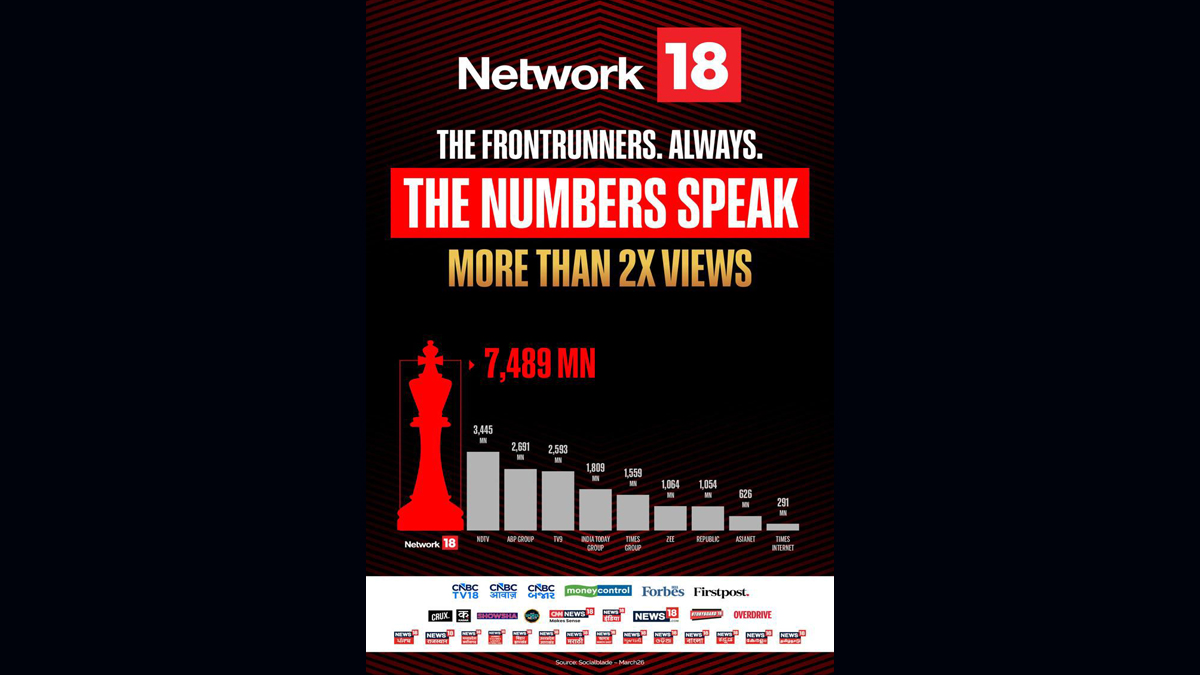
MUMBAI: When the world hit refresh on breaking news, Network18’s channels were already streaming ahead. As geopolitical tensions and war-driven headlines fuelled a surge in global news consumption, the network’s digital playbook delivered big clocking record Youtube viewership across English, Hindi and business news categories in March 2026.
At the forefront was CNN-News18, which emerged as the clear leader in the English news segment with 130 million live and video-on-demand views. The channel edged past competitors such as Times of India (126.5 million), Times Now (101.1 million), India Today (88.2 million) and NDTV (77.5 million), according to Databeings data for March.
In the Hindi news arena, News18 India delivered a commanding performance, racking up a staggering 3,297 million views on YouTube. The channel comfortably outpaced NDTV India, which recorded 3,119 million views, underlining its deep reach and consistent engagement with mass audiences, as per Playboard data.
The network’s dominance wasn’t confined to general news. In the Hindi business segment, CNBC Awaaz topped the charts with 92 million views, narrowly ahead of Zee Business (90 million) and well ahead of ET Now Swadesh (57 million). Meanwhile, its English counterpart CNBC-TV18 posted a strong 58 million views, reinforcing the network’s cross-category strength.
The spike in viewership reflects a broader shift in audience behaviour, with viewers increasingly turning to digital platforms particularly Youtube for real-time updates and in-depth coverage during high-intensity news cycles. For Network18, the numbers signal more than just scale; they underline the effectiveness of a multi-platform strategy that blends speed, credibility and continuous coverage.
In a month where the news never paused, it seems viewers chose to stay tuned where the stream never stopped.






