Cable TV
GTPL Hathway to promote 40 Mbps broadband speed to masses

MUMBAI: As wireline broadband business is emerging as a sector full of growth opportunities, several cable operators, as well as MSOs, are increasing their investment in the segment. GTPL Hathway, the Gujarat based cable and broadband player, is ready to lower its ARPU in the broadband segment to get more customers. Reliance Jio’s entry has got companies worried about losing subscribers and many of them are revising prices while others are ready to lower subscription costs.
GTPL Hathway’s capex allocation shows the increased importance of broadband business for the company. While in Q1 2019, the capex stood at Rs 21 crore (almost equal to Rs 24 crore capex for cable TV business), in Q4 FY 2018 Rs 8 crore was the broadband capex. For entire FY 2019, the company will invest Rs 50-60 crore on broadband.
The company’s plan is to make 40 Mbps a mass product for which the ARPU stands at Rs 388 to Rs 450 per month. One of the main reasons for emphasising on this particular range is to control churn rate of subscribers as attracting more customers with high speed and high volume will make a loyal user base. Churn is happening more on the side of lower speed, where the company is providing 5 Mbps or 8 Mbps speed due to the wireless competition. Even for the 40 Mbps plan, the cost has already come down.

“We are pushing this (40 Mbps) for mass, so we are looking forward that the numbers will start coming from this quarter and next quarter we will see a surge in the number,” chief strategy officer Piyush Pankaj commented on the broadband segment revenue in an earnings call. The company has targetted broadband revenue for this financial year to be at Rs 160-170 crore.
Though overall the company witnessed only 10,000 new broadband subscriber addition despite creating 230,000 home passes, its logic revolves around the basic formula of supply and demand. “In this quarter if you see our FTTH implementation on the ground for the home pass is around 65-70 per cent complete and then you see the home pass is increased,” Pankaj added. According to company guidance, it is going to add around 100,000 net subscribers this year.
The Jio rampage is likely to cause havoc in the broadband sector too. Pankaj said that the company is waiting for other players to come into the market with new pricing to make any decision on whether or not to scale down investment. For now, the capex guidance for broadband business would remain same.
“The decision like investment in broadband cannot be based on one quarter pricing of any particular player. We expect the market to expand considerably,” GTPL Hathway chairman and non-executive director Rajan Gupta said.
While GTPL has a huge fibre network available in Gujarat, it is not rolling out fibre to home or building because of low demand. There is a very limited demand for 100mbps and 40mbps in those markets.
“With large players coming in investing there and that is where is the whole demand will build up and GTPL already has a huge infra, so pricing is one play, but more than pricing it is about revenue from a particular area and the overall size of the pie. Frankly, there are multiple factors needs to be evaluated, which will be clearer over the next two to three quarters,” Gupta added.
In terms of its traditional cable business, the company expects phase three and phase four ARPU increase in this quarter and next quarter while phase one and phase two ARPU increased in the last quarter.
“For phase two we are going to take the hike (10 per cent hike) in Q4 of FY 2019. Phases three and phase four we have already taken the hike in Q2 that is from July onwards,” Pankaj said. “Current Q1 ARPU we will see the 10 per cent jump for phases three and four, but you will see the full 10 per cent increase in two quarters’ time in Q2 and Q3,” he added further.
Though the company had Rs 126 crore content cost in Q1, it is now confident that it won’t exceed Rs 500-510 crore until some big acquisition happens. However, the company has indicated it is looking forward to some of the acquisitions which could increase the content cost further as well as the revenue.







Cable TV
Hathway Cable appoints Gurjeev Singh Kapoor as CEO
Leadership change comes as cable TV faces shrinking subscriber base and modest earnings pressure
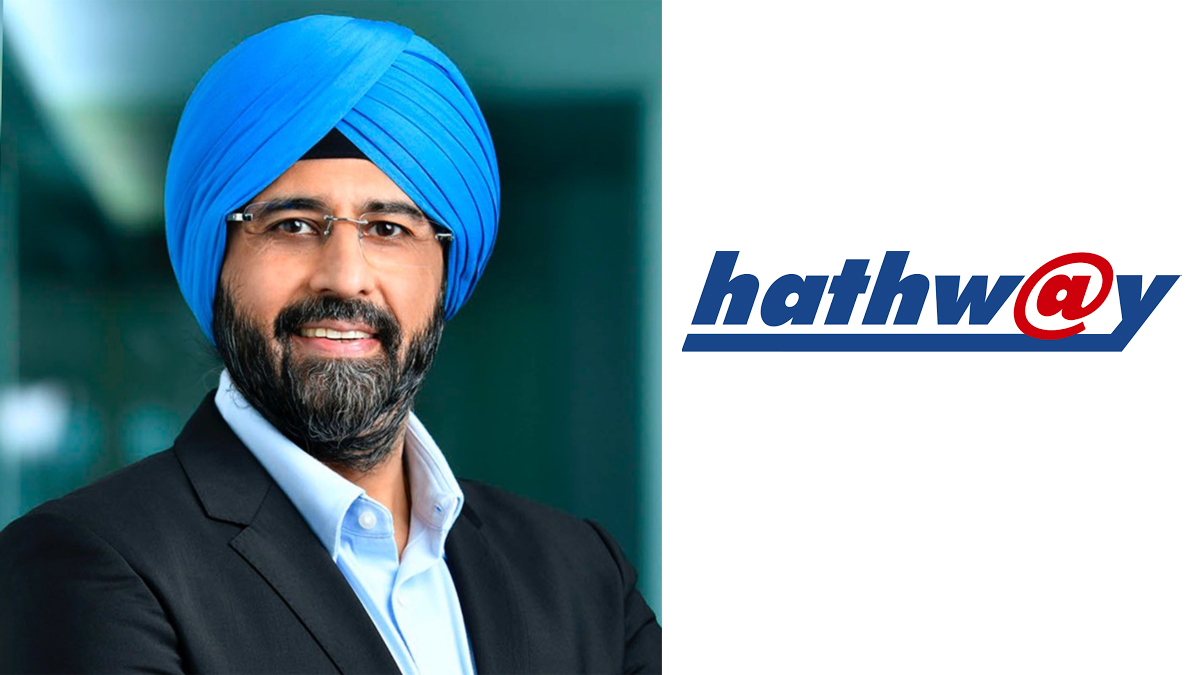
MUMBAI: Hathway Cable and Datacom has tapped industry veteran Gurjeev Singh Kapoor as chief executive officer, marking a leadership pivot at a time when India’s cable television business is under mounting strain.
Kapoor will take over from Tavinderjit Singh Panesar, who is set to retire in August after a long innings with the company. Panesar, chief executive since 2023, has held multiple leadership roles at Hathway, including his latest stint beginning in 2022.
Kapoor brings more than three decades of experience in media and entertainment. He most recently led distribution at The Walt Disney Company’s Star India business, now part of JioStar. His career spans television distribution and affiliate partnerships, with stints at Sony Pictures Networks India, Discovery Communications and Zee Entertainment.
Panesar, with over three decades in the industry, has worked across strategic planning, distribution and business development in media, broadcasting and manufacturing. His past associations include ESPN Star Sports, Star India, Apollo Tyres and JK Industries.
The transition lands as the cable sector grapples with structural disruption. Traditional operators are losing ground to streaming platforms, while telecom and broadband players tighten the squeeze with bundled offerings.
An EY report estimates India’s pay-TV base could shrink by a further 30 to 40 million households by 2030, taking the total down to 71 to 81 million. The slide follows a loss of nearly 40 million homes between 2018 and 2024, a contraction that has already wiped out more than 37,000 jobs in the local cable operator ecosystem.
Hathway’s numbers reflect the strain. The company reported a consolidated net profit of Rs 93 crore for FY25, down from Rs 99 crore a year earlier. Revenue inched up to Rs 2,040 crore from Rs 1,981 crore. As of December 2025, it had about 4.7 million cable TV subscribers and roughly 1.02 million broadband users.
Kapoor steps in with a familiar brief but a shrinking playbook. In a market where viewers are cutting cords faster than companies can reinvent them, the new chief executive inherits a business fighting to stay plugged in.






