News Broadcasting
Govt to make amendments only after consultation: PM

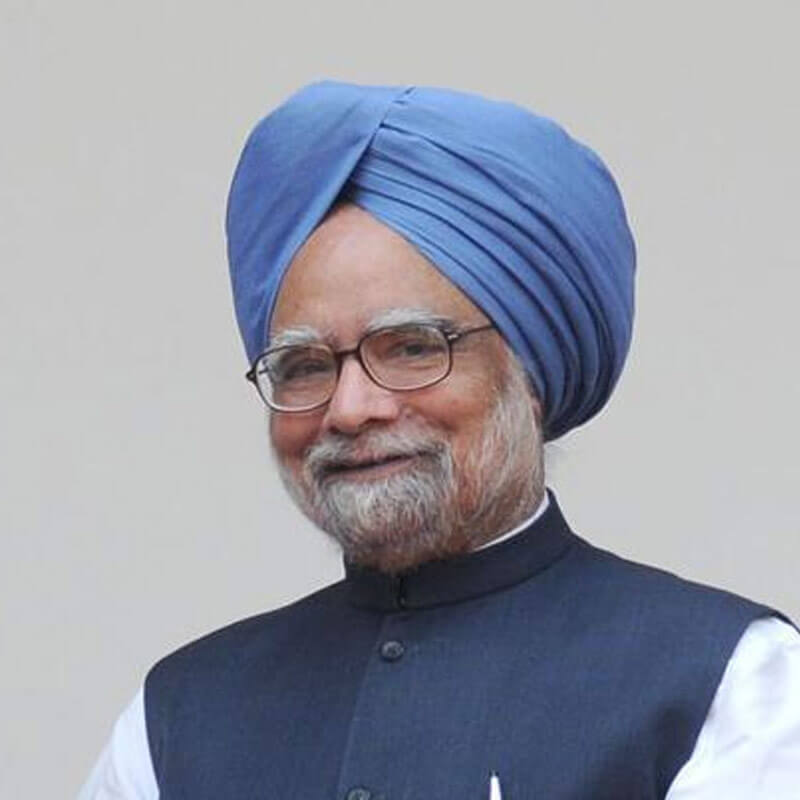
NEW DELHI: News channels can take a breather with prime minister Manmohan Singh hinting at a broader consultation with all stakeholders before coming out with any amendments that would put curbs on news coverage.
The PM on Wednesday assured editors of news broadcasters that any changes in the act will only be taken up “after the widest possible consultation with all the stakeholders and eliciting their different points of view on the proposed changes.”
In a brief statement, the PM office said that the PM has received “several representations from the media agencies regarding certain proposed changes in the Cable Television Network Rules currently under consideration.”

Thus, the PM has put the Cable Television Networks (Regulation) Act, which was seen as a gag act on media, on hold for now.
Earlier, the government had been contemplating some changes in the act and the rules under it in view of what it perceives to be the “excessive and exaggerated” coverage of the tragic terrorist attack in Mumbai on 26 November and the “continual” coverage thereon.
The Act now monitors stories on sex, crime, footage of narco-analysis admissions and others.
Editors of news channels have been trying to mobilise political support and have met BJP President Rajnath Singh, LK Advani, and AICC president Sonia Gandhi to express their concerns over the proposed amendments.
Gandhi said that she and the Congress party believed that “the freedom of the press should not be compromised.” She further assured that a “middle way” would be found to solve the problem.
Several political leaders such as Samajwadi Party leader Amar Singh, CPI (M) general secretary Prakash Karat and Sitaram Yechury have extended their support to news broadcasters. Yechury, for instance, said his party had asked the government to form an independent regulatory board for the media industry.
Karat has written a letter to PM saying, “Our Party is of the opinion that there should be no hasty step taken regarding media regulation. Apart from the self-regulatory mechanism put in place by the news channels, it is necessary to have co-regulation through an independent regulatory body. How this is to be done has to be discussed and a common approach arrived at. Till then, no steps should be taken to empower the government and the administration to further regulate the news channels.”





News Broadcasting
Network18 channels lead YouTube news viewership in March 2026
CNN-News18, News18 India and CNBC channels top categories with record views
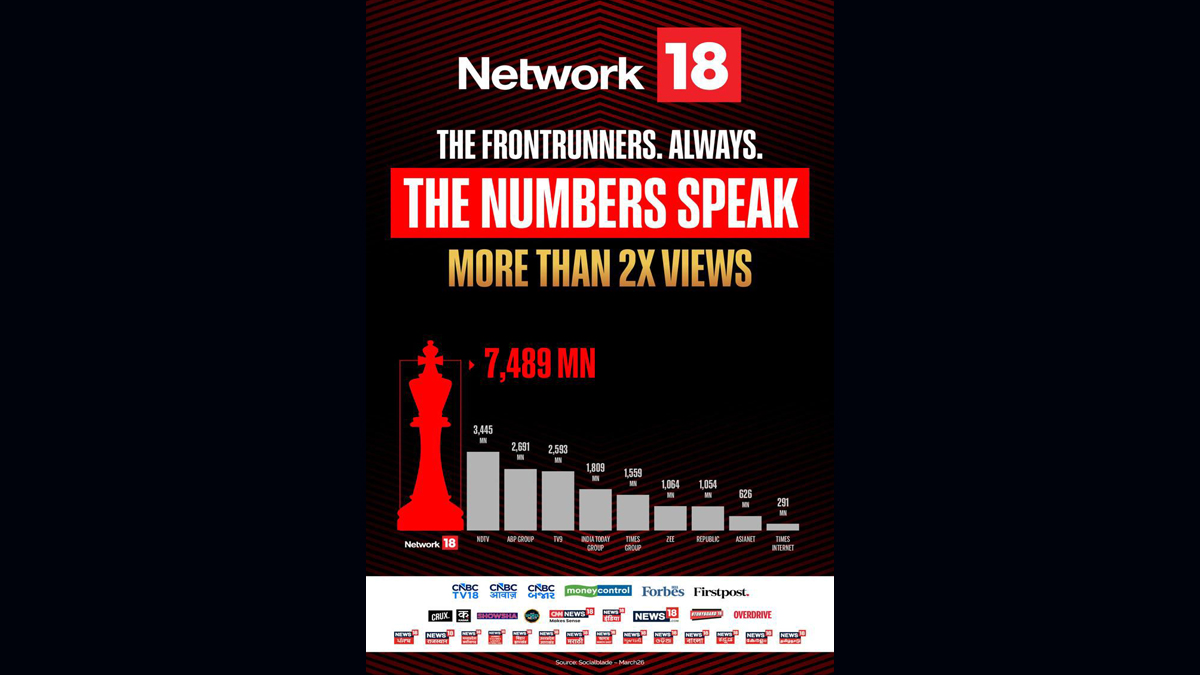
MUMBAI: When the world hit refresh on breaking news, Network18’s channels were already streaming ahead. As geopolitical tensions and war-driven headlines fuelled a surge in global news consumption, the network’s digital playbook delivered big clocking record Youtube viewership across English, Hindi and business news categories in March 2026.
At the forefront was CNN-News18, which emerged as the clear leader in the English news segment with 130 million live and video-on-demand views. The channel edged past competitors such as Times of India (126.5 million), Times Now (101.1 million), India Today (88.2 million) and NDTV (77.5 million), according to Databeings data for March.
In the Hindi news arena, News18 India delivered a commanding performance, racking up a staggering 3,297 million views on YouTube. The channel comfortably outpaced NDTV India, which recorded 3,119 million views, underlining its deep reach and consistent engagement with mass audiences, as per Playboard data.
The network’s dominance wasn’t confined to general news. In the Hindi business segment, CNBC Awaaz topped the charts with 92 million views, narrowly ahead of Zee Business (90 million) and well ahead of ET Now Swadesh (57 million). Meanwhile, its English counterpart CNBC-TV18 posted a strong 58 million views, reinforcing the network’s cross-category strength.
The spike in viewership reflects a broader shift in audience behaviour, with viewers increasingly turning to digital platforms particularly Youtube for real-time updates and in-depth coverage during high-intensity news cycles. For Network18, the numbers signal more than just scale; they underline the effectiveness of a multi-platform strategy that blends speed, credibility and continuous coverage.
In a month where the news never paused, it seems viewers chose to stay tuned where the stream never stopped.






