I&B Ministry
Govt says TV industry to be Rs 50,140 crore in 2014

NEW DELHI: With the general elections coming closer, the government is ensuring that the public becomes aware of the good work it has done in the 10 years of its regime. One of the departments flaunting its feat is the Ministry of Information and Broadcasting (MIB) that issued a statement today which claimed a paradigm shift in information dissemination and policy measures which has led to a vibrant information order in the last ten years.
The Ministry says that with the growth of television channels from 130 in 2004 to 788 in 2014, India has become the third largest TV market with close to 154 million TV households, next to China and the United States. At the same time, the size of the TV industry has witnessed an exponential growth as well. The value of the TV industry is valued at Rs 50,140 crore in 2014 from Rs 18,300 crore in 2006.

MIB says that the initiatives undertaken by it enabled the discourse of ‘India Story’ to be disseminated across different platforms. It also aimed at providing quality information to the masses, thereby ensuring that the inclusive growth perspective is spread.
The Ministry also claims to have pursued policies in order to utilise the benefits of technology and ensure that a framework is built enabling growth and change for the broadcasting landscape in the country. It says that the digitisation process has brought transparency in the system with 30 million STBs being installed in the first two phases.
Some of the highlights of the decade have been the implementation of various guidelines including policy guidelines for uplinking and downlinking of TV channels (amended in 2011), policy guidelines for HITS broadcasting services (2009), policy guidelines for IPTV (2008), Revision of FDI Policy in five segments of broadcasting sector (2012), policy guidelines for TV rating agencies in India (2014) and policy guidelines on direct to home services (2001).
In the film sector, the panel under the Chairmanship of Punjab and Haryana High Court retired Chief Justice Mukul Mudgal examined issues of certification under the Cinematograph Act 1952. The Committee reviewed major areas of concern pertaining to Advisory Panels; Guidelines for certification and issues such as portrayal of women, obscenity and communal disharmony; Classification of Films; Treatment of Piracy; Jurisdiction of the Appellate Tribunal; Review of the provisions of the Cinematograph Act, 1952.The committee has recently submitted its report which is being reviewed by the Ministry.
One of the key highlights of the film sector has been the National Museum of Indian Cinema (NMIC) showcasing India’s rich film heritage over the past 100 years. The Museum is situated in the 6,000 square-foot Gulshan Mahal – a heritage building. The museum is a ready-reckoner of the history of Indian cinema showcasing technological aspects of production and screening of films, as well as its social aspects during the past 100 years. Through its interactive galleries, it traces the evolution of celluloid from the Lumiere Brothers, Raja Harishchandra onwards, and showcases Indian cinema in three stages – silent era, golden era and the modern era.







I&B Ministry
Doordarshan, ICCR sign MoU to boost global reach of Indian culture
Pact taps TV, radio and digital platforms to take cultural content worldwide
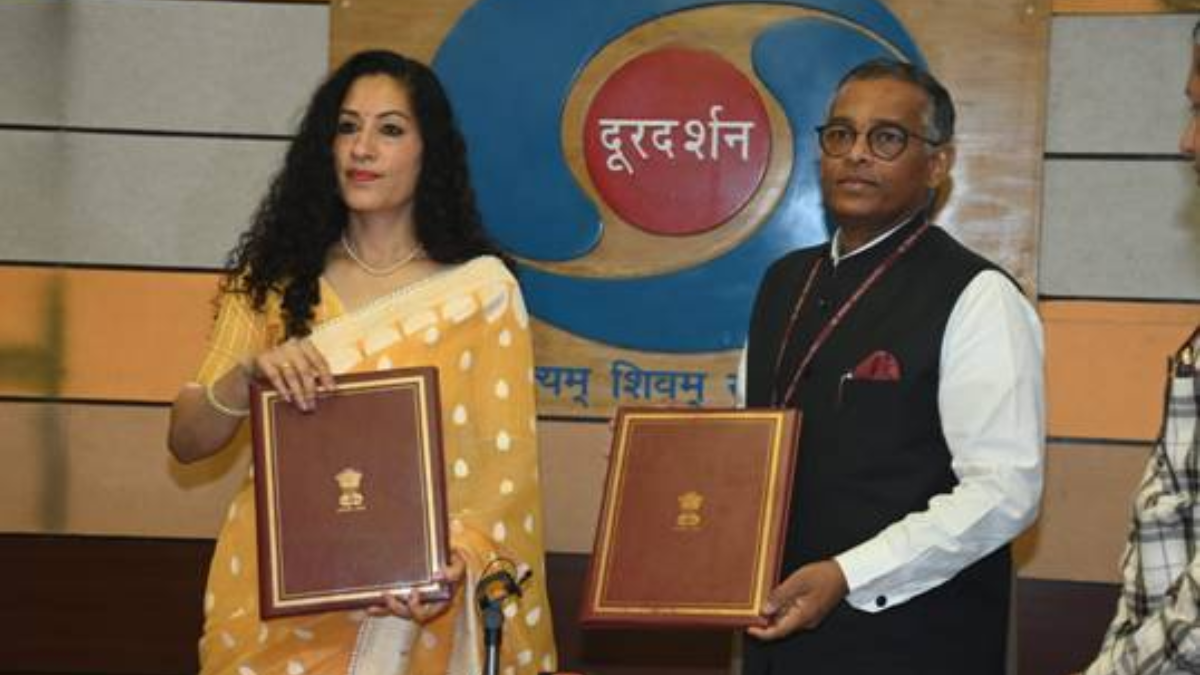
NEW DELHI: In a move aimed at taking India’s cultural story further across borders, Doordarshan under Prasar Bharati has signed a memorandum of understanding with the Indian Council for Cultural Relations to expand the global reach of Indian cultural content.
The agreement, signed on April 7 at Doordarshan Bhawan, brings together the content strength of ICCR and the wide broadcast network of Doordarshan, spanning television, radio and digital platforms.
Under the partnership, ICCR will provide a steady stream of cultural programming, including performances and events organised by Indian missions abroad such as embassies, consulates and cultural centres. Doordarshan will handle production, coverage and distribution, ensuring that these programmes find audiences not just in India but across the world.
The collaboration also opens the door for recorded cultural content from overseas missions to be aired across multiple platforms, including OTT and social media, making Indian art, music and heritage more accessible to global viewers.
A notable feature of the MoU is joint ownership of content rights in perpetuity, including digital rights. This allows both organisations to archive and reuse material over time, building a long-term cultural repository while maximising reach. Doordarshan will also support pre-event promotion and cross-platform visibility to drive engagement.
Speaking at the signing, Doordarshan director general K. Satish Nambudiripad and Indian Council for Cultural Relations director general K. Nandini Singla highlighted the potential of the partnership to strengthen India’s cultural diplomacy through modern media channels.
The agreement, initially valid for three years, also allows Doordarshan to explore monetisation opportunities from the content generated, adding a commercial layer to cultural broadcasting.
As India looks to blend tradition with technology, this partnership signals a clear intent to make its cultural voice not just heard, but seen and streamed across the globe.






