I&B Ministry
Govt. in no hurry to take call on CAS

NEW DELHI: The government is no hurry to take a final decision on broadcast and cable regulators recommendations on conditional access, distribution of channels and a new policy for FM radio broadcasts in the country.
In this regard, the information and broadcasting ministry has now sought the views from various state governments, I&B minister Jaipal Reddy informed Lok Sabha (Lower House) today.
The recommendations of the Telecom Regulatory Authority if India (Trai) are under various stages of examination, Reddy informed fellow parliamentarians,indicating that no time frame can be indicated for a final decision on Trais recommendations.

In October, Trai had submitted a voluminous report to the government suggesting various models for implementing conditional access or addressability in Indian cable homes. It had suggested three models for rolling our CAS. Reason for these options: one system of addressability cannot be feasible for the whole country, though in the long run the system is the best way to bring about transparency in the industry.
Controversially, it had suggested that any new pay channel launched after 26 December , 2003 must come through a set-top box on a mandatory basis and would not form part of an exiting bouquet.Ditto for free to air channels turning pay.
Setting the ball rolling for the second phase of privatisation of FM radio, Trai had recommended there should be migration to revenue share of four per cent annually (since then unofficially rejected by the government) and that up to 26 per cent foreign investment could be allowed, subject to government review of the existing policy that bars any foreign investment in this sector.
In Parliament today, Reddy also did not indicate whether a time frame had been given to the state government to revert with their views on various issues.




I&B Ministry
CBFC speeds up film certification; average approval time cut to 22 days
Over 71,900 films cleared in five years as digital system shortens approval timelines
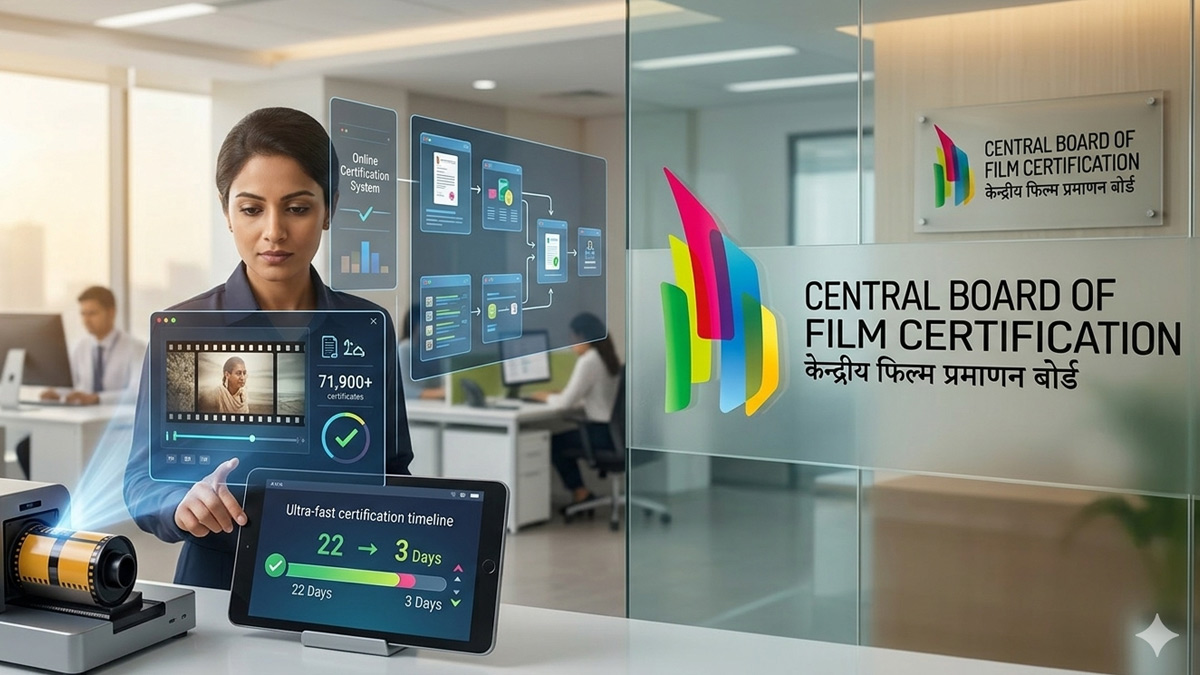
MUMBAI: The Central Board of Film Certification (CBFC) has significantly reduced the time taken to certify films, with the average approval timeline now down to 22 working days for feature films and just three days for short films.
Operating under the Ministry of Information and Broadcasting, the statutory body certifies films for public exhibition in line with the Cinematograph Act, 1952 and the Cinematograph (Certification) Rules, 2024. The rules prescribe a maximum certification period of 48 working days, though the adoption of the Online Certification System has sharply accelerated the process.
Over the past five years, from 2020-21 to 2024-25, the board certified a total of 71,963 films across formats. Of these, the majority fell under the U category with 41,817 titles, followed by UA with 28,268 films and A with 1,878 films. No films were certified under the S category during the period.
Film approvals have also steadily risen in recent years. The CBFC cleared 8,299 films in 2020-21, a figure that peaked at 18,070 in 2022-23 before settling at 15,444 films in 2024-25. During the same period, 11,064 films were certified with cuts or modifications.
Despite the high volume of certifications, outright refusals remain rare. Only three films were denied certification over the last five years, with one refusal recorded in 2022-23 and two in 2024-25.
The board may recommend cuts or modifications if a film violates statutory parameters relating to the sovereignty and integrity of India, security of the state, friendly relations with foreign states, public order, decency or morality, defamation, contempt of court or incitement to an offence.
Filmmakers can challenge CBFC decisions in court. Data shows that such disputes remain limited but have seen some fluctuation. Between 2021 and 2025, a total of 21 certification decisions were challenged before High Courts, with the number rising to 10 cases in 2025.
Responding to a question in the Rajya Sabha, minister of state for information and broadcasting L. Murugan shared the data. The question was raised by Mallikarjun Kharge.
With faster timelines and a largely digital workflow, the certification process appears to be moving at a far brisker pace, signalling a shift towards quicker clearances for India’s growing film output.