I&B Ministry
Govt favours net neutrality; data is the new oil: RS Prasad


NEW DELHI: The much-debated net neutrality issue got some additional boost from the Indian minister of electronics & information technology and law & justice Ravi Shankar Prasad when he said that the government favours non-discriminatory access to the Internet.
“We are strong advocates of non-discriminatory access to Internet and democratization of Internet governance,” Prasad said yesterday while dwelling on the issue of net neutrality and digital dividends to average citizens.
However, he didn’t elaborate on the net neutrality (and OTT) issue, which is being studied by the Telecom Regulatory Authority of India (TRAI) in totality for possible guidelines and regulations. TRAI has already undertaken a lengthy consultation process with various stakeholders and its final recommendations are awaited.

Pointing out that India is home to 270 million smart-phones, a number that’s likely to swell to 500 million in few years time, Prasad said that India doesn’t want to miss out on the digital revolution having missed the industrial revolution.
Making a case for more efficient bandwidth availability at affordable rates to an average Indian, Prasad said, “Data is the new oil… (and) digital India is ideology neutral, politics neutral and only pro-India.”
Prasad, who was delivering the inaugural address at the Observer Research Foundation (ORF)-organised “CyFy 2016: Digital Asia & Scripting the New Governance Order” here yesterday evening, asserted if a digital profile of India is drawn it would look something like this: 1.03 billion mobile phones, 1.05 million digital identity (Aadhaar cards) and 400 million internet users, apart from a digital army of young people who have fanned out in rural areas running Common Services Centres at more than 200,000 places.
Enumerating the various digital initiatives undertaken under the Digital India plan, something that is very dear to Prime Minister Modi, the senior minister opined that the government had undertaken some “path-breaking” programmes.
“Digital India is for the under-privileged… (and) digital inclusion will come about with digital connect,” the Minister said, adding the government was creating a digital infrastructure for Indians so that citizens could reap digital dividends aplenty.
Pointing out that a digital India would provide more effective governance and remove socialistic-era licence regime, Prasad said in a few years time India would become a $ 1 trillion digital economy.
But the cyber space also brings along many dangers. Emphasising on the importance of precaution, Prasad said, “Governments of all countries have to come together to safeguard their citizens from the threats of cyber crimes.”
ORF, which annually organises a conference on cyber-related issues, including security and entertainment, is an independent self-sustaining think-tank. Having started in the early 1990s, it has been backed by the now Mukesh Ambani-controlled Reliance Industries.
The full address of the minister could be viewed here:
https://www.facebook.com/RaviShankarPrasadOfficial/videos/10154464395568329/




I&B Ministry
Doordarshan, ICCR sign MoU to boost global reach of Indian culture
Pact taps TV, radio and digital platforms to take cultural content worldwide
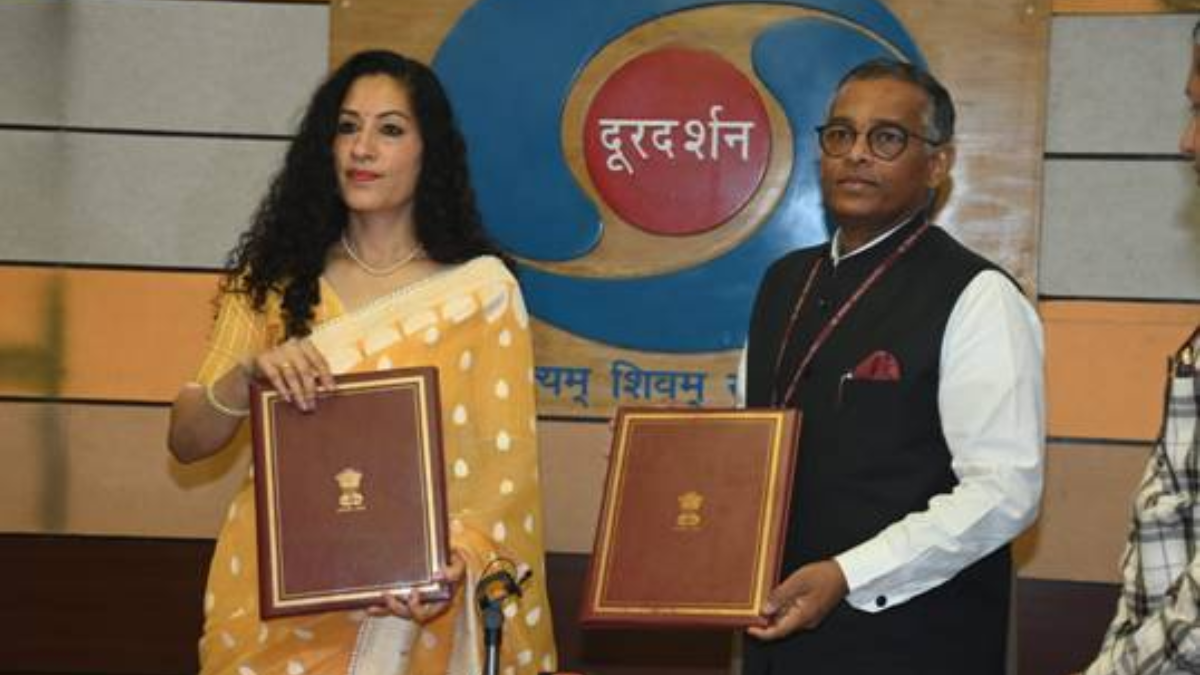
NEW DELHI: In a move aimed at taking India’s cultural story further across borders, Doordarshan under Prasar Bharati has signed a memorandum of understanding with the Indian Council for Cultural Relations to expand the global reach of Indian cultural content.
The agreement, signed on April 7 at Doordarshan Bhawan, brings together the content strength of ICCR and the wide broadcast network of Doordarshan, spanning television, radio and digital platforms.
Under the partnership, ICCR will provide a steady stream of cultural programming, including performances and events organised by Indian missions abroad such as embassies, consulates and cultural centres. Doordarshan will handle production, coverage and distribution, ensuring that these programmes find audiences not just in India but across the world.
The collaboration also opens the door for recorded cultural content from overseas missions to be aired across multiple platforms, including OTT and social media, making Indian art, music and heritage more accessible to global viewers.
A notable feature of the MoU is joint ownership of content rights in perpetuity, including digital rights. This allows both organisations to archive and reuse material over time, building a long-term cultural repository while maximising reach. Doordarshan will also support pre-event promotion and cross-platform visibility to drive engagement.
Speaking at the signing, Doordarshan director general K. Satish Nambudiripad and Indian Council for Cultural Relations director general K. Nandini Singla highlighted the potential of the partnership to strengthen India’s cultural diplomacy through modern media channels.
The agreement, initially valid for three years, also allows Doordarshan to explore monetisation opportunities from the content generated, adding a commercial layer to cultural broadcasting.
As India looks to blend tradition with technology, this partnership signals a clear intent to make its cultural voice not just heard, but seen and streamed across the globe.







