News Broadcasting
GoM meeting fails to address increasing FDI cap in DTH


NEW DELHI: At a time when the Economic Survey has said that India continues to lag behind other Asian developing countries like China, Hong Kong, Singapore and Thailand in terms of FDI and share in global trade, a group of Indian ministers (GoM) that met here failed to take up the issue of increasing the FDI cap in a direct to home (DTH) television venture, as had been suggested by a government panel earlier.
The GoM, however, according to government sources, has recommended that FDI ceiling in telecom and civil aviation sectors be increased, respectively, to 74 and 49 per cent. At present, in the telecom sector FDI is capped at 49 per cent. The GoM, according to sources, also took up certain aspects of FDI in the print medium. However, the details of this was not available.
The cabinet for a final view would now take up these recommendations of the GoM, amongst others. The GoM comprises, includes the ministers of finance, home affairs and defence and commerce & industry. The broadcasting industry was expecting some reprieve in the form of increase in the FDI cap in a DTH venture that has been capped at 20 per cent. Former information and broadcasting minister Sushma Swaraj was staunchly against any review of the existing DTH guidelines.

DTH is one sector that has the capability of attracting fairly sized foreign investment if the FDI is cap slightly liberalised as a typical DTH venture needs investment between $ 400-500 million. However, a certain section of the industry and the government was against any move to liberalise the DTH segment as it would have gone against the common minimum programme of the present coalition government that had stated it would keep the foreign holding in electronic medium capped at 20 per cent, including DTH.
A report card on the economic health of the country, was tabled in Parliament yesterday. The Economic Survey said that FDI inflows of ten select Asian developing countries in 2001 showed that India’s FDI inflows accounted for a mere 0.5 per cent share of world total against an impressive 6.4 per cent for China, 3.1 per cent for Hong Kong and 1.2 per cent for Singapore. Based on data compiled by the World Investment Report, 2002 and the International Financial Statistics, 2003, though India’s share in world exports has improved from 0.67 per cent to 0.7 per cent in 2001, it ranked ninth among the ten countries followed only by Sri Lanka.
In absolute terms, India garnered FDI worth a mere $3.4 billion in 2001 compared to a whopping $46.8 billion by China, $22.8 billion by Hong Kong, $8.6 billion by Singapore and $3.8 billion by Thailand. The survey, however, sought to underplay the difference between India and China stating that “it appears that the gap between these two estimates may be exaggerated owing to technical issues in measurement”.





News Broadcasting
News18 India launches Command Centre war explainer with Arya
New show shifts from debates to decoding global conflicts and impacts
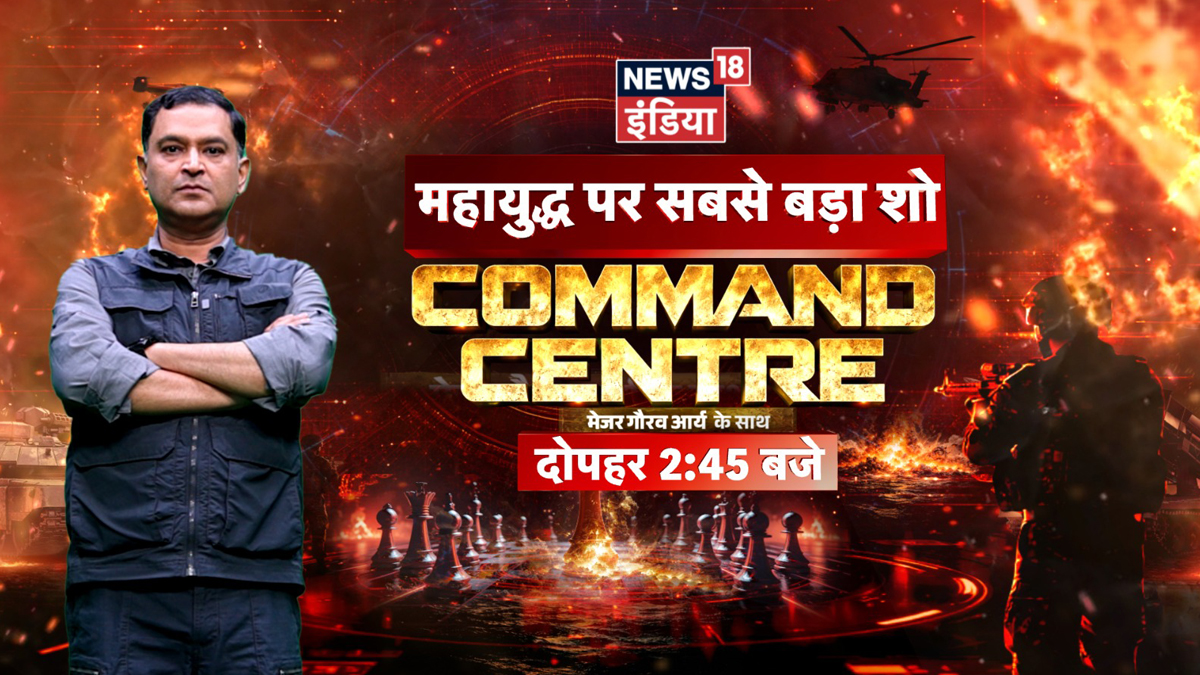
MUMBAI: News18 India has rolled out a new war-focused programme, Command Centre, featuring Gaurav Arya, as it looks to offer viewers a sharper, more grounded take on global conflicts amid rising tensions in West Asia.
Positioned as an “insider war room”, the show moves away from conventional panel debates and instead focuses on explaining military developments, decoding strategy and connecting global events to their everyday impact, from fuel prices to economic shifts.
The format leans heavily on visuals and data. The studio has been designed like a command hub, complete with large LED war maps, real-time graphics and an alert system to track developments as they unfold.
At the centre of it all is Arya, who brings his military background to simplify complex war strategies for viewers. His signature line, “Seedhi baat samjhiye”, anchors the show’s promise of clarity over noise.
News18 India managing editor Jyoti Kamal said, “Command Centre, featuring Major Gaurav Arya is designed to deliver accurate insights and a clear perspective on how evolving conflicts impact everyday life, from household budgets to national security. With expert voices analysing every development in real time, the show goes beyond headlines to decode what’s happening now, what it means, and what could come next.”
Echoing the intent, Gaurav Arya added, “In times of war, confusion is the biggest threat. With News18 India’s Command Centre, we are bringing viewers inside the war room, decoding strategies, tracking every escalation, and explaining, in the simplest terms, what it means for India and for every household. Seedhi baat samjhiye, this is where you understand not just what is happening, but what happens next.”
The weekday show will air in the afternoon slot and will also feature Gaurav Shukla, adding to its editorial depth.
With its mix of analysis, visuals and a clear focus on impact, the show reflects a broader shift in news consumption. Viewers are no longer just watching events unfold, they are looking to understand what those events mean for them.







