News Broadcasting
For Yash Raj, only Fanaa’s TV strategy on track


MUMBAI: It’s a big movie from the biggest banner in the country – Yash Raj. And while the latest Aamir Khan blockbuster Fanaa is roiled in one controversy after another, on the small screen, it is all going smoothly. Or so the studio’s representatives aver.
Yash Raj Films VP Music and Home Entertainment Vijay Kumar rubbishes reports which appeared in certain sections of the media that the studio has demanded money from television channels to telecast Fanaa promos and songs. “For Fanaa, we have associated with all the channels, including Star World, HBO and ETC Music. The rumours that Yash Raj has locked horns with the music channels over telecast rights of these music videos are absolutely baseless. We have never demanded money for telecasting Fanaa promos and songs, and in fact, it is Yash Raj who has to pay these channels money for airing these clips.”
When contacted by indiantelevision.com, Zee Telefilms however remained noncommittal. “No comments on the official position,” reads an SMS sent by spokesperson Ashish Kaul. Channel [V] head honcho Amar K Deb said that the channel had some spots of Fanaa. A source close to B4U also confirmed that the channel was running Fanaa promos and song clips.

Kumar explains that the production house has in fact employed a certain promotional strategy which involves all the channels. “Yash Raj follows a certain promotional strategy when it comes to television. We shift our promos and music videos from one channel to another from time to time and this shift is strategically designed to get the maximum coverage. We are telecasting our 60 second song and promo clips on all the channels.”
On Yash Raj’s exclusive tie up with MTV and Sony, Kumar adds, “It is true that we have exclusive tie-ups with Sony and MTV for programming and marketing activities. But that has nothing to do with providing the Fanaa content to other channels. Our association with these channels are on and there is no disagreement between Yash Raj and the channels over payment issue.”
Agrees MTV VP creative content Ashish Patil, “What MTV has with Yash Raj Films on Fanaa is an exclusive marketing tie-up. MTV holds the tradition of being a key player in the TV promotions of all the Yash Raj Films and this continues with Fanaa also. The Fanaa music was released on MTV and we had the exclusive rights to telecast these songs for about five to seven days post the music release. Sony is our programming partner and the channel has lined up various wrap around programmes on the movie.”
Patil adds that, MTV had lined up a series of promotional activities for Fanaa on the channel. “Tomorrow we will be telecasting an Aamir-Kajol show Fanaa for You, which will have the lead stars of Fanaa interviewing each other. Other innovations we have lined up include creating special MTV logos based on the Fanaa format,” he says.
The Fanaa for You show is in fact shared between Sony Entertainment Television and MTV. “In a unique exercise of media roadblock, Aamir and Kajol’s candid conversation Fanaa for You will be shown on 25 May at 8 pm. The stars will have freewheeling chat about themselves and their experience of working together for the much talked about movie Fanaa,” states a Sony release.
Interestingly, even NDTV has organised a special show with the two stars that airs on the sister channels NDTV India and NDTV 24×7 Thursday night at 8 pm and 8:30 pm respectively. It is worth noting that when Yash Raj released their blockbuster Bunty aur Babli last year, the film’s two leads Abhishek Bachchan and Rani Mukherjee had appeared on the channel as news readers in the pre-release “stunt”.
Additionally, the Times Group’s FM network Radio Mirchi is also a part of Thursday’s 8 pm “simulcast” of the Fanaa preview. And the Net has not been left out either. The film’s preview will be web streamed on both Yahoo! and MSN.
FANAA FACES TOTAL GUJARAT BLACKOUT, MULTIPLEX NO SHOW IN REST OF COUNTRY
The big screen story however is entirely different. “Cinema Paradiso” it most certainly is not for the most powerful production house in the country as it squares up in an eyeball-to-eyeball confrontation with the top multiplex chains all over India.
That the stakes are enormously high is a given. And who blinks first will determine whether the status quo is maintained in the producer distributor dynamic or the rules are rewritten in favour of big film banners like Yash Raj.
Fanaa, which also marks the comeback of the much loved Kajol to the silver screen after a long break, is not only guaranteed (at least for the present) a politically engineered total blackout in the western Indian state of Gujarat, but also confronts a multiplex fadeout in the rest of the country.
The crux of the issue is on how the box office collections are to be shared. According to the head of one multiplex chain, as per current norms big banners get 48 per cent of the net collections by way of distributor’s share in the first week, 38 per cent in the second week and 30 per cent from the third week on. Yash Raj is however demanding 60 per cent, 50 per cent, 40 per cent for the first three weeks and 35 per cent from then on.
Though the matter was still at a stalemate at the time of filing this report, the head of the multiplex did point out that Yash Raj had come down a bit from its earlier stand and was ready to end the whole controversy if the exhibitors were willing to accept a 55:45 per cent revenue share in the first week.
Fanaa director Kunal Kohli remains confident that people will get to see the movie in multiplexes as well. “We are hopeful of reaching a solution. Discussions are still going on. There is scope for a positive outcome,” he says.
Kohli has been quoted earlier in media reports as saying: “We believe that we bring a certain value to film and that we should accordingly get that benefit. We have also conveyed to them that we are asking for better terms only if the film performs well at the box office. If it doesn’t, we are willing to go with the old terms.”
If the matter is not settled though, the movie will open mainly at all single-screen theatres across the country on 26 May.
LAUNCH OF MERCHANDISE AROUND MOVIE
According to media reports, Yash Raj is launching its merchandising division with Fanaa. Three products related to the movie can be purchased. The first is a reflection cup-saucer set. The cup has a mirror finish which shows the reflection of Fanaa, when placed on the saucer. The second is a ceramic mug that has the autographed pictures of Aamir Khan and Kajol and the third is the chili pendant that Aamir Khan sports in the film.







News Broadcasting
Kamlesh Singh receives Haldi Ghati Award from MMCF
India Today Group editor honoured for three decades of journalism at Udaipur ceremony.
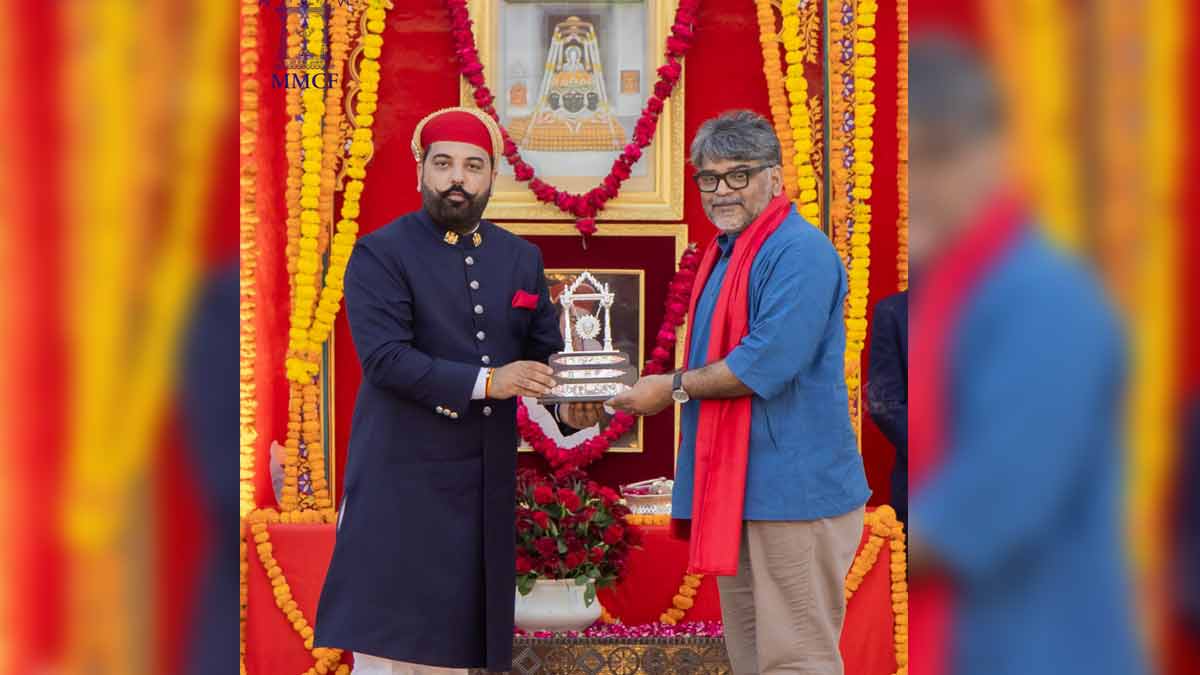
MUMBAI- Kamlesh Singh just turned a lifetime of sharp words into a shiny shield because when journalism wakes up a society, even the Maharana of Mewar wants to pin a medal on it.
The Maharana of Mewar Charitable Foundation (MMCF) conferred its prestigious Haldi Ghati Award on Kamlesh Singh, a senior editor at the India Today Group, during a ceremony in Udaipur on 15 March 2026. The national award, instituted in 1981-82, recognises “work of permanent value that initiates an awakening in society through the medium of journalism.”
Singh, who leads several editorial initiatives including Aaj Tak Radio, the Teen Taal community and The Lallantop, was presented the honour by Lakshyaraj Singh Mewar, Managing Trustee of MMCF. The citation highlighted his three decades of contributions to Indian media, innovations in digital journalism, mentoring young reporters, and his popular podcast persona “Tau” on Teen Taal, which fosters thoughtful public discourse.
The Haldi Ghati Award, named after the historic Battle of Haldighati symbolising valour and resilience, is one of four national awards given annually by MMCF. Past recipients include Tavleen Singh, Piyush Pandey and Raj Chengappa.
Other honourees this year included Padma Vibhushan Pt Hari Prasad Chaurasia, Vedamurti Devvrat Rekhe, Treeman of India Marimuthu Yoganathan, Vir Chakra Capt Rizwan Malik, and US-based researcher Molly Emma Aitken, who received the Colonel James Tod Award for contributions to understanding Mewar’s spirit and values.
In an era where headlines often shout louder than substance, the MMCF quietly reminded everyone that real journalism isn’t about noise, it’s about the quiet, persistent work that stirs society awake, one thoughtful story at a time.







