e-commerce
Flipkart rewrites retail media with speed data and a dash of drama

MUMBAI: What do love, Lays and logistics have in common? Flipkart, apparently. At its Goa Fest 2025 masterclass, the e-commerce giant rolled out a full-funnel manifesto for how brands can advertise smarter, sell faster and even deliver anti-love chocolates in 10 minutes flat. Packed with metrics, media strategy, and a sprinkling of Valentine’s wit, the session was a whirlwind tour of how retail media is no longer just about deals but about data, delight and deep hyperlocal targeting.
At the Flipkart masterclass held at Goa Fest 2025, the brand flipped the script on what e-commerce advertising can do showcasing how its ecosystem is now a robust, intelligent ad-tech playground for everyone from FMCG giants to rural D2C sellers.
Launched as Flipkart’s quick commerce vertical, Flipkart Minutes is not just delivering tomatoes in 10 minutes, it’s shipping electronics. Over 25–28 per cent of all orders now include phones and gadgets, especially in Tier 2 India, where users increasingly need a “Pogo phone” faster than their Wi-Fi can buffer.

But the brilliance isn’t just logistical, it’s hyperlocal advertising. Brands can now target delivery guys’ helmets in Koramangala or run a Valentine’s Day campaign only for Bangalore. Flipkart cited Cadbury’s 42 per cent YoY sales growth from a split “pro-love” and “anti-love” campaign using Minutes, a strategy that played both sides of the heart-shaped field.
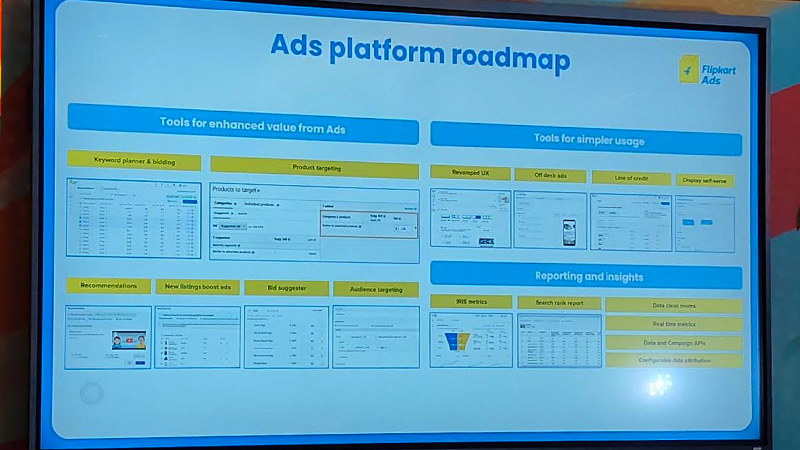
Flipkart’s Iris analytics platform empowers advertisers with full-funnel insights. Beyond ROAS (Return on Advertising Spend), brands now get New-to-Brand (NTB) metrics measuring how many fresh eyeballs saw and clicked their products.
With over 2,000 types of audience signals in play and 80 per cent of advertisers using them, Flipkart is serious about understanding behaviour, not just demographics. Think: not just who’s browsing, but what they previously bought, which pin codes they search from, and what their most-used credit card says about them.
Perhaps the most disruptive insight? Flipkart is offering a line of ad credit to small and rural advertisers based on past performance. Instead of upfront payments, sellers can now use ad credit and pay back as a percentage of actual sales freeing up crucial cash flows.
Flipkart’s Brand Self-Serve portal has gone from being a display hub to an intelligent coach. Its Keyword Planner allows precise targeting (e.g. phones under Rs 30,000), while PCS Spotlight brings masthead-style prominence right inside search results.
Thanks to 6–7 layers of search recommendations, even first-time advertisers can run effective campaigns. Add to that Product Performance Ads and a creative Brand Solutions team, and what you have is not just ads, but entire storytelling experiences optimised for ROAS and reach.
Flipkart’s anecdotal evidence packs punch. Coke targeted party hours before New Year’s by finding users buying Lays and Chakna—not soda. Cadbury ran two opposing Valentine’s Day campaigns, pro-love for Silk, anti-love for Gems and saw their sales shoot up 42% over last year’s campaign.
With Big Billion Day on the horizon, Flipkart is focusing on customer loyalty targeting, allowing brands to reach habitual discount-hunters during specific periods.
Their ambitious roadmap includes pushing retail media as a top-funnel tool too. It’s no longer just a performance play. Retail media is now about brand discovery, contextual engagement, and creative risk-taking without betting the whole national ad budget.
From smart shopping insights to delivering slow-mo smartphones faster than you can say “Galaxy S24 FE,” Flipkart’s masterclass proved one thing: retail media isn’t just booming, it’s blooming.







e-commerce
Flipkart rolls out 105 per cent bonus for 20,000 employees
Strong FY25 performance drives payouts even as layoffs and shifts unfold.

MUMBAI: In a year where belts were tightened and rewards loosened, Flipkart seems to be playing both offence and defence trimming roles on one hand while handing out a generous 105 per cent bonus on the other. The Walmart owned e commerce major has rolled out a 105 per cent bonus payout for 2025, covering nearly 20,000 employees, signalling a year of steady operational momentum even as the company navigates restructuring pressures. The payout, communicated internally by chief human resources officer Seema Nair, is tied to performance across key metrics including growth, operational efficiency, financial outcomes and people indicators, a combination that suggests the company is inching closer to its long stated goal of sustainable profitability.
Employees at SD level and below are set to receive their bonuses in March, while payouts for senior leadership, including vice presidents and senior vice presidents, will follow after the close of the performance cycle. The elevated 105 per cent multiplier stands out in a sector where cautious payouts have increasingly become the norm, pointing to what appears to be a relatively strong internal scorecard for FY25.
Yet, the announcement arrives with a noticeable contrast. Earlier this year, Flipkart reduced its workforce by around 300 roles as part of its annual performance review process. While officially framed as performance driven, the juxtaposition of layoffs alongside above target bonuses reflects a more nuanced balancing act, one that prioritises cost discipline while continuing to reward and retain high performing talent.
This dual approach is becoming increasingly common across the technology and e commerce landscape, where companies are navigating an uneven hiring environment while under pressure to deliver profitability. Rewarding top contributors, even amid selective workforce reductions, allows firms to maintain morale and retain critical talent without losing sight of financial prudence.
At the same time, Flipkart is also undergoing leadership shifts that hint at a broader strategic recalibration. Nishant Verman has been appointed senior vice president for corporate development and partnerships, while group chief financial officer Sriram Venkataraman is set to step down. Ravi Iyer will take on expanded responsibilities within the finance function, marking a reshuffle at the top as the company gears up for its next phase.
These changes come amid reports that Flipkart is planning to shift its holding structure back to India, a move widely interpreted as groundwork for a potential public listing. While timelines remain fluid, the combination of stronger financial discipline, leadership restructuring and employee incentivisation suggests a company preparing itself for greater scrutiny and scale.
For employees, the 105 per cent payout offers a welcome boost in what has otherwise been a period of adjustment. For Flipkart, it is a signal that even as it cuts where necessary, it is willing to spend where it counts. In the high stakes game of growth versus profitability, the company appears to be hedging its bets carefully, rewarding performance while reshaping itself for what could be its most defining chapter yet.






