News Broadcasting
Financial Express managing editor Sunil Jain succumbs to Covid


New Delhi: The ferocious second wave of Covid-19 continues to take a heavy toll on the news industry. Sunil Jain, managing editor of Financial Express passed away on Saturday after battling with post-Covid complications. He was 58.
“My brother, Sunil Jain, passed away this evening after post-Covid complications. He suffered a cardiac arrest earlier in the day but was revived, and finally passed after another cardiac arrest around 8.30 p.m. The doctors and all medical staff at AIIMS did their best and more. I thank you for standing by us in this dark hour,” his sister Sandhya Jain said in a statement.
We lost my brother Sunil Jain this evening to Covid+its complications. Doctors+staff at AIIMS battled heroically, but the demon was too powerful. May Tirthankaras guide his onward journey; deep gratitude to all who stood by us in these darkest days @drharshvardhan @rajivtuli69
— Sandhya Jain (@vijayvaani) May 15, 2021
A senior journalist with over three decades of experience, Jain started his journalistic career as a reporter in India Today magazine in 1991 and went on to become the magazine’s business editor. He then moved on to head the business and economy coverage for The Indian Express. Six years later, he joined Business Standard. He returned to the Express Group in 2010 as assistant editor of The Financial Express.
His sudden demise has left the news media world in a state of shock, with several friends, colleagues, and prominent personages expressing their grief over demise on social media. “Your Express family will miss you,” said The Indian Express’ executive editor Anant Goenka.

Sunil Jain, Managing Editor of Financial Express lost his battle to Covid today. He was a friend, of unquestionable integrity & inspired us with his professional commitment. Privileged to have known him, will cherish his passion, balance & wisdom.Your Express family will miss you
— Anant Goenka (@anantgoenka) May 15, 2021
President Ramnath Kovind took to Twitter to condole the senior journalist’s demise. “Sunil Jain was an editor known for his candour and forthright views. It was a treat to read his columns. After his untimely demise, his absence will be deeply felt in the world of journalism. My condolences to his family and friends,” he said in a tweet.
Sunil Jain was an editor known for his candour and forthright views. It was a treat to read his columns. After his untimely demise, his absence will be deeply felt in the world of journalism. My condolences to his family and friends.
— President of India (@rashtrapatibhvn) May 15, 2021
“You left us too soon, Sunil Jain. I will miss reading your columns and hearing your frank as well as insightful views on diverse matters. You leave behind an inspiring range of work. Journalism is poorer today, with your sad demise. Condolences to family and friends. Om Shanti” said Prime minister Narendra Modi in a tweet.
You left us too soon, Sunil Jain. I will miss reading your columns and hearing your frank as well as insightful views on diverse matters. You leave behind an inspiring range of work. Journalism is poorer today, with your sad demise. Condolences to family and friends. Om Shanti.
— Narendra Modi (@narendramodi) May 15, 2021
Several Union ministers including the minister of Information and Broadcasting, Prakash Javadekar, Finance minister Nirmala Sitharaman, and Railways minister Piyush Goyal also paid tributes.
Anguished to hear about the passing away of Sunil Jain ji. He will forever be remembered for his journalistic brilliance. His untimely demise has left a huge void in the media fraternity.
My deep condolences to his family. Om Shanti— Prakash Javadekar (@PrakashJavdekar) May 15, 2021
Hundreds of journalists have lost their lives in the catastrophe that has ravaged the country. India now accounts for half of all global new infections. On Saturday, India recorded 3.26 lakh Covid-19 cases and lost 3,890 lives that pushed the death toll to 2.6 lakhs.






News Broadcasting
News18 India launches Command Centre war explainer with Arya
New show shifts from debates to decoding global conflicts and impacts
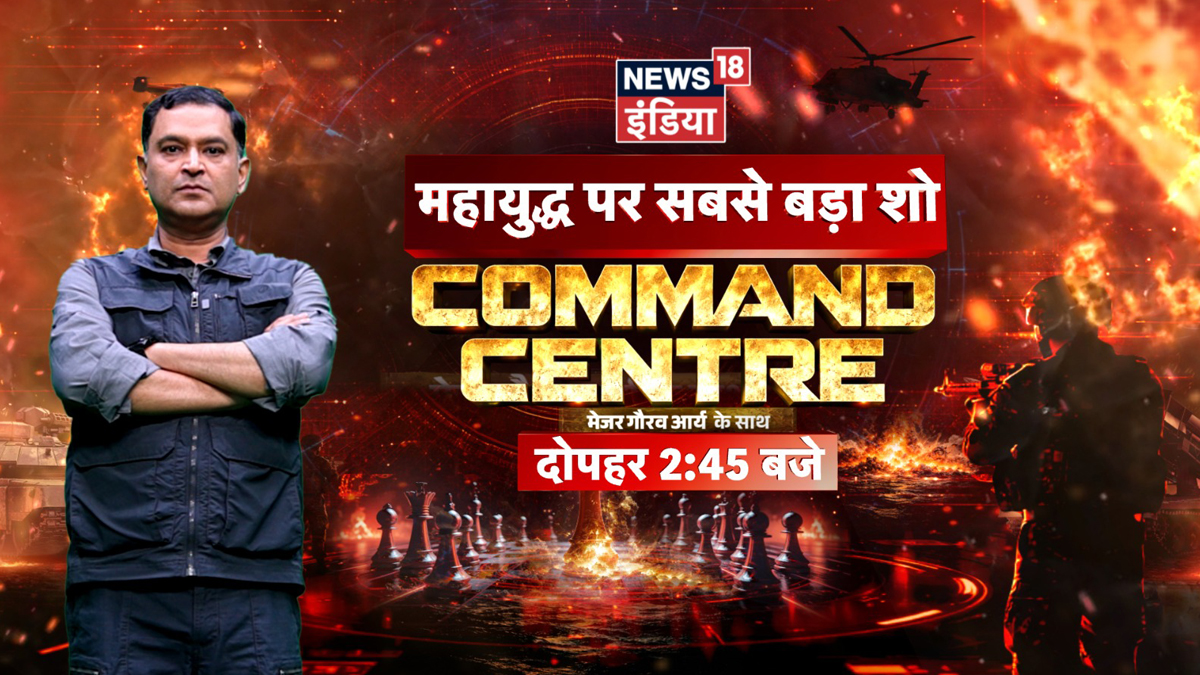
MUMBAI: News18 India has rolled out a new war-focused programme, Command Centre, featuring Gaurav Arya, as it looks to offer viewers a sharper, more grounded take on global conflicts amid rising tensions in West Asia.
Positioned as an “insider war room”, the show moves away from conventional panel debates and instead focuses on explaining military developments, decoding strategy and connecting global events to their everyday impact, from fuel prices to economic shifts.
The format leans heavily on visuals and data. The studio has been designed like a command hub, complete with large LED war maps, real-time graphics and an alert system to track developments as they unfold.
At the centre of it all is Arya, who brings his military background to simplify complex war strategies for viewers. His signature line, “Seedhi baat samjhiye”, anchors the show’s promise of clarity over noise.
News18 India managing editor Jyoti Kamal said, “Command Centre, featuring Major Gaurav Arya is designed to deliver accurate insights and a clear perspective on how evolving conflicts impact everyday life, from household budgets to national security. With expert voices analysing every development in real time, the show goes beyond headlines to decode what’s happening now, what it means, and what could come next.”
Echoing the intent, Gaurav Arya added, “In times of war, confusion is the biggest threat. With News18 India’s Command Centre, we are bringing viewers inside the war room, decoding strategies, tracking every escalation, and explaining, in the simplest terms, what it means for India and for every household. Seedhi baat samjhiye, this is where you understand not just what is happening, but what happens next.”
The weekday show will air in the afternoon slot and will also feature Gaurav Shukla, adding to its editorial depth.
With its mix of analysis, visuals and a clear focus on impact, the show reflects a broader shift in news consumption. Viewers are no longer just watching events unfold, they are looking to understand what those events mean for them.







