Hindi
Filmfare spotlights Gujarat’s cinematic potential!

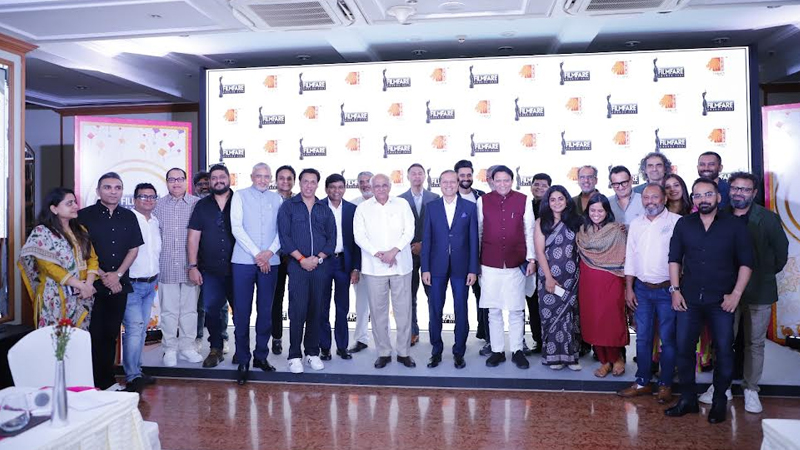
Mumbai: For over seven decades, Filmfare has been chronicling remarkable accomplishments and milestones of the Indian Film Industry. The platform continues to lead the way in honouring cinematic and artistic brilliance. For the 69th edition of the Filmfare Awards, which is scheduled to be held on January 2024, Filmfare takes the celebrations to the Vibrant State of Gujarat. One of the core objectives of this partnership seeks to establish Gujarat as a global centre for tourism, investment, and a thriving hub for cinematic production.
The inaugural Filmmakers’ Round Table took place at the Taj Lands End in Mumbai on 11 October where the event served as a significant precursor to the Filmfare awards. Spearheaded by The Times Group managing director Vineet Jain, Filmfare played a pivotal role in fostering the growth of the Indian film industry. It achieved this by convening a distinguished panel of attendees.
Leading this high-profile gathering was the Gujarat chief minister Bhupendrabhai Patel, who headed a high-powered delegation from the Gujarat Government. Accompanying him was the Tourism of Gujarat minister Mulubhai Bera, as well as other key policy makers and officials from the Government of Gujarat.

The film & entertainment industry was well-represented, with prolific filmmakers such as Imtiaz Ali, Aanand L. Rai, Boney Kapoor, Om Raut, Mukesh Bhatt, R. Balki, Jayantilal Gada, Nitesh Tiwari, Ashwiny Iyer Tiwari, Nikkhil Advani, Ramesh Taurani, Madhur Bhandarkar, Apoorva Mehta, Raj & DK, Harshavardhan Kulkarni, Venky Mysore, Aparna Purohit, Anand Pandit in attendance, among others. The session was deftly moderated by the actor Kubbra Sait, who skillfully guided in-depth discussions that shed light on Gujarat’s comprehensive support systems for filmmakers.
The Round Table event underscored Gujarat’s unwavering commitment to becoming the ultimate destination for filmmaking and film production. This commitment is substantiated by their world-class infrastructure, enticing incentives, and a comprehensive cinematic policy.
Patel commented, “Our collaboration with Filmfare signifies Gujarat’s vision to be at the forefront of cinematic excellence, and this Round Table is a significant milestone towards achieving that goal. We are committed to providing the necessary infrastructure, incentives, and support to ensure that Gujarat becomes a preferred destination for filmmakers from across the world.”
Tourism of Gujarat minister Mulubhai Bera said, “Gujarat’s rich cultural heritage and diverse landscapes have always been a source of inspiration for filmmakers. We are excited to partner with Filmfare to promote Gujarat as a thriving hub for cinematic productions. With a welcoming atmosphere, breath-taking locations, and robust support systems, Gujarat offers filmmakers a unique canvas to bring their artistic visions to life.”
Jain commented, ” The Government of Gujarat has been unwavering in its dedication to offer filmmakers the necessary support, infrastructure, and policies. We are proud to be a facilitator in bringing together the entertainment industry and a canvas like Gujarat for painting their stories on.”





Hindi
India’s telecom subscribers cross 1.32 billion in February 2026
Broadband base swells past 1.06 billion as Jio and Airtel tighten grip on the market.
MUMBAI: India’s telecom sector is ringing in steady growth once again adding millions of new connections every month while the race for broadband supremacy continues to heat up like a fiercely contested cricket match. According to the latest data released by the Telecom Regulatory Authority of India (TRAI) on 1 April 2026, the total telephone subscriber base in the country reached 1,321.31 million at the end of February 2026. This marked a net addition of 7.31 million subscribers during the month, translating into a monthly growth rate of 0.56 per cent.
Wireless subscribers (including mobile and Fixed Wireless Access) stood at 1,273.31 million, registering a net addition of 6.97 million and a growth rate of 0.55 per cent. Within this, urban wireless connections grew to 730.75 million (growth 0.70 per cent), while rural wireless subscribers reached 542.56 million (growth 0.35 per cent).
Wireline subscribers, though much smaller in scale, showed slightly faster growth. The total wireline base increased to 47.99 million, with a net addition of 0.34 million and a monthly growth rate of 0.70 per cent. Urban areas continued to dominate wireline connections with a share of 89.41 per cent.
Overall tele-density in India improved to 92.66 per cent. Urban tele-density stood at 150.68 per cent, while rural tele-density edged up to 60.02 per cent.
The broadband subscriber base crossed a significant milestone, reaching 1,059.05 million at the end of February 2026. This reflected a healthy net addition of 6.33 million subscribers and a monthly growth rate of 0.60 per cent from January’s figure of 1,052.72 million.
Segment-wise, mobile wireless access continued to drive the majority of growth with 996.52 million subscribers. Fixed Wireless Access (including 5G FWA) added 16.51 million, while wired broadband stood at 46.02 million.
Reliance Jio Infocomm Ltd. maintained its commanding lead with 519.64 million broadband subscribers. Bharti Airtel Ltd. followed with 364.14 million, Vodafone Idea Ltd. with 129.36 million, Bharat Sanchar Nigam Ltd. with 28.70 million, and Atria Convergence Technologies Ltd. with 2.38 million.
Together, these top five players command a massive 98.60 per cent share of the total broadband market.
In the wireless (mobile) segment, private operators continued to dominate with 92.59 per cent market share, leaving public sector undertakings (BSNL and MTNL) with just 7.41 per cent.
Out of the total 1,257.29 million wireless (mobile) subscribers, 1,177.60 million were active on the peak Visitor Location Register (VLR) date, representing an impressive 93.66 per cent activity rate. Bharti Airtel led in this metric with 99.42 per cent of its subscribers active.
Meanwhile, 14.47 million subscribers submitted requests for Mobile Number Portability (MNP) in February, indicating healthy competition and customer churn across zones.
While urban areas still lead in absolute numbers, rural connectivity is slowly catching up. Rural wireless tele-density stood at 59.46 per cent, compared with the much higher urban figure of 142.32 per cent.
Fixed Wireless Access using 5G technology also showed promising traction, growing to 11.93 million subscribers. Reliance Jio and Bharti Airtel are the primary players driving this segment.
The data paints a picture of a maturing yet still rapidly expanding telecom ecosystem. With total telephone subscribers now well past the 1.32 billion mark and broadband users comfortably above 1.06 billion, India continues to solidify its position as one of the world’s largest and most dynamic digital markets.
From bustling city streets to remote villages, more Indians are staying connected than ever before proving that when it comes to telecom, the country’s appetite for growth shows no signs of hanging up anytime soon.






