Broadband
FCC gets Indian origin Ajit Pai as its chairman

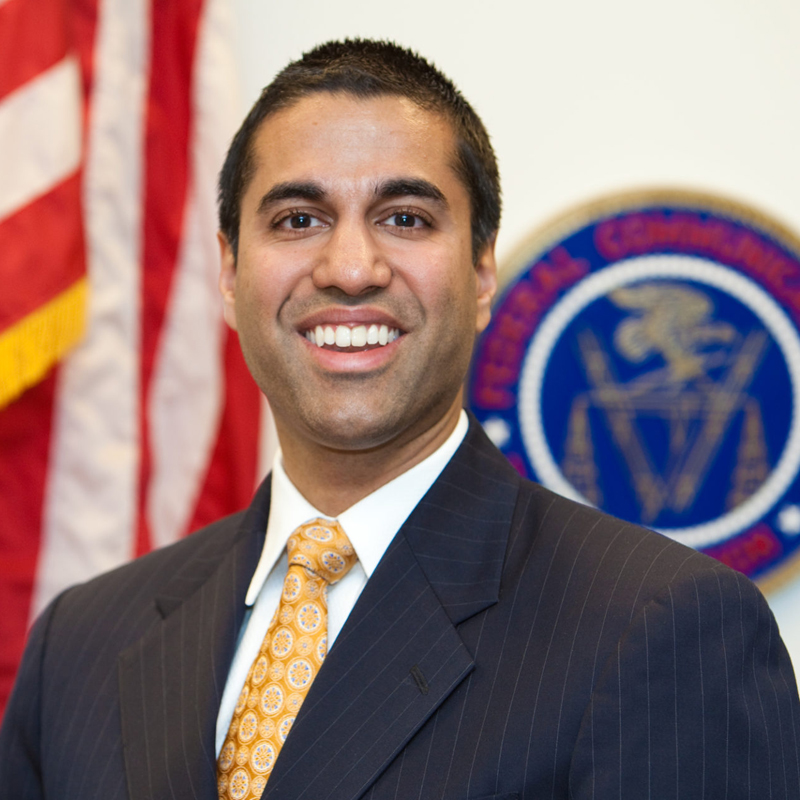
MUMBAI: Indians are familiar with Ajit Pai who addressed Ficci Frames as a keynote speaker just three years ago. But Pai is the point man designated by US president Donald Trump as the 34th chairman of the Federal Communications Commission (FCC) who will be drawing up communications policy in one of the most highly networked and communications heavy nations on earth.
Pai, a senior republican on the FCC, was appointed as a commissioner in 2012 by the then President Barack Obama and later confirmed by the senate. He replaces outgoing chairman Tom Wheeler.
“I look forward to working with the new administration, my colleagues at the Commission, members of Congress and the American public to bring the benefits of the digital age to all Americans,” Pai said in a statement.

Ajit Pai had credited his family for his successful rise as communications regulator during his Ficci Frames speech: Said he: “I was born and brought up in the United States, but my family’s roots are here in India. My mother grew up in Bangalore, and my father was raised in Hyderabad. In 1971, they came to the United States with just a radio and ten dollars in their pockets. Now, forty-three years later, here I am, in the country of my forefathers, speaking to you as the first Indian-American to serve on the FCC. The credit for this goes to my parents, who, like many immigrants, sacrificed to give me opportunities not available to them as children. It goes to my grandparents, who instilled in my parents the value of hard work and the vision to dream big.”
According to the FCC website Pai’s rules on communication regulations are as follows:
* Consumers benefit most from competition, not preemptive regulation. Free markets have delivered more value to American consumers than highly regulated ones.
* No regulatory system should indulge arbitrage; regulators should be skeptical of pleas to regulate rivals, dispense favors, or otherwise afford special treatment.
* Particularly given how rapidly the communications sector is changing, the FCC should do everything it can to ensure that its rules reflect the realities of the current marketplace and basic principles of economics.
* As a creature of Congress, the FCC must respect the law as set forth by the legislature.
* The FCC is at its best when it proceeds on the basis of consensus; good communications policy knows no partisan affiliation.
Pai as the commissioner had proposed a:
* Comprehensive plan to promote broadband deployment to all Americans. The federal government must make it easier to for broadband providers to retire increasingly obsolete copper lines in favor of next-generation technologies like fiber.”
• It must enable rural residents to have the same choice for stand-alone broadband typically found in cities.
• It must create a roadmap for state and local governments so that companies that want to compete in the broadband market don’t have to jump through unnecessary regulatory hoops in order to lay fiber to consumers.
• It must promote common-sense policies like “Dig Once” and reform pole attachment rules to reduce the costs of building digital networks.
• It must streamline the process for deploying wireless infrastructure, from big towers to small cells.
• It must free up more licensed spectrum for use by wireless carriers and more unlicensed spectrum for things like Wi-Fi.
• And it must preserve Internet freedom here and abroad, so that the online world can flourish free from heavy-handed government intervention.
Additionally, Pai ai was the first member of the FCC in over two decades to call for revitalizing the AM radio band; the basic reforms he proposed were adopted in 2015. He also urged the FCC to create a task force to study the “Internet Protocol Transition” and report on obsolete rules that could be repealed; that task force was created.
He is likely to undo the net neutrality regime that the FCC had been pursuing under outgoing chairman Wheeler.






Broadband
ACT Fibernet elevates Aditya Singh to chief customer experience officer
Former senior vp to drive service, retention and delivery revamp

BENGALURU: ACT Fibernet has elevated Aditya Singh to chief customer experience officer, effective 1 January, 2026, as the broadband provider seeks to tighten its grip on service quality in an increasingly competitive market.
Singh, who previously served as senior vice-president – customer experience and loyalty at group level, will now join the executive committee and lead the company’s end-to-end customer transformation agenda.
The move gives him oversight of customer service, customer retention and service delivery, alongside a broader mandate to strengthen network resilience and field operations. The company said the reshuffle underlines its intent to deliver a “consistent, seamless and superior” experience to its 2.3m subscribers across more than 30 cities.
Headquartered in Bengaluru, ACT Fibernet, the consumer-facing brand of Atria Convergence Technologies Limited, is one of India’s largest wired internet service providers. It has built its pitch on high-speed connectivity and responsive customer support, at a time when fibre roll-outs and price wars are redrawing the broadband map.
In a statement, Singh said he was “deeply honoured” to take on the expanded brief and join the executive committee as the company sharpens its focus on simplifying customer touchpoints and turning subscribers into brand advocates.
The elevation signals a clear priority: in a crowded fibre market, customer experience is fast becoming the decisive battleground.