News Headline
Fan base needs to increase for sports team monetisation: Panel

MUMBAI: India’s evolving sports ecosystem has a lot to offer in terms of opportunities for monetisation. But in order for that to happen, a stronger fan base with long term loyalty to respective teams and better infrastructure like stadiums need to be created. This was the opinion shared at a session on monetisation from sports in India titled ‘The M-Word “Monetisation”- Lessons To Learn,’ which was held at the Australia Business Week in India.
The panelists included, Australian proximity engagement company and Touch Holdings managing director Simon Szewach, Populous senior principal Andrew James and SE TransStadia COO Hiren Pandit. The session was moderated by Victoria University Dean College of sport and exercise science professor Hans Westerbeek.
The discussion began with Westerbeek asking the panelists whether it was worth investing in Indian sports? Pandit shared his knowledge by replying that investment in Indian sports can be seen in two ways; either as an associate with the sport or as a pure business investment. “Is the sport like the Indian Premier League (IPL) large enough for all franchises to make money?” he asked. He added saying that apart from making profits from their respective teams, owners had used their franchises for other better purposes than just receiving ROI. “The UB Group, which owns the Royal Challengers Bangalore uses the team to gain visibility because advertising of liquor brands is not allowed in India,” he informed.
James felt that passion for the sport was the first step necessary for investment, followed by steps to connect with fans. “Currently there is a boom in the UK to build stadiums so that English Premier League (EPL) teams can connect better with the fan base. On the other hand, the Liverpool team has more fans in Indonesia than in the UK.” He opined that it was now necessary to capture this fan base and monetise it. For example Liverpool selling its jerseys in Indonesia and making profits from the same.
Castellino then said that the honeymoon period, whereby sports is only looked in terms of passion, was over. “Sports should now be looked as a business seriously,” he said. He went on to say that it was a challenge to create winning franchises, which could deliver not just during tournaments but also during non-game events in order to pull in fans. Providing an analogy he said Manchester United had 80 per cent of its fan base in different parts of the world and 20 per cent only in the UK! He found that teams should first gather fans of this scale on board and then make money.
Westerbeek then posed a second question: “Famous clubs like Real Madrid and Barcelona are fan membership driven, wherein the profits are directed back towards these clubs. Is the club membership model effective in India?”
Pandit, relating to the share market, said that India’s population was very large versus the size of investors, which was very small. He also found it difficult to define a “fan” in India due to their fickle nature as they tend to follow only a winning team. He therefore said that India was not ready to have a model where fans could own a team. “India is not a sporting nation but a nation of couch potatoes, who want to lie back and watch a match on television. Single person investors are ready but not 1,000 fans,” he emphasised.
Szewach at this point interjected and said, “Passion for sports drives out when not reinforced through constant messages. There is a need to constantly engage with fans throughout the year.” He lamented about how he found it difficult to purchase jerseys of the IPL franchises in sport shops, even when the event was just a few months away.
Castellino felt that professionalism, which has entered the Indian sports ecosystem now, would help in its growth in the long run.
The discussion then revolved around the role of federations in India and if they were a stumbling block when it came to monetisation of sport entities.
Pandit opined that most federations were interested in governing the sport rather than promoting it. “It is a complicated situation,” he said, adding that the challenge currently would be to prove to the government that they are only required for the short term and entities can become self sufficient in the long run. “Studies have shown that our stadiums are used only for two per cent of the time and therefore are under utilised. There exists a vicious cycle between grassroots programme and monetisation,” he said.
James recalled his first visit to India 10 years ago wherein he met N Srinivasan and Lalit Modi. He found it shocking how one single Indian player could earn more income versus the revenue generated by stadiums. “It is extremely inexpensive to build a stadium in India versus the cost of building a 500 million pound stadium in the UK,” he said.

Post the discussion, the panel was seen sharing their thoughts with the audience. They were of the opinion that much more was needed to be done and there were a lot of opportunities for sponsorships for various teams. Westerbeek concluded by saying, “It is about two magic words – ecosystem and opportunities – for the Indian sports market. A lot more concrete definition would come by in the next five years.”



NEW DELHI: Hamdard Laboratories gathered a cross-section of India’s achievers in New Delhi on Friday, handing out the Hakeem Abdul Hameed Excellence Awards to figures who have left their mark across healthcare, education, sport, public service and the arts.
The ceremony, attended by minister of state for defence Sanjay Seth and senior officials from the ministry of Ayush, celebrated individuals whose work blends professional success with a sense of public purpose. It was as much a roll call of achievement as it was a reminder that influence is not measured only in profits or podiums, but in people reached and lives improved.
Among the headline awardees was Alakh Pandey, founder and chief executive of PhysicsWallah, recognised for turning affordable digital learning into a mass movement. On the sporting front, Arjuna Awardee and kabaddi player Sakshi Puniya was honoured for her contribution to the game and for pushing women’s participation onto bigger stages.
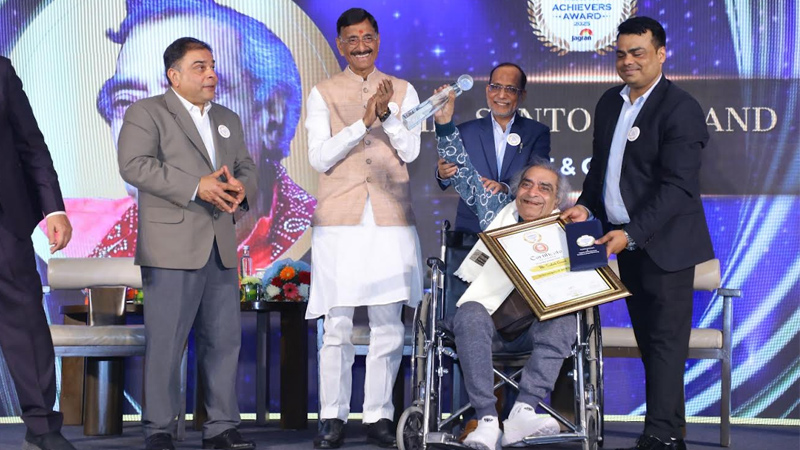
The cultural spotlight fell on veteran lyricist and poet Santosh Anand, whose songs have echoed across generations of Hindi cinema. At 97, Anand accepted the honour with characteristic humility, reflecting on a life shaped by perseverance and hope.
Healthcare honours spanned both modern and traditional systems. Manoj N. Nesari was recognised for strengthening Ayurveda’s place in national and global health frameworks. Padma shri Mohammed Abdul Waheed was honoured for his research-backed work in Unani medicine, while padma shri Mohsin Wali received recognition for his long-standing contribution to patient-centred care.
Education and social development also featured prominently. Padma shri Zahir Ishaq Kazi was honoured for decades of work in education, while former Meghalaya superintendent of Police T. C. Chacko was recognised for public service. Goonj founder Anshu Gupta received an award for his dignity-centred rural development initiatives, and the Hunar Shakti Foundation was honoured for empowering women and young girls through skill development.
The Lifetime Achievement Award went to former IAS officer Shailaja Chandra for her long career in public healthcare and governance, particularly in the traditional systems under Ayush.
Speaking at the event, Hamdard chairman Abdul Majeed said the awards were a tribute to those who combine excellence with empathy. “These awardees reflect Hakeem Sahib’s belief that healthcare, education and public service must ultimately serve humanity,” he said.
Minister Seth struck a forward-looking note, saying India’s young population gives the country a unique opportunity to become a global destination for learning, health and wellness by 2047.
The ceremony also featured the trailer launch of Unani Ki Kahaani, an upcoming documentary starring actor Jim Sarbh, set to premiere on Discovery on 11 February.
Instituted in memory of Unani scholar and educationist Hakeem Abdul Hameed, the awards have grown into a national platform that celebrates those building a more inclusive and resilient India. For one evening at least, the spotlight was not just on success, but on service with substance.







