News Broadcasting
ETNOW business conclave spotlights India’s road to a $5 trillion economy


MUMBAI- India’s economic ambitions took centre stage at the ETNOW.in Business Conclave & Awards 2025, where industry stalwarts and policymakers mapped out the nation’s journey toward a $5 trillion economy by 2030. Aligned with ET NOW’s ‘Rise with India’ ethos, the event served as a strategic forum for discussions on AI, digital policy, space technology, and national security key pillars of the Viksit Bharat vision.
Union minister Jitendra Singh highlighted India’s rapid strides in the space sector, revealing that the industry attracted Rs 1,000 crore in private investments within months of opening to commercial players. He projected a fivefold expansion of India’s space economy, reaching $44 billion in the next decade, citing missions like Gaganyaan as milestones of self-reliance.
Former union minister and tech investor Rajeev Chandrasekhar made a compelling case for revamping India’s outdated IT laws, stressing that the 25-year-old IT Act fails to account for the Internet and AI—two transformative forces driving the digital economy. “A modern, entrepreneur-first legal framework is needed, free from unnecessary bureaucratic hurdles,” he asserted.

Governor of Arunachal Pradesh, Lt. Gen. K.T. Parnaik (Retd.), underscored the role of strong border security and infrastructure in economic growth, detailing Arunachal Pradesh’s potential as a hydropower hub with a capacity of 58,000 MW.
The ETNOW.in Business Conclave & Awards 2025 honoured excellence across 82 categories, recognising industry leaders driving innovation and impact. Naveen Kukreja (Paisabazaar.com) and Ashish Kashyap (IND Money) were named ETNOW Industry Icons, while Central Park Flower Valley secured the Leading Township of the Year award.
ACT21 Software Pvt. Ltd. was celebrated for Excellence in Fintech with its HyPerform solution, and VAXIFLU-4 (Zydus) received the Service Excellence Award in Vaccines & Prevention. In the branding space, U.S. Polo was recognised for its Excellence in Marketing Campaign (2024-2025), while Exhale Label emerged as the Emerging Fashion Brand, reinforcing its growing influence in the fashion industry.






News Broadcasting
Network18 channels lead YouTube news viewership in March 2026
CNN-News18, News18 India and CNBC channels top categories with record views
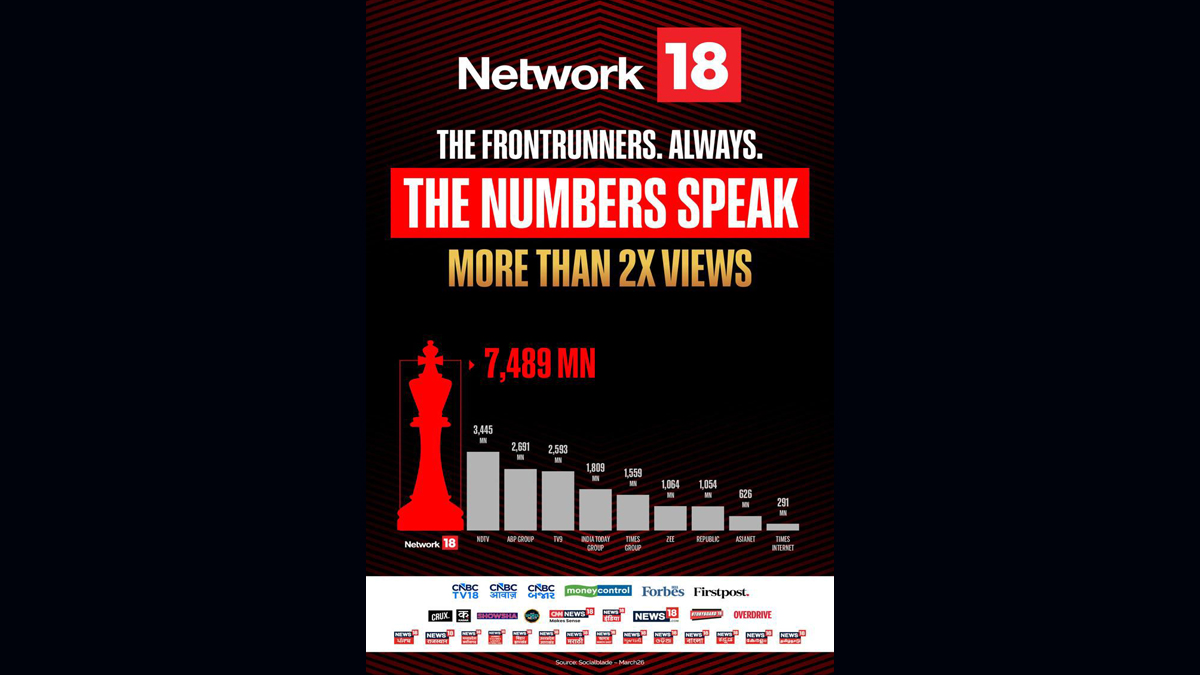
MUMBAI: When the world hit refresh on breaking news, Network18’s channels were already streaming ahead. As geopolitical tensions and war-driven headlines fuelled a surge in global news consumption, the network’s digital playbook delivered big clocking record Youtube viewership across English, Hindi and business news categories in March 2026.
At the forefront was CNN-News18, which emerged as the clear leader in the English news segment with 130 million live and video-on-demand views. The channel edged past competitors such as Times of India (126.5 million), Times Now (101.1 million), India Today (88.2 million) and NDTV (77.5 million), according to Databeings data for March.
In the Hindi news arena, News18 India delivered a commanding performance, racking up a staggering 3,297 million views on YouTube. The channel comfortably outpaced NDTV India, which recorded 3,119 million views, underlining its deep reach and consistent engagement with mass audiences, as per Playboard data.
The network’s dominance wasn’t confined to general news. In the Hindi business segment, CNBC Awaaz topped the charts with 92 million views, narrowly ahead of Zee Business (90 million) and well ahead of ET Now Swadesh (57 million). Meanwhile, its English counterpart CNBC-TV18 posted a strong 58 million views, reinforcing the network’s cross-category strength.
The spike in viewership reflects a broader shift in audience behaviour, with viewers increasingly turning to digital platforms particularly Youtube for real-time updates and in-depth coverage during high-intensity news cycles. For Network18, the numbers signal more than just scale; they underline the effectiveness of a multi-platform strategy that blends speed, credibility and continuous coverage.
In a month where the news never paused, it seems viewers chose to stay tuned where the stream never stopped.






