News Broadcasting
ESPN files winding up petition against InCableNet


MUMBAI: First was the shut-off. Now the courts have been drawn into the dispute.
A week after ESPN Star Sports (ESS) cut off signals to Hinduja Group MSO INCableNet over outstanding subscription dues it says have crossed Rs 71 million, it today instituted winding up proceedings in the Bombay High Court.
The petition filed before the court states that despite several service agreements in place, INCableNet had consistently failed to pay up on monthly dues and was in admitted default to the tune of Rs 40 million.

A statement issued by ESS says the Bombay High Court has admitted the petition and listed it for hearing on 29 January, 2004.
In the petition, ESS states that it has entered into various service contract(s) with InCableNet to distribute ESPN and Star Sports channels in Mumbai and other cities, which it services. InCableNet was to pay monthly subscription fees.
However, ESS alleges, InCableNet has failed to make payments towards the subscription fees in accordance with the contract(s). Despite InCableNet’s failure to pay the fees, ESS claims to have kept the services on and made bonafide attempts to persuade InCable to discharge their payment obligations.
The petition ends stating, despite several repeated promises and written commitments, InCableNet has backed out of its promise to pay the admitted sum of over Rs 40 million.
On 10 November, ESS had discontinued the signals of its channels ESPN and Star Sports to IIMCL stating that “IIMCL had failed to pay routine monthly dues, despite repeated collection efforts”.
ESS Software VP, affiliate sales, Sricharan Iyengar had pointed out earlier this month that they had received a letter from IncableNet CFO Srinivas Palakodeti, who had assured to pay them Rs 30.65 million, the outstanding amount then. This letter was dated 27 August 2003, but ESPN has not yet realised the money.
A response on the issue is awaited from InCableNet.







News Broadcasting
UDF poised to return to power in Kerala, says Manorama-CVoter survey
Massive opinion poll projects shift in Kerala politics ahead of 2026 Assembly elections.
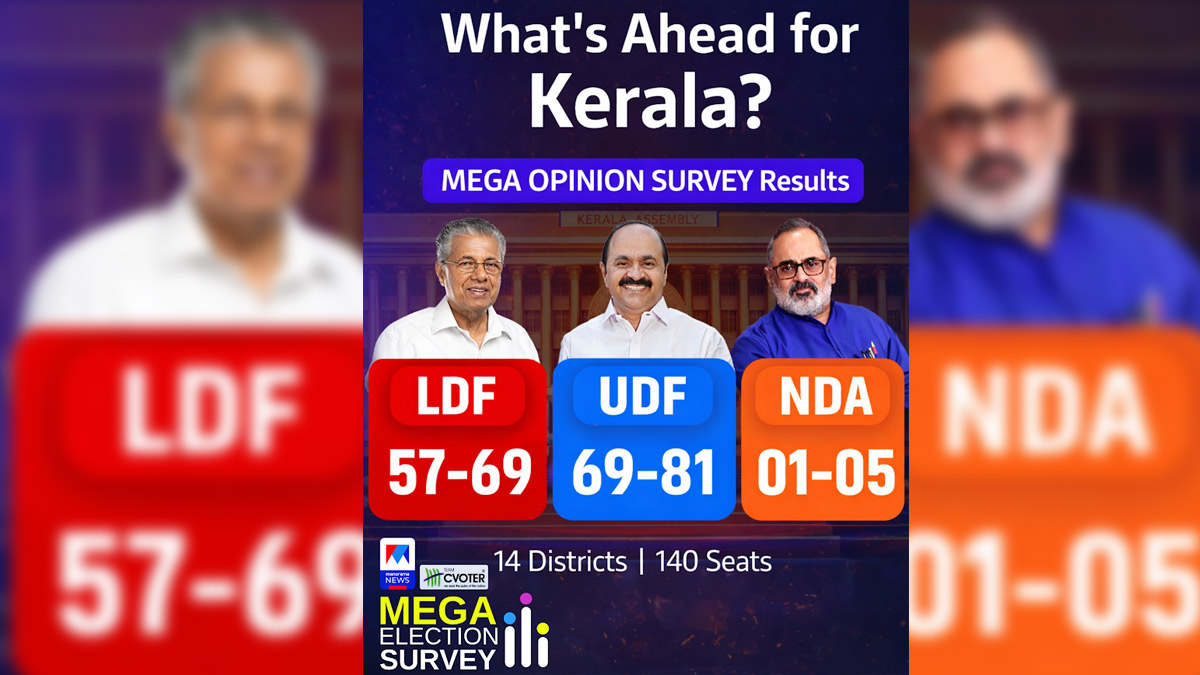
MUMBAI: The winds of change appear to be blowing through Kerala’s political landscape and this time, they seem to favour the United Democratic Front. A comprehensive mega opinion survey conducted by Manorama News in partnership with CVoter projects a potential comeback for the UDF in the upcoming Kerala Legislative Assembly Elections 2026. The survey, covering all 140 constituencies with a massive sample size of nearly 90,000 respondents, predicts the UDF could win between 69 and 81 seats.
The ruling Left Democratic Front (LDF) is expected to secure 57 to 69 seats, a significant drop from the 99 seats it won in the 2021 elections. This would mean the LDF losing 30 to 42 of its sitting seats. Meanwhile, the National Democratic Alliance (NDA), which drew a blank in 2021, is projected to open its account with 1 to 5 seats.
Region-wise, the UDF is expected to make strong gains in Malabar, winning 25 to 34 out of 48 seats, and in Central Kerala, where it could bag 29 to 33 out of 53 seats. In South Kerala, the LDF is likely to retain an edge with 21 to 25 seats, while the UDF may improve to 12 to 16 seats. The NDA could pick up 1 to 3 seats in the southern region.
The survey was conducted between 14 and 26 March 2026, with additional tracker and snap polls carried out from December 2025 to March 2026. A total of 89,693 respondents participated, ensuring representation across all demographics and social segments.
Manorama News has a strong track record of accuracy, with its previous projections closely matching the actual results of the 2019 and 2024 Lok Sabha elections as well as the 2021 Kerala Assembly polls.
In Kerala’s famously fierce political battles, this survey suggests the pendulum may be swinging back. Whether the final verdict matches these numbers or throws up another surprise, one thing is clear, the 2026 Assembly elections are shaping up to be one of the most keenly watched contests in the state’s history.






