News Broadcasting
ESPN feed back on INCable Net after agreement on declared connectivity


More than three months after the ESPN Star Sports feed to the Hinduja group promoted INCable Net was switched off in Mumbai in a dispute over the declared connectivity that the MSO was willing to accept, the two sides finally thrashed out an agreement in the early hours today at 1:30 am.
An joint press release stated that with the “landmark settlement”, InCable Net and ESPN Software “have resolved all outstanding issues, and entered a new era of cooperation and long-term relationship to the satisfaction of both the parties.” Following the agreement, all outstanding legal cases between the two parties will be withdrawn at the earliest.
The agreement that was reached last night is the outcome of hectic parleys that have been on for the the last few weeks. And the major impetus for the meeting of the minds as it were was, as is to be expected, cricket. India has just embarked on a two-month tour of the Caribbean and the India-West Indies cricket series officially begins 11 April.

As regards the source of the dispute, it was not really the new monthly subscription rate of Rs 24 for the two sports channels that was the core issue but the declared subscriber base that INCable was willing to accede to. The new rates became effective 1 January 2001 and ESPN Software switched off its feed on 5 January.
At the end of last year, 150,000 was the declared subscriber base that ESPN Star Sports had with INCable. Though no one was willing to come on record, industry sources say the new subscriber base that has been agreed to is above 200,000.
Speaking on behalf of INCable, Rajeev Vyas, president, said: The spirit of the agreement encourages cooperation between the service providers and the cable operators, and both parties will work towards enhancing subscriber base at the same time increasing quality of service to consumers.
Sricharan Iyengar, vice-president – affiliate sales ESPN Software India said: A long-term agreement of this nature envisages closer cooperation between the two parties to ensure that all issues are sorted out through discussions and mutual understanding. We believe that such an agreement will immensely benefit the channels, the cable operators and the consumers.
The new contract that has been signed between ESPN Software and InCable is a backdated one that runs for the next two years from 1 January 2002 to 31 December 2003. There have been clauses included in the new contract that allow for ramping up of declared subscriber base over the next two years. It is not clear at this stage whether the agreement is based on the present subscription rate being maintained for the full duration of the contract or whether there will be an increase in rates at the beginning of next year as has been the case till now. Another question is whether there is any limit on how much the sports broadcaster can hike its rates.
One thing that appears clear from the new terms that have been worked into the contract is that it will be binding on both sides to adhere to it. By the looks of it, the consumer can expect a far more incident free two years than has been the case till now.





News Broadcasting
Network18 channels lead YouTube news viewership in March 2026
CNN-News18, News18 India and CNBC channels top categories with record views
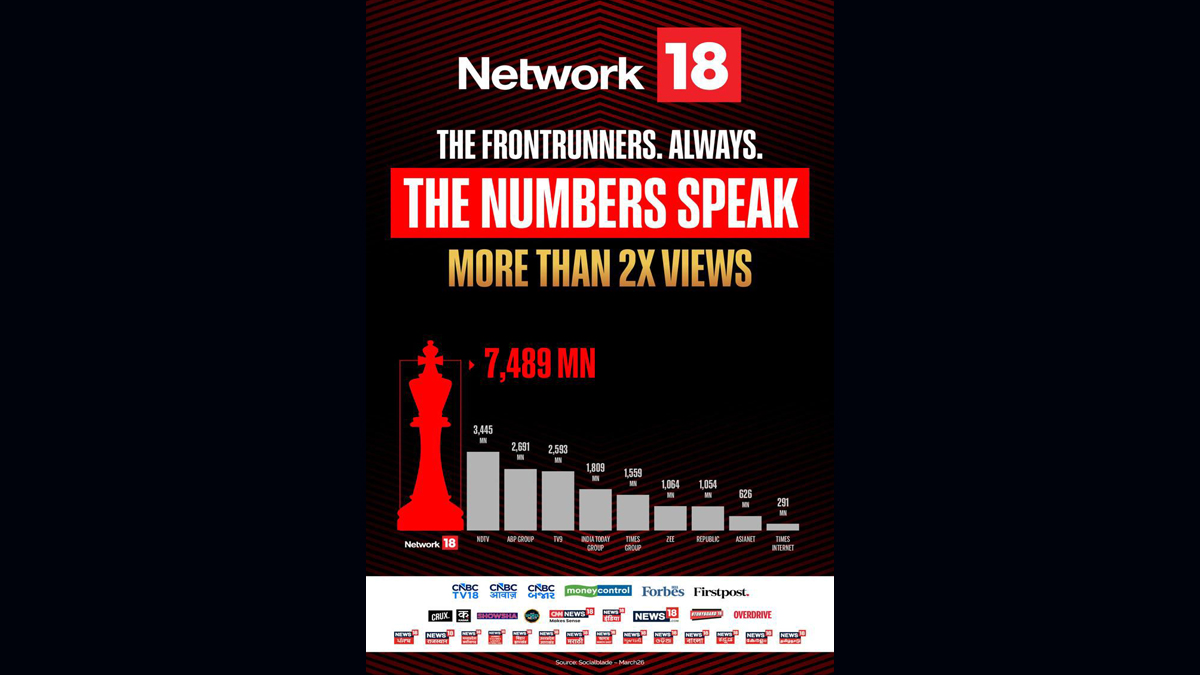
MUMBAI: When the world hit refresh on breaking news, Network18’s channels were already streaming ahead. As geopolitical tensions and war-driven headlines fuelled a surge in global news consumption, the network’s digital playbook delivered big clocking record Youtube viewership across English, Hindi and business news categories in March 2026.
At the forefront was CNN-News18, which emerged as the clear leader in the English news segment with 130 million live and video-on-demand views. The channel edged past competitors such as Times of India (126.5 million), Times Now (101.1 million), India Today (88.2 million) and NDTV (77.5 million), according to Databeings data for March.
In the Hindi news arena, News18 India delivered a commanding performance, racking up a staggering 3,297 million views on YouTube. The channel comfortably outpaced NDTV India, which recorded 3,119 million views, underlining its deep reach and consistent engagement with mass audiences, as per Playboard data.
The network’s dominance wasn’t confined to general news. In the Hindi business segment, CNBC Awaaz topped the charts with 92 million views, narrowly ahead of Zee Business (90 million) and well ahead of ET Now Swadesh (57 million). Meanwhile, its English counterpart CNBC-TV18 posted a strong 58 million views, reinforcing the network’s cross-category strength.
The spike in viewership reflects a broader shift in audience behaviour, with viewers increasingly turning to digital platforms particularly Youtube for real-time updates and in-depth coverage during high-intensity news cycles. For Network18, the numbers signal more than just scale; they underline the effectiveness of a multi-platform strategy that blends speed, credibility and continuous coverage.
In a month where the news never paused, it seems viewers chose to stay tuned where the stream never stopped.






