Fiction
Dubbing comes to a standstill; subtitling goes on

MUMBAI: The outbreak of Covid2019 has not only brought the film and TV production industry to a halt, but even the associated sectors. The dubbing industry is one.
However, the pandemic hasn't stopped people from consuming content. In fact, people are consuming content more than ever. According to a recent study conducted by KPMG, there has been a perceptible increase in media consumption during the last few weeks as people have remained homebound.
With no new content in the making, most dubbing and subtitling companies are suffering huge losses.

Business Of Languages (BOL) founder and CEO Rahul Bhatia says, “Currently, the dubbing industry has completely shut down. In this case, working from home is also not possible. We, in fact, tried doing it with artists with setups available at home but the outcome was not that great. So, technically everything is shut down as far as dubbing is concerned.”Prime Focus Technologies AVP Dubbing Bipin Doshi said, "Creating fresh viewing content requires lot of personal interaction which in the current scenario is neither permitted nor advisable. This means localizing existing or older content is the only option to ensure that audience currently ensconced at home gets entertained. Traditional method of dubbing currently is on a halt due to the restrictions in place but PFT is working on couple of approaches to start the dubbing process without endangering health of team or talent."
Bhatia says that though dubbing is not happening, other kinds of works like e-learning content where video reference is not required are going on. It can be recorded on the phone and shared with the client. Apart from that, IVR and audiobox projects are also being conducted from the confines of people's homes.
Even for dubbing content in the regional language, Bhatia says it is not possible without studios and proper artists.
Mega Media Studio MD John Joseph says that nobody is approaching for dubbing work right now. Most of the films are halfway through and those which are lined up do not have a release date.
"Covid2019 has immensely affected our studio. Nothing is happening right now on the production side but post-production work is slowly happening. We are just continuing with films which were happening in the studio before lockdown."
According to Joseph, unless films are completed, they cannot go ahead with the dubbing work.
Doshi begun taking tentative steps for remote dubbing last year and managed to do a couple of tests just before the lockdown came into place. According to him voice quality is something that will take a while in addressing. The output will get homogenised to a certain extent and better quality can be achieved if talent can acoustically treat their rooms, mics are used etc so that voice quality can be monitored. It is important to solve for change in room tonality which is inherently found when audio is recorded in different setups.
He adds, "Although we have begun using remote dubbing solutions it has lot of technical and user end challenges as this industry has never tried it before."
Fakt Marathi Enterr10 MD Shirish Pattanshetty, however, says that the dubbing industry is making use of some other sectors to survive.
"As far as industry norm goes people have been deferred from operating dubbing studios but some large corporates are using dubbing to their benefit to tap various content for different languages to ensure there is freshness in the content to cater to the audiences so that the retention level is high," he says.
As the lockdown continues, no new episodes are being made. So, Pattanshetty thinks that the second-best option would be to dub the existing projects into native languages that are demanded by the audiences. He also believes that dubbing content is a beter option that showing OTT shows on TV.
On the contrary, subtitling is happening with the help of cloud-based platforms where artists are translating the content and sharing on the platform. The cloud-based solutions enable them to download and transfer easily and quality issues do not come into play like they do for audio in dubbing.
Cloud-based solutions enable editors also to work from home as long as they have stable broadband connectivity. Prime Focus Technologies has a cloud-based solution on its flagship product called CLEAR for content sharing, viewing and reviewing of the same at the other end. For localization, the options of reviewing multi-language audio tracks without creation of additional video screeners is a lifesaving facility. "Ability to give access through independent user IDs with watermarking of the content ensures online viewing of the files without having to send them to any one separately," Doshi adds.
While different states are mulling over various lockdown-lifting strategies, Bhatia says, “We have to wait till the government grants permission to resume work. We work with a lot of professional dubbing artists but due to the lockdown most of them are in their hometown. So, we are waiting for permission so that people could travel. As of now we are completely clueless what is going to happen next.”
Pattanshetty thinks that even if Mumbai remains shut there would be dubbing studios based out of Pune, Kolhapur or Sangli who could ensure work is delivered to other connecting places. If Delhi becomes fully functional, Hindi content can take help from Delhi studios.
Bhatia also points out that even after the lockdown is lifted clients will cut down the numbers of hours of dubbing. As cost-cutting measures, they might want to have only 20 hours of dubbed content rather than 50 hours.
Joseph says, "We are currently suffering as there is no payment coming in. Initially, we would be finishing three to four movies a month and now we are restricted to just one."
In a recent announcement, Kerala cultural affairs minister AK Balan said that the Malayalam film industry will soon resume the post-production work of pending films. Meanwhile, FEFSI association president RK Selvamani has requested the Tamil Nadu government to grant them the permission to resume post-production works such as dubbing, re-recording and editing for films and TV soaps. Additionally, the Karnataka government has also granted indoor shoot permission with minimal 18 to 20 people. While there were rumours that the Maharashtra government was likely to give some leeway, the sudden spurt in the number of cases has closed that door.
ZEEL executive vice president and cluster head South business Siju Prabhakaran says, “We are waiting for the Maharashtra government to grant permission to resume post-production work. In the meantime it is a good opportunity for people to use footages of short-form content which is pending for a long time.”
Although new shows are not in production, ZEEL says it has certain shows as backup which will be used in the content pipeline for future. Prabhakaran adds that audiences know short-form content are sometimes shot on the phone and there is a possibility that it will have a technical snag. As far as a proper TV serial or a film is concerned, it requires a dubbing studio.
For now, the dubbing industry doesn't have a way out and industry players are waiting for a revival strategy.






Fiction
Banijay merges with All3Media in $6.65 billion deal
Marco Bassetti will lead the combined company as CEO
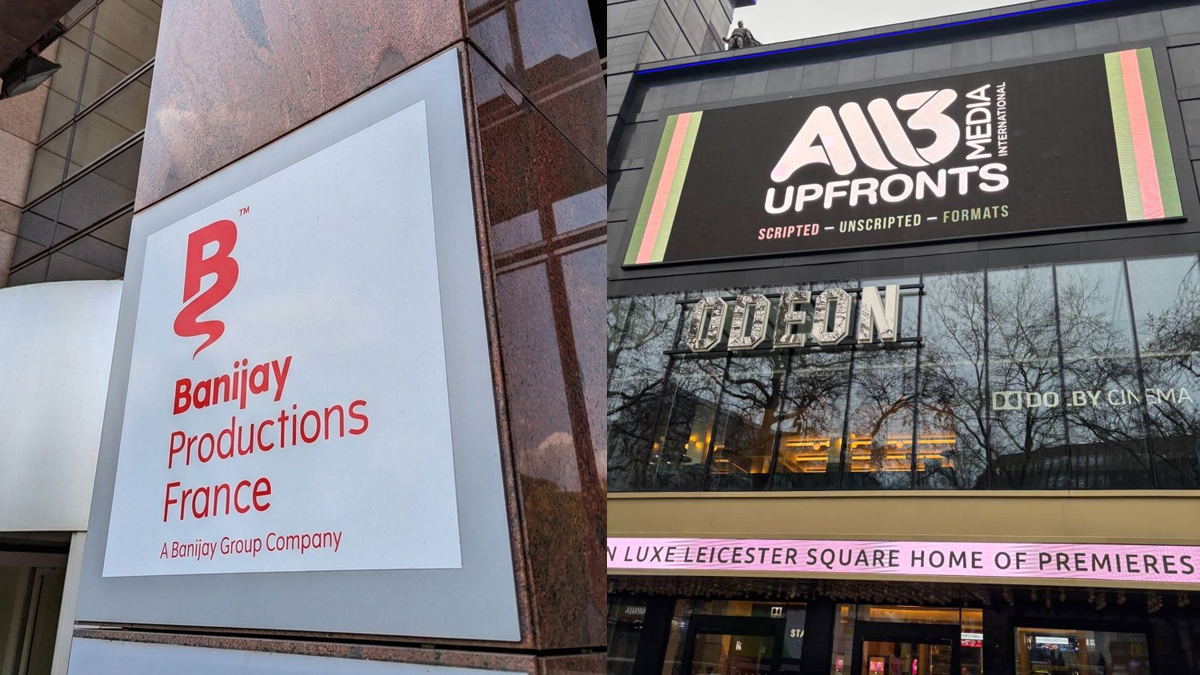
PARIS: Six years after acquiring Endemol Shine at the height of the pandemic, Banijay has struck again. The European production heavyweight is merging with All3Media in a deal that will create a television titan with $6.65 billion in revenue and redraw the contours of a fast-consolidating market.
The combined company will trade under the Banijay name and be owned 50 per cent each by Banijay Group and RedBird IMI, which acquired All3Media in 2024. The transaction is expected to close by autumn, subject to regulatory approvals.
Banijay Entertainment CEO Marco Bassetti, will take the top job at the enlarged group. All3Media CEO Jane Turton becomes deputy CEO. RedBird IMI CEO Jeff Zucker will serve as chairman.
The logic is scale. Broadcasters are commissioning less, streamers are tightening budgets and global buyers are fewer but bigger. Against that backdrop, heft matters. The merged entity will generate roughly $6.65 billion in revenues based on 2024 figures, giving it sharper elbows in rights negotiations and deeper pockets for franchise-building.
“Entrepreneurialism, ambition and creativity” remain core to Banijay’s DNA, Bassetti said, flagging plans to invest more heavily in new intellectual property, live events and emerging platforms. Turton struck a similarly bullish note, pointing to All3Media’s journey from a 2003 start-up to a global supplier of hit formats and high-end drama.
Between them, the two groups control a formidable slate. Banijay’s catalogue spans MasterChef, Big Brother, Survivor, Black Mirror, Peaky Blinders and Deal or No Deal. All3Media’s labels include Studio Lambert, producer of The Traitors and Squid Game: The Challenge; Two Brothers, behind The Tourist; and Neal Street, currently producing the forthcoming Beatles biopics directed by Sam Mendes for Sony.
The back catalogue is equally muscular. Banijay Rights holds some 220,000 hours, while All3Media International adds around 35,000 hours, forming one of the industry’s largest libraries.
Banijay, controlled by French entrepreneur Stéphane Courbit and listed in Amsterdam, counts more than 130 production companies across 25 territories. All3Media operates over 40 labels, with strong positions in the UK, US and Germany. The enlarged group will also lean into live entertainment, building on Banijay’s Balich Wonder Studio, which produced the opening ceremony of the Milan-Cortina Winter Olympics, and the Independents.
The deal marks a shift in tone. As recently as October, Bassetti suggested that mergers and acquisitions were not a priority. But the drumbeat of consolidation has grown louder. Mediawan has moved for Peter Chernin’s North Road. David Ellison’s Paramount has agreed to a $110 billion takeover of Warner Bros, with plans to combine HBO Max and Paramount plus. ITV has explored selling its media and entertainment arm to Comcast-owned Sky, though talks have reportedly slowed.








