News Headline
DTH licensing recommendations: TRAI restricts vertically integrated broadcasters from owning more than one DPO

MUMBAI: The Telecom Regulatory Authority of India (TRAI) has come out with some rules and regulations regarding a host of issues including crucial ones such as DTH licences and cross holding. In a recommendation paper that it gave out, it has said that certain restrictions be placed on vertically and horizontally integrated broadcasters and distribution platform operators (DPOs).
A vertically integrated broadcaster will be permitted to control only one DPO while a vertically integrated DPO will be restricted from controlling any other DPO of other category in the relevant market. For this it has defined the meaning of cross holding and control to be as: ‘a broadcaster includes the broadcaster itself, its subsidiary companies /associate companies/ companies of its relatives, its holding company and subsidiary companies /associate companies/ companies of its relatives of its holding company and any other broadcaster in its control. Similarly, a DPO includes the DPO itself, its subsidiary companies /associate companies/ companies of its relatives, its holding company and subsidiary companies /associate companies/ companies of its relatives of its holding company and any other DPO in its control.’

In its paper, TRAI states that ‘In order to ensure orderly growth of the broadcasting and distribution sectors and to avoid compromises or limitations on competition, certain cross-holding restrictions may be required to be put in place. Accordingly, the Authority recommends uniformity in the policy of cross holding /control between broadcasters and DPOs and amongst DPOs in the broadcasting and distribution sector.’
Depending on the shareholding patterns as prescribed by TRAI, companies will have to restructure their operations within one year. Industry sources say that the only two probable companies that are likely to be affected are the Zee group with Siti Cable and Dish TV and the Sun group with Sumangli Cable and Sun Direct.
However TRAI also states that there can’t be cross holding amongst DPOs of different categories. The paper states, ‘there cannot be any cross holding/control between an MSO (A), MSO cum HITS operator (B) or a HITS operator (C) and a DTH operator (D), while there could be controlling stakes amongst A, B and C subject to market share restrictions, as specified from time to time.’
DPOs have been given set parameters for market share/dominance. For DTH operators, the relevant market would be the entire country while for an MSO it is the state. The market share of a DPO would be the number of active subscribers of that DPO as a percentage of the total number of active subscribers of that category of DPOs.
On the DTH side, most operators are glad with the outcome of the paper that will now go through the Ministry of Information and Broadcasting (MIB). Says DTH Operators Association of India president and Tata Sky CEO Harit Nagpal, “We are glad with the outcome. There were two main issues that needed to be addressed: continuity of DTH licences and licence fee. The paper has made both amply clear, the migration process included. When the licence fee of 10 per cent was introduced there wasn’t any additional service and entertainment tax on it. We had been asking for relief on the licence fee to be calculated on adjusted gross revenue rather than gross revenue.”
The period of DTH licence has been extended from the current 10 years to 20 years while the one time entry fee has been retained at Rs 10 crore. The big relief is the reduction of licence fee from 10 per cent of gross revenue (GR) to 8 per cent of adjusted gross revenue (AGR). An industry source said that the DTH industry earns anywhere between Rs 8000 crore to Rs 9000 crore annually, pegging the savings that will come due to the 2 per cent relief at nearly Rs 200 crore. “The reprieve on overall taxation is the highlight point. Although industry would have liked it to be 6 per cent of AGR, this isn’t bad at all,” said the source.
Speaking on the new guidelines, Videocon director Saurabh Dhoot says, “This is a step in the direction towards encouraging industry riddled with high taxation and double taxation. However, content cost not included in deduction remains a concern area.”
Supporting the extension of DTH licence, TRAI states that though the guidelines are silent on the provision of extension, it could not be its intent to disallow them from continuing their business post 10 years of existence. ‘Starting a DTH business entails a huge investment of resources. It would, therefore, be a reasonable expectation on the part of DTH licensees that, on the expiry of the initial 10 year licence, they would be eligible to apply for issue of a new licence, so that they could continue their business,’ it states.
The new DTH licensing regime has been brought to bring fair degree of stability in the sector, to proper overall growth of the sector as it will create a conducive environment for investment from strategic investors. This will in turn spur innovation in terms of adoption of better technology and services.
The DTH Operators Association had requested TRAI to consider initial licence of 20 years which it has agreed to give on the lines of Telecom licence while its second request of a 20 year extension has been kept to 10 years. ‘The Authority also recommends that the renewal shall be on the terms and conditions, including renewal fee, specified by the Licensor (MIB), in consultation with the TRAI.’
AGR is calculated by excluding service tax, entertainment tax and sales tax/VAT paid to the government from the GR. The annual licence fee shall be subject to a minimum of 10 per cent of the entry fee while the licence should have a provision that prescribes that the licensor has the right to modify the licence fee as a percentage of AGR any time during the currency of the agreement.
The earlier rule of providing a bank guarantee (BG) of Rs 40 crore has been changed. Licencees will have to furnish a BG for an amount that is equal to payable licence fee for two quarters and other dues not otherwise securitised. The BG has to be valid for a year and renewed on a year on year basis in a way that it will be valid for the entire licence period. New entrants will have to give a fixed BG of Rs 5 crore for first two quarters and then continue in the manner prescribed above.
Those DTH operators that are serving their time in the existing regime can migrate to the new regime any time during its current licence period. Before migrating, it has to however clear dues and fulfill obligations under the old regime as well as clear legal cases. The ones who want to migrate will have to pay the entry fee again for a new licence but a rebate, commensurate to the remaining licence period may be granted to them.
The quantum of migration fee will be as follows:
Migration fee = [Entry fee in the new DTH licensing regime – (Entry fee under existing License/existing license period i.e. 10 years) x (No. Of years remaining in the existing regime at the time of migration)]. In this formulation part of a year is not to be counted.
Currently, STB interoperability isn’t possible because of the different technologies being adopted by the operators due to their entering the market at different times. Therefore, the bureau of Indian standards (BIS) has been asked to regularly keep updating the standing of STB technology, in consultation with TRAI. A tariff order for DTH was recommended by TRAI last year that allowed an easy exit option to subscribers, ensuring availability of consumer–premises-equipment (CPE – that primarily consists of STB and Dish antenna) at reasonable prices, easy to understand terms and conditions and at the same time, protecting the interests of the service providers. This order is sub-judice in TDSAT.







NEW DELHI: Hamdard Laboratories gathered a cross-section of India’s achievers in New Delhi on Friday, handing out the Hakeem Abdul Hameed Excellence Awards to figures who have left their mark across healthcare, education, sport, public service and the arts.
The ceremony, attended by minister of state for defence Sanjay Seth and senior officials from the ministry of Ayush, celebrated individuals whose work blends professional success with a sense of public purpose. It was as much a roll call of achievement as it was a reminder that influence is not measured only in profits or podiums, but in people reached and lives improved.
Among the headline awardees was Alakh Pandey, founder and chief executive of PhysicsWallah, recognised for turning affordable digital learning into a mass movement. On the sporting front, Arjuna Awardee and kabaddi player Sakshi Puniya was honoured for her contribution to the game and for pushing women’s participation onto bigger stages.
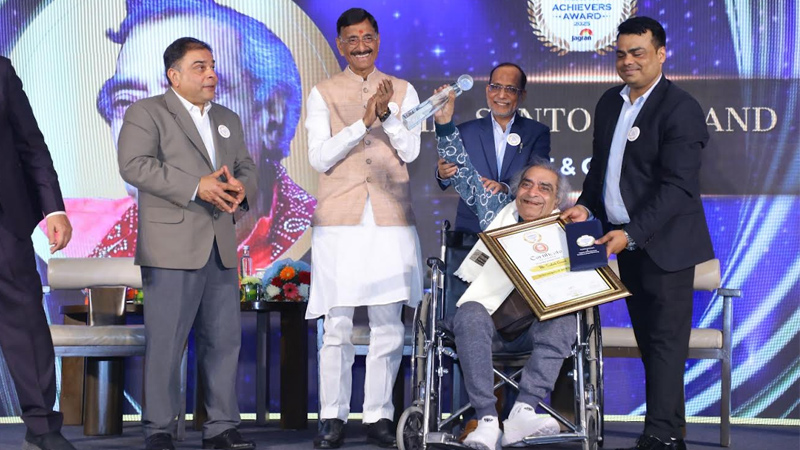
The cultural spotlight fell on veteran lyricist and poet Santosh Anand, whose songs have echoed across generations of Hindi cinema. At 97, Anand accepted the honour with characteristic humility, reflecting on a life shaped by perseverance and hope.
Healthcare honours spanned both modern and traditional systems. Manoj N. Nesari was recognised for strengthening Ayurveda’s place in national and global health frameworks. Padma shri Mohammed Abdul Waheed was honoured for his research-backed work in Unani medicine, while padma shri Mohsin Wali received recognition for his long-standing contribution to patient-centred care.
Education and social development also featured prominently. Padma shri Zahir Ishaq Kazi was honoured for decades of work in education, while former Meghalaya superintendent of Police T. C. Chacko was recognised for public service. Goonj founder Anshu Gupta received an award for his dignity-centred rural development initiatives, and the Hunar Shakti Foundation was honoured for empowering women and young girls through skill development.
The Lifetime Achievement Award went to former IAS officer Shailaja Chandra for her long career in public healthcare and governance, particularly in the traditional systems under Ayush.
Speaking at the event, Hamdard chairman Abdul Majeed said the awards were a tribute to those who combine excellence with empathy. “These awardees reflect Hakeem Sahib’s belief that healthcare, education and public service must ultimately serve humanity,” he said.
Minister Seth struck a forward-looking note, saying India’s young population gives the country a unique opportunity to become a global destination for learning, health and wellness by 2047.
The ceremony also featured the trailer launch of Unani Ki Kahaani, an upcoming documentary starring actor Jim Sarbh, set to premiere on Discovery on 11 February.
Instituted in memory of Unani scholar and educationist Hakeem Abdul Hameed, the awards have grown into a national platform that celebrates those building a more inclusive and resilient India. For one evening at least, the spotlight was not just on success, but on service with substance.






