I&B Ministry
Digital Media Ethics Code will make publishers accountable: I&B Jt Secy Vikram Sahay

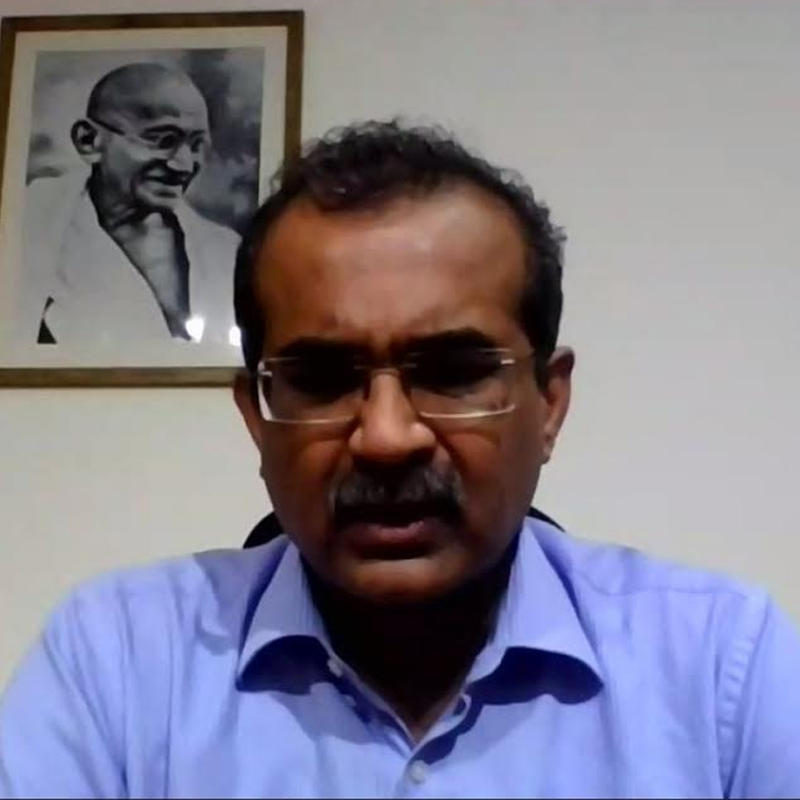
New Delhi: As the government’s stand-off with a few social media companies continues over the new IT rules, ministry of information and broadcasting joint secretary Vikram Sahay said that Digital Media Ethics Code is aimed at addressing the grievances of the common man, and should be viewed as a ‘citizen-centric legislation’.
“Digital Media Ethics Code is aimed at stopping transmission of content which is objectionable to women or harmful to children. Presence of a regulatory body can control and stop the spread of fake news as well as make the publishers accountable. It is essentially citizen-centric legislation,” he said on Tuesday.
The MIB joint secretary was speaking at a webinar on ‘Digital Media Ethics Code’ organised by Press Information Bureau, Maharashtra and Goa for improving stakeholder understanding of Part III of the Information Technology (Intermediary Guidelines and Digital Media Ethics Code) Rules, 2021, that came into effect on 26 May.

India is the world’s fastest growing OTT market and the market is expected to reach $2.9 billion by 2024 which is an annual growth of 28.6 per cent. Sahay said the new rules become all the more important, amid this recent explosion of digital content. “The purpose of the Digital Media Ethics Code is to stop transmission of content which is objectionable to women or harmful to children,” he added.
Elaborating on how the online news portals are the major source of news among Indians under 35 years of age and that there is a 41 per cent increase in time spent on such news apps, Sahay said, “When there are content regulators like Press Council of India for newspapers and Cable TV Network Act, 1995 for News on TV there has been no such regulation for news on digital platforms. Similar is the case for OTTs which do not have a regulation unlike that of Cinema Halls or Television.”
The new rules notified on 25 February, came into effect on 26 May recommend a three-tier mechanism for the regulation of all online media. According to the new IT Rules, social media and streaming companies will be required to take down contentious content quicker, appoint grievance redressal officers and assist in investigations. The rules also seek to regulate the functioning of online media portals and publishers, over-the-top (OTT) platforms and social media intermediaries.
“There will be an inter-departmental committee to deal with unresolved complaints by news publishers or regulatory bodies and for that it is imperative that disclosure of information in public domain regarding grievance redressal by publisher and self-regulating body is done,” said the joint secretary.
Sahay also added that the I & B ministry will collect basic information about people working on news portals or OTT platforms, in a prescribed format by the stakeholders. “More than 1800 of people working on news portals or OTT platforms have already submitted their details to the ministry, where most of them have submitted voluntarily,” he added.
Digital news publishers, representatives of film industry, Over the Top (OTT) platforms and online content producers attended the webinar, along with academicians, researchers, students and officers of state government of Maharashtra and Goa.







MUMBAI: When the numbers go silent, the noise on screen gets a little harder to measure. Ministry of Information and Broadcasting has extended the suspension of television rating data for news channels, directing Broadcast Audience Research Council (BARC) to withhold TRPs for another four weeks. The latest order, issued on March 31, 2026, builds on an earlier directive from March 6 that had paused ratings for a month. The ministry has clarified that the blackout will continue for four weeks or until further instructions are issued whichever comes earlier keeping the industry in a prolonged state of data drought.
The reasoning, officials suggest, lies far beyond domestic screens. With geopolitical tensions in West Asia continuing to escalate, the government has flagged concerns over how such developments could influence news consumption and presentation. The move is aimed at curbing excessive sensationalism and speculative coverage during what it describes as a sensitive global moment.
For the broadcast ecosystem, the absence of Television Rating Points (TRPs) is more than symbolic, it removes the industry’s primary scorecard. Ratings dictate advertising flows, shape editorial strategies and fuel the competitive pecking order among news channels. Without them, broadcasters are effectively operating without a public performance benchmark.
The timing only adds to the complexity. Amid a high-intensity global news cycle, channels must now navigate audience engagement without the weekly feedback loop that typically drives programming decisions. Advertisers, too, are left recalibrating, leaning on proxies such as brand strength, reach and distribution instead of hard viewership data.
While framed as a temporary regulatory intervention tied to maintaining public order, the extended suspension underscores a broader unease about the tone and direction of news coverage. For now, the ratings race is on pause but the battle for attention continues, just without a scoreboard.






