Cable TV
DEN Network fixed-line b’band biz plan hinges on partnerships & leveraging present infra


MUMBAI: With telcos handing out data at cheap rates in various package sizes under innovative schemes, mobile data consumption has increased rapidly in India in the last few years, while the growth of fixed-line broadband (FLBB) users has been tepid, if not completely static. MSO DEN Networks now wants to tap the hitherto unexplored opportunities of FLBB as a business proposition. So, what’s the plan?
Not only DEN wants to use its own and partners’ customer bases in 100 small cities of India, but is also, probably, eyeing the huge FLBB market that will open up as the Indian government ramps up its BharatNet project to provide Internet and broadband services to approximately 250,000 gram panchayats or local village administrations through state-run telcos and third-party service providers, including cable operators.
The reason for hi-speed broadband in 100 cities in 10 Indian states is to try overcome the low returns in big cities and metros. “We have also seen a lot of stress in the fixed line broadband ARPUs of all the major metros, be it Mumbai, Delhi, Bangalore [and] Kolkata,” DEN Networks CEO SN Sharma said during a recent analyst call, going onto add that the ARPUS were low in the “top 10 towns of the country”.


In April, DEN Broadband Pvt. Ltd, a subsidiary of DEN Networks, had announced expansion of its hi-speed internet services to 100 cities across India. After completion, DEN Broadband aims to enable 1.1 crore (11 million) Indian households with high-speed broadband services by 2020 with 20 MB speeds on an average under different sets of packaging and schemes — in contrast to average lower offerings from various telcos.
And, to back its claims, DEN Networks quotes data from international and domestic sources. In a presentation made to investors, the Sameer Manchanda-founded company justified its focus on FLBB by saying that if regulator TRAI’s December 2017 data was to be believed, there were 425 million wireless Internet subscribers, while there were only 18 million FLBB subs. Over the years, Indian FLBB growth has remained static compared to its APAC peers like Australia, China, Vietnam and Thailand.
So, how is DEN going to go about its FLBB plans in 100 cities? The company plans to leverage its existing cable universe and tie-ups with last mile operators by going the franchisee model, leveraging present infrastructure (80 per cent already fibre-enabled), and lower capex and operational costs. Affordable technology like Metro Ethernet and GPON, coupled with standardized technical solutions, customer support from DEN and a pre-paid collect model on B2C basis, according to the company, would make good business sense.
“We have a plan to enable 15 towns in the first quarter. Overall, 100 towns have to be enabled, and you will be surprised that LCOs themselves are approaching us,” Sharma informed an analyst, adding that it was not just a one-way traffic as company execs too were tapping LCOs informing them of the benefits as the infrastructure is already in place and the project could have additional revenue spin-offs for the LCOs. DEN has earmarked Rs. 100 crore (Rs.1 billion) as capex for the FLBB project over the three-year period.
What is fueling DEN’s aspirations? Quoting Singapore-based Media Partners Asia figures, the company presentation told investors that there had been
15X rise year-on-year in Internet data traffic in 2017 with video content contributing 65 per cent of total mobile data traffic apart from the fact that India’s FLBB penetration was expected to increase to 10.3 per cent from the present single digit share by year 2022. Moreover, as content and applications keep getting heavier and denser in size, FLBB high speed broadband solutions could be ideal for offices and homes.
“Our fiber is just 100 meters away from each of the subscriber that is being served by us,” Sharma explained to analysts, adding with broadband ARPUs low in metros and bigger cities it was decided to target the rest of the country that is not only a “virgin area” but has “equally good” demand.
Asked about Reliance Jio’s ambitious plans to rollout broadband services in the country, which can disrupt this segment too, Sharma refused to comment, saying, “I am nobody to comment on others business.”
Also Read :
DEN expands broadband services; plans Rs 100 cr capex
Aim to take phase 3 ARPU to phase 1 value: Den Networks’ SN Sharma
DEN readies Android-based STB for Feb launch
TDSAT rules in favor of DEN Networks, directs ZEE entertainment to provide channels on RIO basis






Cable TV
Hathway Cable appoints Gurjeev Singh Kapoor as CEO
Leadership change comes as cable TV faces shrinking subscriber base and modest earnings pressure
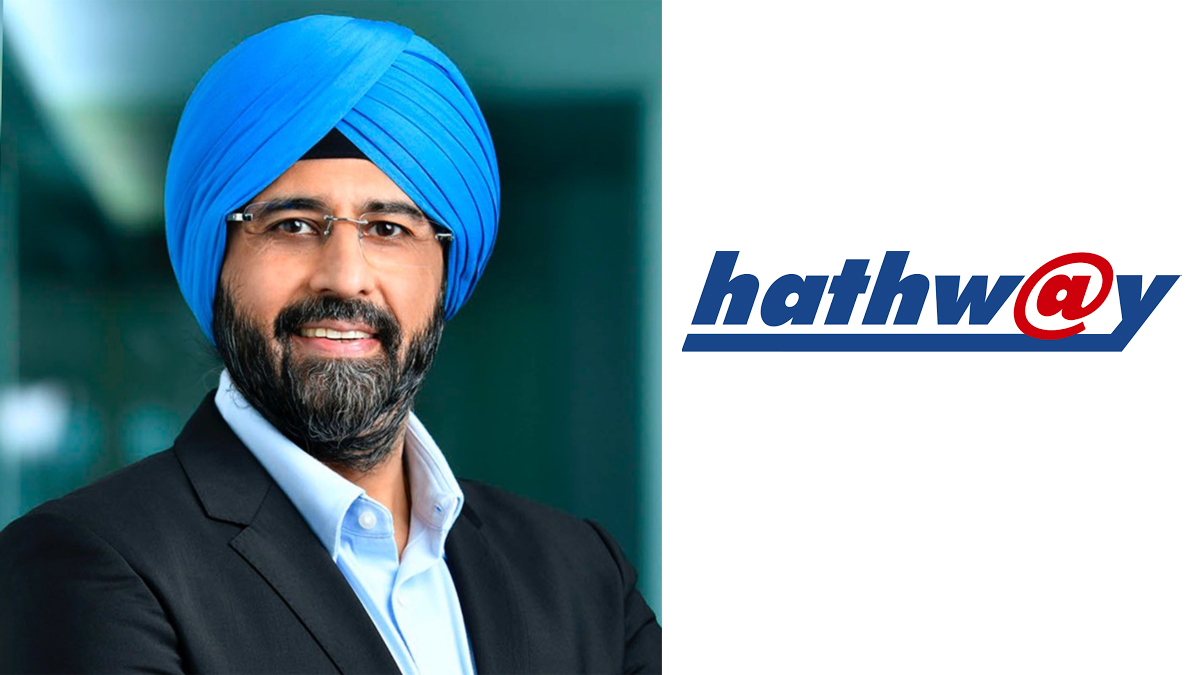
MUMBAI: Hathway Cable and Datacom has tapped industry veteran Gurjeev Singh Kapoor as chief executive officer, marking a leadership pivot at a time when India’s cable television business is under mounting strain.
Kapoor will take over from Tavinderjit Singh Panesar, who is set to retire in August after a long innings with the company. Panesar, chief executive since 2023, has held multiple leadership roles at Hathway, including his latest stint beginning in 2022.
Kapoor brings more than three decades of experience in media and entertainment. He most recently led distribution at The Walt Disney Company’s Star India business, now part of JioStar. His career spans television distribution and affiliate partnerships, with stints at Sony Pictures Networks India, Discovery Communications and Zee Entertainment.
Panesar, with over three decades in the industry, has worked across strategic planning, distribution and business development in media, broadcasting and manufacturing. His past associations include ESPN Star Sports, Star India, Apollo Tyres and JK Industries.
The transition lands as the cable sector grapples with structural disruption. Traditional operators are losing ground to streaming platforms, while telecom and broadband players tighten the squeeze with bundled offerings.
An EY report estimates India’s pay-TV base could shrink by a further 30 to 40 million households by 2030, taking the total down to 71 to 81 million. The slide follows a loss of nearly 40 million homes between 2018 and 2024, a contraction that has already wiped out more than 37,000 jobs in the local cable operator ecosystem.
Hathway’s numbers reflect the strain. The company reported a consolidated net profit of Rs 93 crore for FY25, down from Rs 99 crore a year earlier. Revenue inched up to Rs 2,040 crore from Rs 1,981 crore. As of December 2025, it had about 4.7 million cable TV subscribers and roughly 1.02 million broadband users.
Kapoor steps in with a familiar brief but a shrinking playbook. In a market where viewers are cutting cords faster than companies can reinvent them, the new chief executive inherits a business fighting to stay plugged in.






