Cable TV
Delhi HC removes legal hurdles to implement DAS IV by 1 Jan 2017


NEW DELHI/ MUMBAI: The Delhi High Court has vacated all interim orders giving extension of deadline in Phase III of digitisation, thus clearing legal hurdles for complete digitisation by the stipulated deadline of 31 December 2016 when the last and Phase IV is supposed to get completed.
The court, disposing of pending petitions, directed all petitioners to run a scroll on their networks about digitisation and analog switch-off in two weeks, apart from informing their subscribers in advance about the change-over to digital signals that will require a set-top-box (STB).
Last month, the court overruled orders passed by various other courts in the country and, in eight other cases, vacated the stay where petitioners had sought an extension of deadline for implementing digital addressable system (DAS) in Phase III areas.

While originally the date for implementation of DAS Phase III was 30 September 2014, it was extended to 31 December 2015 by a notification issued by the ministry of information and broadcasting (MIB). The country, as per the original plan, is supposed to be fully digitised with the completion of Phase IV by the last day of 2016.
With the latest court directive, now it’s up to the various industry stakeholders, the government and the regulator to ensure that Phase IV is completed on schedule or as early as possible. Complete digitisation of TV services in the country is expected to bring about more transparency in the system that would benefit all.
Indian Broadcasting Foundation (IBF) president and Zee MD Punit Goenka said, “We welcome all stakeholders into the dawn of a new era and hope that the digitisation bandwagon continues unabated in Phase IV as well, which is to be implemented from 1 January 2017.”
IBF, an apex body of broadcasting companies, has been involved in the cases filed in various courts that were finally transferred to the Delhi High Court under the direction of the Supreme Court. “We were hit by a flurry of litigations, all filed within a space of 15 days beginning with 30 December 2015, in Andhra Pradesh and Telangana. Stays were obtained on implementation for periods of up to two months. Soon, the fire spread to 18 other high courts with over 50 petitions being filed,” said IBF secretary-general Girish Srivastava.
Welcoming the judgement, Siti Networks Limited ED & CEO and president of All India Digital Cable Federation (AIDCF) VD Wadhwa said, “This is a landmark moment in the Digital India journey as it will clear the passage for timely implementation of DAS Phase IV. It is now obligatory on part of broadcasters and other players to disconnect analog signals within two weeks. This will also pave the way for digital revenues to flow in from these areas.” AIDCF is an industry body representing digital MSOs.
According to Hinduja Group CEO-Media Tony DSilva, “It’s a positive step in the direction of digitisation. I would appreciate if MIB comes out with a clarification on final cut-off date for digitisation and be more realistic in the dates for Phase IV.”
DEN CEO S N Sharma, terming the court direction as positive, said that the demand (for STBs) would increase as the legal question marks over DAS have been cleared.
Background To Legal Cases Relating to Digitisation
A total of 62 cases had been filed in different courts and 29 cases had been transferred by various courts to Delhi by July-end. Of the 62 cases, 12 had been disposed off by respective courts and three cases had been withdrawn by the petitioners.
While the Andhra Pradesh and Telangana High Court had given orders extending the deadline of 31 December 2015 for Phase III, the Bombay High Court, while referring to a judgement, had said that if similar situation prevails in all states, then the stay can be pan-India. This was because the plea taken by petitioners in high courts was shortage of STBs.
Ministry of Information and Broadcasting (MIB) had admitted that the Law Ministry had observed the order passed by the Andhra Pradesh High Court staying Phase III “appears to have all-lndia applicability”.
Indiantelevision.com had reported in January this year that MIB had told the Punjab and Haryana High Court it had “decided not to press the requirement of having a STB as for now till the decision of the cases, which are pending before various other high courts”.
Sensing the wildfire effect the DAS Phase III cases could have, MIB approached Supreme Court with a plea to transfer all similar cases to one high court and the apex court asked Delhi High Court in April 2016 to handle these cases and directed notices to be sent to all other high courts to forward relevant files to Delhi HC.
Also Read:
DAS cases put off to 23 Nov as legal processes incomplete
Siti Networks CEO V.D. Wadhwa hails dismissal of DAS III cases by Delhi HC




Cable TV
Hathway Cable appoints Gurjeev Singh Kapoor as CEO
Leadership change comes as cable TV faces shrinking subscriber base and modest earnings pressure
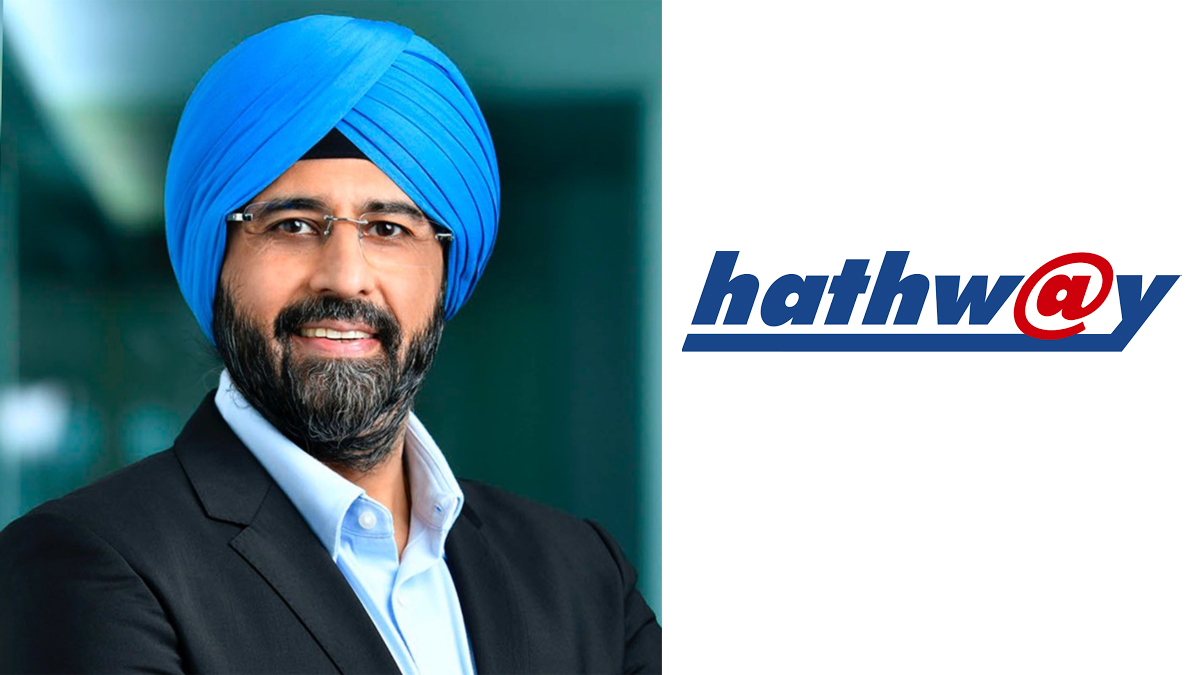
MUMBAI: Hathway Cable and Datacom has tapped industry veteran Gurjeev Singh Kapoor as chief executive officer, marking a leadership pivot at a time when India’s cable television business is under mounting strain.
Kapoor will take over from Tavinderjit Singh Panesar, who is set to retire in August after a long innings with the company. Panesar, chief executive since 2023, has held multiple leadership roles at Hathway, including his latest stint beginning in 2022.
Kapoor brings more than three decades of experience in media and entertainment. He most recently led distribution at The Walt Disney Company’s Star India business, now part of JioStar. His career spans television distribution and affiliate partnerships, with stints at Sony Pictures Networks India, Discovery Communications and Zee Entertainment.
Panesar, with over three decades in the industry, has worked across strategic planning, distribution and business development in media, broadcasting and manufacturing. His past associations include ESPN Star Sports, Star India, Apollo Tyres and JK Industries.
The transition lands as the cable sector grapples with structural disruption. Traditional operators are losing ground to streaming platforms, while telecom and broadband players tighten the squeeze with bundled offerings.
An EY report estimates India’s pay-TV base could shrink by a further 30 to 40 million households by 2030, taking the total down to 71 to 81 million. The slide follows a loss of nearly 40 million homes between 2018 and 2024, a contraction that has already wiped out more than 37,000 jobs in the local cable operator ecosystem.
Hathway’s numbers reflect the strain. The company reported a consolidated net profit of Rs 93 crore for FY25, down from Rs 99 crore a year earlier. Revenue inched up to Rs 2,040 crore from Rs 1,981 crore. As of December 2025, it had about 4.7 million cable TV subscribers and roughly 1.02 million broadband users.
Kapoor steps in with a familiar brief but a shrinking playbook. In a market where viewers are cutting cords faster than companies can reinvent them, the new chief executive inherits a business fighting to stay plugged in.







