News Broadcasting
Deal signed, ABP holds 74% in Star News holding company MCCS


MUMBAI / NEW DELHI: In the end the “bhadralok” from Bengal, Aveek Sarkar, held firm and had his way in the matter of how much stake his Ananda Bazar Patrika Group would hold in the reconstituted Media Content and Communications Services India Pvt Ltd (MCCS).
The agreement signed today between ABP Pvt Ltd and the Star Group gives the West Bengal-based media company 74 per cent and Star 26 per cent in the augmented paid-up equity share capital of MCCS. Sarkar will have to cough up Rs 750 million for his 74 per cent stake, which means MCCS is being valued at a little over Rs 1 billion.
The new joint venture company MCCS, which is responsible for the broadcast of Star News, has been formed to comply with the revised government guidelines for the uplink of news channels out of India.

Accordingly, the board of directors of MCCS is also being reconstituted. Information available with indiantelevision.com indicates that there will be six members on the MCCS board headed by Sarkar himself. Ravina Raj Kohli continues as president of Star News, as too Sanjay Pugalia as news director of the channel.
MCCS, which will probably be filing a fresh uplink application before the government on Monday, will now reportedly be doing so as an ABP Group company in which Star is the minority stakeholder. Additionally, companies that Star News was outsourcing from like Touch Telecontent (India) Pvt Ltd (for infrastructure support) and Rent Works Ltd, are reportedly to be merged with MCCS.
What will be the arrangement as far as Hughes Software Systems Ltd, which supplies newsgathering and connectivity-related equipment to MCCS, is not immediately clear. It is reasonable to assume that Hughes remains out of the ambit of this merger. It may be recalled that US-based Hughes Electronics (which is in the process of being bought over by News Corp) owns 55.44 per cent equity stake in Hughes Software Systems Ltd.
A question that arises is what happens to the former stakeholders in MCCS? While Vir Sanghvi is out of the country and former largest stakeholder in MCCS Suhel Seth was unavailable for comment (as too Hemendra Kothari of DSP Merill Lynch), indiantelevision.com did manage to elicit a response from Jeetendra, chairman of Balaji Telefilms. Jeetendra, who held a 5 per cent stake in the earlier restructured MCCS, said the shares he’d held had already been returned. Queried as to what the terms were, he said Star had repaid the nominal amount he’d put down for the shares.
Commenting on the developments ABP managing director A Lahiri said, “This alliance is in line with the ABP Group’s strategy to get into the fastest growing media space from our traditional area of expertise, which is print media. Our partnership with Star Group will enable us to gain in terms of scope, scale and influence. In turn, ABP’s 80 years of history and expertise in content making will add value to Star News.”
Star India CEO Peter Mukerjea had this to say: “In ABP we found a strong media partner that shares our vision for Star News – providing Indian viewers, news that is unbiased and relevant to our country. We have great faith and confidence that a partnership such as this – of two leading media companies will be a stepping stone into a very positive future for our viewers, advertisers, cable operators and all stake holders.”
Star News came into being in its current avatar in April after its content contract with Prannoy Roy’s NDTV ceased. The Hindi news channel is headquartered in Mumbai, has a super bureau in Delhi and 19 regional bureaux across the country.






News Broadcasting
UDF poised to return to power in Kerala, says Manorama-CVoter survey
Massive opinion poll projects shift in Kerala politics ahead of 2026 Assembly elections.
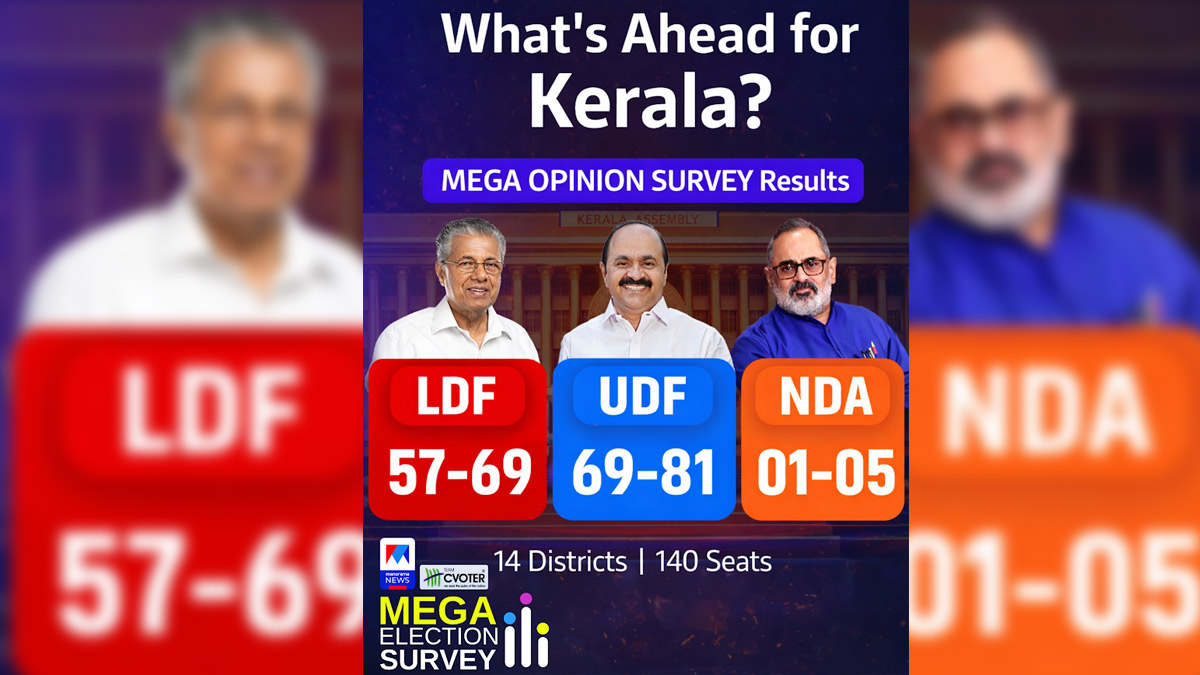
MUMBAI: The winds of change appear to be blowing through Kerala’s political landscape and this time, they seem to favour the United Democratic Front. A comprehensive mega opinion survey conducted by Manorama News in partnership with CVoter projects a potential comeback for the UDF in the upcoming Kerala Legislative Assembly Elections 2026. The survey, covering all 140 constituencies with a massive sample size of nearly 90,000 respondents, predicts the UDF could win between 69 and 81 seats.
The ruling Left Democratic Front (LDF) is expected to secure 57 to 69 seats, a significant drop from the 99 seats it won in the 2021 elections. This would mean the LDF losing 30 to 42 of its sitting seats. Meanwhile, the National Democratic Alliance (NDA), which drew a blank in 2021, is projected to open its account with 1 to 5 seats.
Region-wise, the UDF is expected to make strong gains in Malabar, winning 25 to 34 out of 48 seats, and in Central Kerala, where it could bag 29 to 33 out of 53 seats. In South Kerala, the LDF is likely to retain an edge with 21 to 25 seats, while the UDF may improve to 12 to 16 seats. The NDA could pick up 1 to 3 seats in the southern region.
The survey was conducted between 14 and 26 March 2026, with additional tracker and snap polls carried out from December 2025 to March 2026. A total of 89,693 respondents participated, ensuring representation across all demographics and social segments.
Manorama News has a strong track record of accuracy, with its previous projections closely matching the actual results of the 2019 and 2024 Lok Sabha elections as well as the 2021 Kerala Assembly polls.
In Kerala’s famously fierce political battles, this survey suggests the pendulum may be swinging back. Whether the final verdict matches these numbers or throws up another surprise, one thing is clear, the 2026 Assembly elections are shaping up to be one of the most keenly watched contests in the state’s history.






