News Broadcasting
DD struggles to meet revenue target; Quraishi blames cricket

NEW DELHI: Doordarshan is “struggling” to meet its annual revenue target, a senior official of Prasar Bharati said today.
While speaking to the journalists about Doordarshan’s programming line up for Gulf War coverage in collaboration with Saeed Naqvi’s Third Eye, Doordarshan director-general SY Quraishi today admitted: “I know it’s already February, but we are struggle a bit to meet our (annual) revenue target.”
According to Quraishi, during the last financial year, which ended on 31 March 2002, DD had netted a total revenue of about Rs 625 billion.

Quraishi reiterated that the fall in the revenue this year is because of the “unrealistic” high amount of money that had come in last year, courtesy two deals that have fallen apart now. The two deals, which he mentioned, were the HFCL-Channel Nine deal for DD Metro and Budha Films’ marketing rights for cricket on DD.
Quraishi also pointed out that because of the poor performance of the Indian cricket team at the World Cup, revenues of the national broadcaster may get hit.
The DG said: “Looking at the continuing bad performance of Indian team, DD may end up making slightly less revenue than that projected,” adding that the revenue sharing will be also contribute to the loss. DD and Nimbus are in a 20:80 revenue sharing deal; this is apart from a minimum guarantee money promised by Nimbus for the cricket matches.
DD is airing 16 matches live on DD national, while another 27 matches are being aired on DD Metro a day after the match has being played.
Quraishi also mentioned that DD will be doing some live programming as part of its Union Budget special on 28 February. According to the data, last year’s coverage, including the Railway Budget, got DD 95 per cent viewership.
DD had been allocated Rs.800 million by the Planning Commission for fresh programming . Quraishi said that “efforts are to utilise the fund on commissioning programmes, especially for DD Bharati.”
Meanwhile, Third Eye will be getting Rs 500,000 per day for Gulf war coverage. Quraishi explained the outsourcing will be a “safe bet without risking our own employees.






News Broadcasting
Network18 channels lead YouTube news viewership in March 2026
CNN-News18, News18 India and CNBC channels top categories with record views
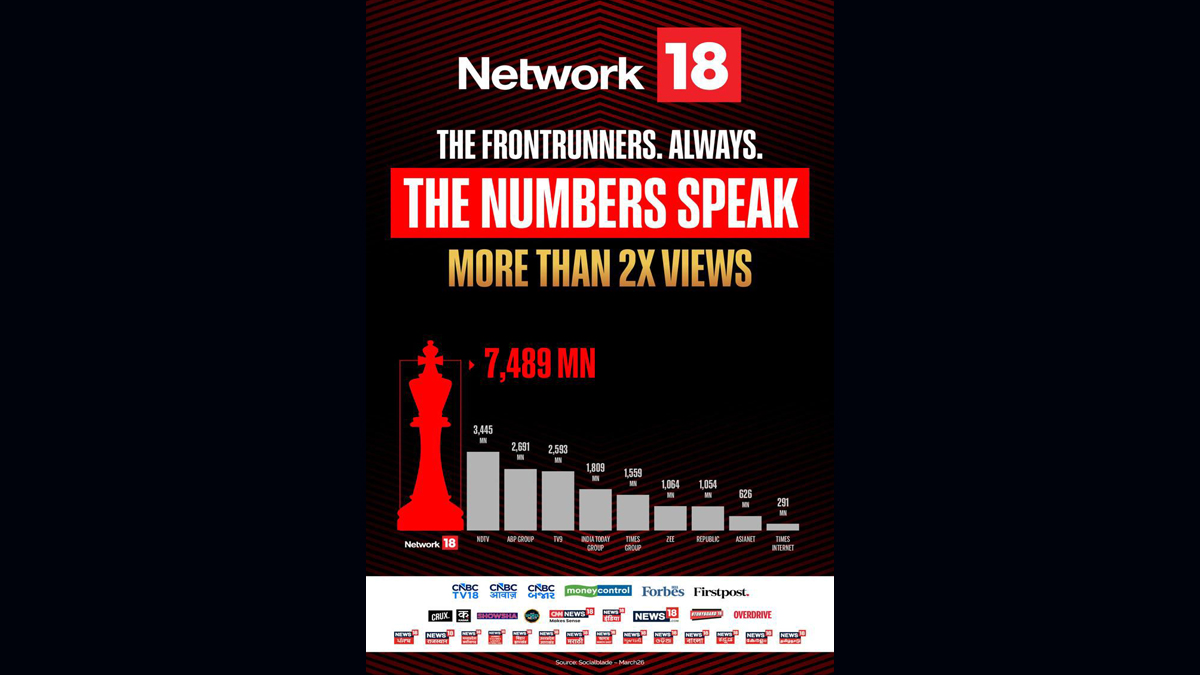
MUMBAI: When the world hit refresh on breaking news, Network18’s channels were already streaming ahead. As geopolitical tensions and war-driven headlines fuelled a surge in global news consumption, the network’s digital playbook delivered big clocking record Youtube viewership across English, Hindi and business news categories in March 2026.
At the forefront was CNN-News18, which emerged as the clear leader in the English news segment with 130 million live and video-on-demand views. The channel edged past competitors such as Times of India (126.5 million), Times Now (101.1 million), India Today (88.2 million) and NDTV (77.5 million), according to Databeings data for March.
In the Hindi news arena, News18 India delivered a commanding performance, racking up a staggering 3,297 million views on YouTube. The channel comfortably outpaced NDTV India, which recorded 3,119 million views, underlining its deep reach and consistent engagement with mass audiences, as per Playboard data.
The network’s dominance wasn’t confined to general news. In the Hindi business segment, CNBC Awaaz topped the charts with 92 million views, narrowly ahead of Zee Business (90 million) and well ahead of ET Now Swadesh (57 million). Meanwhile, its English counterpart CNBC-TV18 posted a strong 58 million views, reinforcing the network’s cross-category strength.
The spike in viewership reflects a broader shift in audience behaviour, with viewers increasingly turning to digital platforms particularly Youtube for real-time updates and in-depth coverage during high-intensity news cycles. For Network18, the numbers signal more than just scale; they underline the effectiveness of a multi-platform strategy that blends speed, credibility and continuous coverage.
In a month where the news never paused, it seems viewers chose to stay tuned where the stream never stopped.






