News Broadcasting
DD, AIR call off strike for time being


NEW DELHI: The programming staff association of Doordarshan and All India Radio have deferred a decision to go on strike from today. The decision comes after an assurance of redress of their grievances from Prasar Bharati chief executive K S Sarma and Information and Broadcasting secretary Pawan Chopra, after a series of meetings held last week.
However, indiantelevision.com learns that it has been conveyed to the authorities concerned, that the various contentious issues should be resolved as soon as possible and a broad decision should be arrived at, preferably, within a week’s time.
Pointing out that he appreciates the association’s decision to defer the proposed strike, which would have certainly affected DD and AIR’s functioning partly, chief executive of Prasar Bharati, K S Sarma, said, ” Meetings were held both at Prasar Bharati and the information and broadcasting ministry last week and we are seized of the matter. Ways to redress grievances of the programming staff are being worked out.”

Till the time of writing this report, the association representatives could not be contacted for comments on latest developments.
The programming staff association,one of the three associations in Prasar Bharati, while threatening to start a stir, had said in a statement last week, “The association is trying to attract attention of the authorities towards the acute shortage of programme staff which is hampering the efforts to meet competition from other channels and increase the revenue of the organisation to make it self reliant.”
Indiantelevision.com also learns from government sources that I&B secretary Chopra met up with the association representatives on Saturday and conveyed to them that a package involving promotion and training of programming staff has been almost finalised by the ministry for implementation soon.
“In the wake of all this, the association was requested to reconsider its decision to go on strike from this week,” a government source said, adding that the association in-principle agreed to defer the proposed stir for some time.
However, there seems to be some rift amongst the three associations in Prasar Bharati that still functions like a government organisation with unions often holding authorities to ransom in a bid to make them agree to their demands.
The other two associations – the programming welfare association and the one which has Indian Information Service employees as its members, are not part of the proposed stir. Government sources also indicated that the present stir threat is nothing but “arm-twisting tactics,” especially when a ‘babu’ culture of mediocrity still rules Prasar Bharati.
DD and AIR has about 13,000 programming staff on its rolls as part of a 40,000-odd employee base of Prasar Bharati Corporation that has been modeled on another public service broadcaster, British Broadcasting Corporation.






News Broadcasting
News18 India launches Command Centre war explainer with Arya
New show shifts from debates to decoding global conflicts and impacts
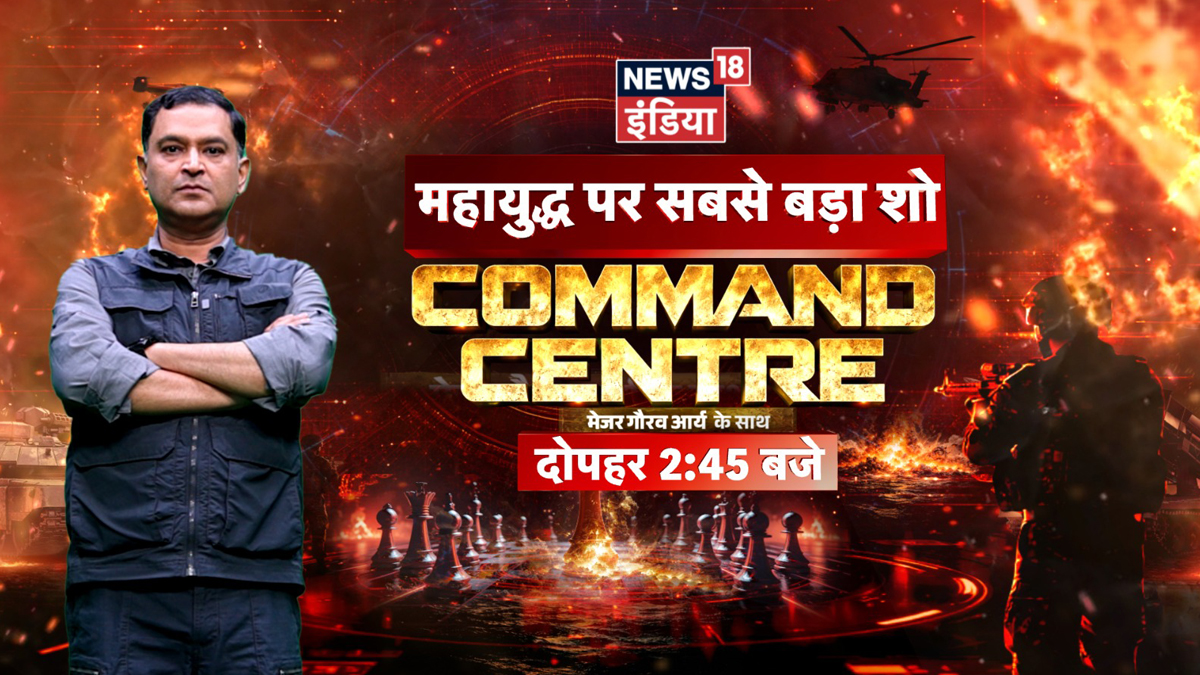
MUMBAI: News18 India has rolled out a new war-focused programme, Command Centre, featuring Gaurav Arya, as it looks to offer viewers a sharper, more grounded take on global conflicts amid rising tensions in West Asia.
Positioned as an “insider war room”, the show moves away from conventional panel debates and instead focuses on explaining military developments, decoding strategy and connecting global events to their everyday impact, from fuel prices to economic shifts.
The format leans heavily on visuals and data. The studio has been designed like a command hub, complete with large LED war maps, real-time graphics and an alert system to track developments as they unfold.
At the centre of it all is Arya, who brings his military background to simplify complex war strategies for viewers. His signature line, “Seedhi baat samjhiye”, anchors the show’s promise of clarity over noise.
News18 India managing editor Jyoti Kamal said, “Command Centre, featuring Major Gaurav Arya is designed to deliver accurate insights and a clear perspective on how evolving conflicts impact everyday life, from household budgets to national security. With expert voices analysing every development in real time, the show goes beyond headlines to decode what’s happening now, what it means, and what could come next.”
Echoing the intent, Gaurav Arya added, “In times of war, confusion is the biggest threat. With News18 India’s Command Centre, we are bringing viewers inside the war room, decoding strategies, tracking every escalation, and explaining, in the simplest terms, what it means for India and for every household. Seedhi baat samjhiye, this is where you understand not just what is happening, but what happens next.”
The weekday show will air in the afternoon slot and will also feature Gaurav Shukla, adding to its editorial depth.
With its mix of analysis, visuals and a clear focus on impact, the show reflects a broader shift in news consumption. Viewers are no longer just watching events unfold, they are looking to understand what those events mean for them.







