English Entertainment
DC Entertainment: The superhero of television

MUMBAI: Long before she became famous as Susan Meyer of Desperate Housewives, Teri Hatcher played Louis Lane in the cult 90’s series Lois and Clark: The New Adventures of Superman. This was one of the first few series produced in association with DC Comics after Superboy (1988 – 1992).
It ran from 1993 to 1997 and soon afterwards was on Star World India during the late 90s.

In 2001, Tom Welling, with the blessing of the original Superman, Christopher Reeve, donned the superhero’s cape in Warner Bros’ (WB) original production, Smallville that won both critical acclaim and commercial success.
It enjoyed an average viewership of 8.7 million and WB’s second-best 18-49 adult rating ever, according to Media Life Magazine.
The series follows the adventures of Clark Kent right from his pre-Superman days in the fictional town of Smallville in Kansas to his career at the Daily Planet while introducing other DC comics superheroes and villains.
As earlier reported by indiantelevision.com, Smallville was aired in India on Star World with the first few seasons on Wednesday nights at 8 pm, later moving to Saturdays at 7 pm before being pulled off air.
In an earlier interview with the website, Star English Entertainment business head, Kevin Vaz had reasoned, “Since moving Smallville to Saturdays, we weren’t receiving as much traction from the audience as we did during its initial run on Wednesday nights, and there was also new content then which received good response from the audience. Ergo, we had to discontinue airing the new seasons of the series.”
Smallville was a milestone in the journey of DC Comics’ Entertainment, which created a niche for itself in the global television market with the series.
Buoyed by its success, DC followed suit with Human Target, which however, failed to get the viewership it deserved and was hence taken off schedule and eventually cancelled. All the same, the series did air in its entirety on Warner Bros’ Indian channel, WB India.
DC’s TV endeavours post Human Target have met with much greater success.
In 2012, The CW, formed as a result of the merger between WB and Columbia Broadcasting System (CBS), ordered its first drama series based on a DC Comics character Green Arrow.
Arrow revolves round billionaire playboy Oliver Queen, portrayed by Stephen Amell (Dante’s Cove, New Girl), who, after five years of being stranded on a hostile island, returns home to fight crime and corruption as a secret vigilante with a bow and arrow as his ammo of choice. As the series develops, more characters from DC Comics were introduced like Black Canary and The Flash.
Coming to 2014, DC Entertainment has five new properties currently in production with various broadcast and cable networks.
Arrow, the CW Original series has made way for The Flash, an upcoming American television series developed by the writers and executive producers of Arrow. It will be based on the DC Comics character Flash reprised by Barry Allen, a Central City assistant police forensic investigator who by virtue of being caught in a chemical explosion, gets the power of superhuman speed.
The second new property is Gotham, an upcoming television series by Bruno Heller, creator of the Golden Globe and Emmy Award-nominated series Rome and The Mentalist. As the title suggests, Gotham is based on the DC Comics characters Detective James Gordon and Bruce Wayne created by Bob Kane and sundry other characters in the Batman franchise. Interestingly, the series will go into the origins of iconic villains like the Penguin, the Riddler, Cat woman, Two-Face, the Joker, Poison Ivy and Scarecrow. According to inside sources, both The Flash and Gotham might premiere on Star World Premiere HD.
The third newbie is Vertigo, based on an imprint of DC Comics originally created to do stories that could not meet the stringent guidelines of the Comics Code Authority.
NBC’s upcoming supernatural series Constantine is based on DC Comics’ wildly popular series Hellblazer which revolves round seasoned demon hunter and master of the occult, John Constantine, who specializes in “giving hell… hell”.
Given the number of Warner Bros Television and DC Comics properties acquired by Indian broadcasters in the past, one can expect Constantine to end up airing on Star World, Zee Cafe or AXN.
The CW’s upcoming drama series iZombie is loosely based on the series created by Chris Roberson and Michael Allred and published by DC Comics’ Vertigo imprint.
iZombie, developed by Veronica Mars creator Rob Thomas, revolves round a medical student who becomes a zombie, and joins a Coroner’s Office to gain access to the brains she must reluctantly eat so that she can maintain her humanity. For every brain she eats though, she also inherits its memories and must now solve the deaths of these persons with help from the Medical examiner and a police detective.
Also, American Movie Classics (AMC) Network – home to Emmy and Golden Globe Award winning drama series like Mad Men and Breaking Bad – in association with Sony Television, will soon bring to the small screen the satirical and supernatural comic series, Preacher, with comedy writers/actors Seth Rogen (Knocked Up, Superbad) and Evan Goldberg (Neighbours, This is the End) spearheading the project for the cable network.
Preacher follows hardened Reverend Jesse Custer. Accompanied by his ex-girlfriend and a vampire named Cassidy, he searches for God after finding out he has left heaven. The series’ antagonist is Saint of Killers, a Western lone gunman type, hell-bent on killing Jesse.
Since iZombie will air midseason next year and Preacher is still in development, it is too early to speculate on which Indian broadcaster will air these adaptations.
While the past decade has seen a slew of movies (The Dark Knight trilogy, Green Lantern, Superman: Man of Steel and the upcoming Batman vs. Superman: Dawn of Justice) based on a wealth of characters from DC Comics, perhaps it’s time television followed suit as well!





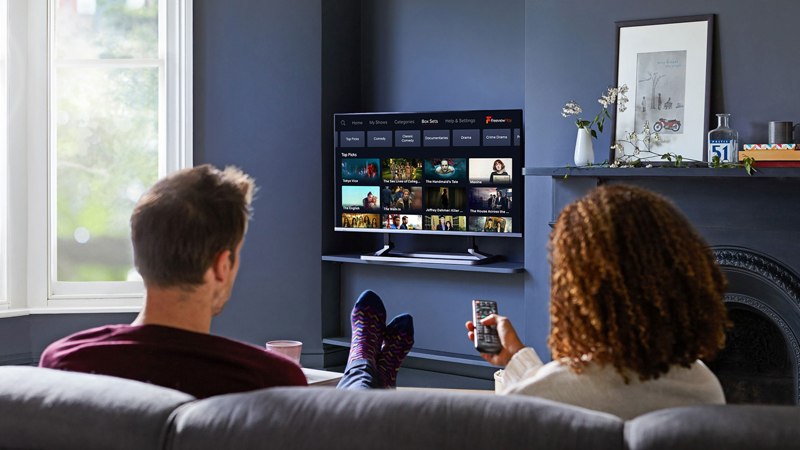
UK: The aerial is losing its grip. As broadband becomes the default way Britons watch television, the UK is edging towards a decisive, and divisive, question: should Freeview be switched off by 2034? The issue, highlighted in reporting by The Guardian, has exposed deep fault lines over access, affordability and the future of public service broadcasting.
For nearly 25 years, Freeview has delivered free-to-air television from the BBC, ITV, Channel 4 and Channel 5 to almost every corner of the country. Even now, it remains the UK’s largest TV platform, used in more than 16m homes and on around 10m main household sets. Yet the same broadcasters that built it are now pressing for its closure within eight years.
Their case rests on a structural shift in viewing. Smart TVs, superfast broadband and the Netflix-led streaming boom have pulled audiences online. Advertising economics have followed. By 2034, the number of homes using Freeview as their main TV set is forecast to fall from a peak of almost 12m in 2012 to fewer than 2m, making digital terrestrial television, or DTT, increasingly costly to sustain.
But critics say the rush to switch off risks abandoning those least able, or least willing, to move online.
“I don’t want to be choosing apps and making new accounts,” says Lynette, 80, from Kent. “It is time-consuming and irritating trying to work out where I want to be, to remember the sequence of clicks, with hieroglyphics instead of words. If I make a mistake I have to start again.”
Lynette is among nearly 100,000 people who have signed a “save Freeview” petition launched by campaign group Silver Voices. She fears the government is about to “take [Freeview] away from me and others who either don’t like, can’t afford, or can’t use online versions”.
Official figures underline the fault lines. A report commissioned by the Department for Culture, Media and Sport estimates that by 2035, 1.8m homes will still depend on Freeview. Ofcom’s analysis shows those households are more likely to be disabled, older, living alone, female, and based in the north of England, Wales, Scotland and Northern Ireland.
Freeview is owned by the public service broadcasters through Everyone TV, which also operates Freesat and the newer streaming platform Freely. After two years of review, DCMS is expected to set out its position soon, drawing on three options proposed by Ofcom: a costly upgrade of Freeview’s ageing technology; maintaining a bare-bones service with only core PSB channels; or a full switch-off during the 2030s.
The broadcasters have rallied behind the third option. They argue that 2034 is the logical cut-off, when transmission contracts with network operator Arqiva expire. By then, they say, the cost of broadcasting to a dwindling audience will far outweigh the returns from TV advertising.
Ofcom agrees a crunch point is approaching. In July, the regulator warned of a “tipping point” within the next few years, after which it will no longer be commercially viable for broadcasters to carry the costs of DTT.
Others see risks beyond economics. Questions remain over whether internet TV can reliably deliver emergency broadcasts, such as the daily Covid updates, in the way that universally available DTT can. The UK radio industry has also warned that an internet-only future for TV could push up distribution costs and force some radio stations off air if PSBs no longer share Arqiva’s mast network.
“It is a political hot potato,” says Dennis Reed, founder of Silver Voices, who says he has “dissociated” his organisation from the government’s stakeholder forum, which he believes is “heavily biased” towards streaming.
The Future TV Taskforce, representing the PSBs, counters that moving online could “close the digital divide once and for all”. “We want to be able to plan to ensure that no one is left behind,” a spokesperson says, adding that rising DTT costs could otherwise mean cuts to programme budgets.
The numbers show the scale of the challenge. Of the 1.8m Freeview-dependent homes projected for 2035, around 1.1m are expected to have broadband but not use it for TV. The remaining 700,000 are forecast to lack a broadband connection altogether.
Veterans of the analogue switch-off, completed in 2012 after 76 years, recall similar fears of “TV blackout chaos”. Around 6 per cent of households were labelled “digital refuseniks”, yet a targeted help scheme and a national campaign, fronted by a robot called Digit Al voiced by Matt Lucas, delivered a largely smooth transition.
This time, the BBC is less keen to foot the bill. Tim Davie, the outgoing director general, has said the corporation should not fund a comparable support programme for a Freeview switch-off.
Research for Sky by Oliver & Ohlbaum suggests that with early awareness campaigns and digital inclusion measures, only about 330,000 households would ultimately need hands-on help ahead of a 2034 shutdown.
Meanwhile, viewing habits continue to fragment. Audience body Barb says 7 per cent of UK households no longer own a TV set, choosing to watch on other devices. In December, YouTube overtook the BBC’s combined channels in total UK viewing across TVs, smartphones and tablets, albeit measured at a minimum of three minutes.
That shift may accelerate. YouTube has recently blocked Barb and its partner Kantar from accessing viewing session data, limiting transparency just as online platforms consolidate power.
“When the government chose British Satellite Broadcasting as the ‘winner’ in satellite TV it was Rupert Murdoch’s Sky instead that came out on top,” says a senior TV executive quoted by The Guardian. “There already is such an outsider ready to be the winner in the transition to internet TV; it is YouTube.”
Freeview’s future now hangs on a familiar British dilemma: modernise fast and risk exclusion, or protect universality and pay the price. Either way, the aerial’s days as king of the living room look numbered.







