Hindi
Darshan denied bail; industry lambasts KFPA for Nikitha Thukral ban


BANGALORE: The potboiler drama of Sandalwood actor Darshan bashing up his wife is showing no signs of conclusion. Bangalore‘s first additional chief metropolitan magistrate Venkatesh Ulagi dismissed his bail petition yesterday and ordered him to remain under judicial custody.
One of the reasons for the court rejecting his bail plea could be that the First Information Report (FIR) filed by his wife Vijaylakshmi at the Vijaynagar Police Station on 9 September speaks of a sordid history of abuse, despite her giving a different version later. The medical report of his wife, on being admitted to the hospital, belies her later claim that she had slipped in the bathroom and sustained injuries.
Meanwhile, people across the industry and various walks of life have come in support of Nikitha Thukral against the unilateral ban imposed on her by the Karnataka Film Producers Association (KFPA). The KFPA had announced a three-year acting ban on the actress, blaming her for the marital discord in Darshan‘s personal life. Allegedly, over the last few years, Darshan has had liaisons with a number of women.
Thukral is a North Indian – a Punjabi, who has acted in around 30 Tamil, Telugu, Kannada and Hindi films. She has denied any ‘other than professional‘ association with Darshan.
All the three actor sons of the doyen of the Kannada Film industry, the late Dr. Rajkumar, have condemned the KFPA saying that it was an irresponsible act and that no association could interfere in the personal affairs of anybody.
The Rajkumar family is known as the first family of Sandalwood and its members wield a considerable amount of power in the industry since they are big producers, distributors and actors. Amongst the other big names from Sandalwood who support Thukral include Ambreesh, Tara and Kannada Cine Artistes Association (KCCA) secretary Doddanna.
A number of people have questioned the KFPA‘s high handedness in blaming the woman and not banning Darshan too; if at all the ban had to be enforced.
Darshan‘s incarceration has put on hold four film projects which are under various stages of production and have cost about Rs 300 million to date. Amongst the four movies is ‘Kranthiveera Sangoli Rayanna‘ (KSR) which is about 80 per cent complete and on which the producers have reportedly spent around Rs 120 million to date. Darshan and Thukral play the lead roles in KSR. The other affected movies are ‘Virat‘, ‘Chingari‘ and ‘Sarathi‘.




Hindi
Remembering Gyan Sahay, the lens behind film, television and advertising
From a puppet rabbit selling poppadums to Hindi cinema, he framed it all.
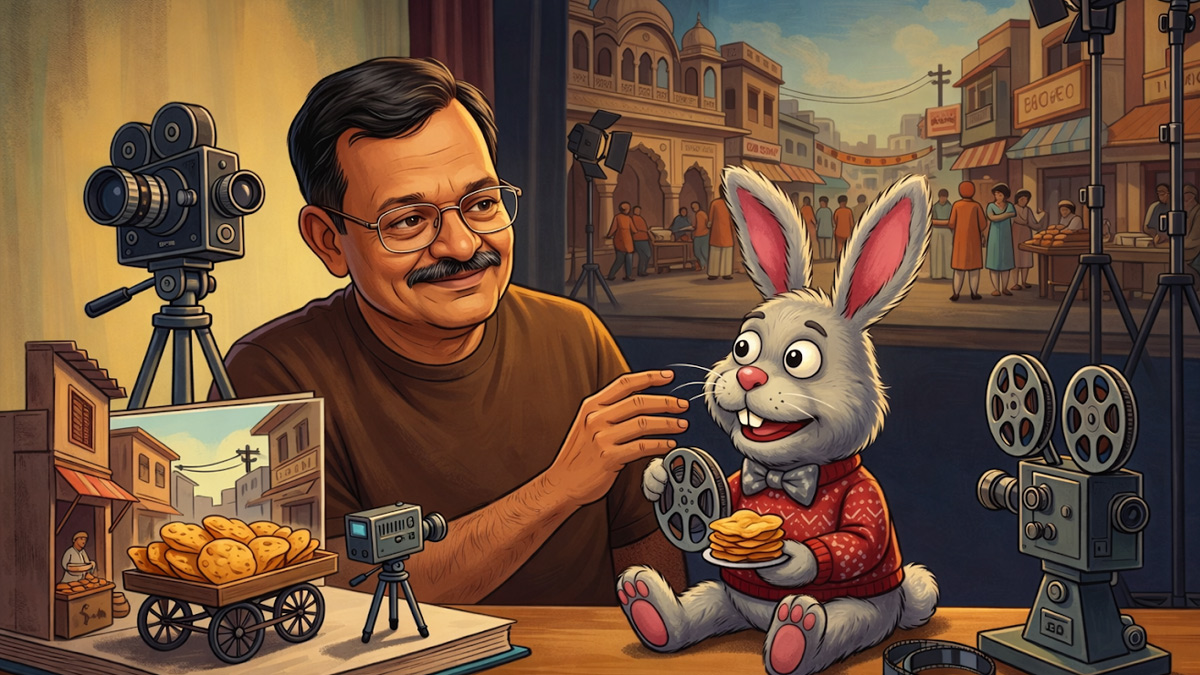
MUMBAI: There are careers, and then there are canvases. Gyan Sahay, the veteran cinematographer, director, and producer who passed away on 10 March 2026 in Mumbai, had one of the latter. Over several decades in the Indian film and television industry, he turned lenses, lights, and the occasional puppet rabbit into something approaching art.
A graduate of the Film and Television Institute of India (FTII) in Pune, Sahay built his reputation as a director of photography across a career that stretched from the early 1970s all the way to the digital age. He was the kind of craftsman who understood that a well-composed shot is not merely a technical achievement but a quiet act of storytelling.
For most Indians of a certain age, however, Sahay will forever be the man behind the rabbit. His direction of the iconic long-running television commercial for Lijjat Papad, featuring its now-legendary puppet bunny, gave the country one of its most cheerfully persistent advertising images. It was the sort of work that sneaks into the national subconscious and takes up permanent residence.

His big-screen credits as cinematographer include Anokhi Pehchan (1972), Pagli (1974), Pas de Deux (1981), and Hum Farishte Nahin (1988). In 1999, he stepped behind a different kind of camera altogether, making his directorial debut with Sar Ankhon Par, a drama that featured Vikas Bhalla and Shruti Ulfat, with a cameo by Shah Rukh Khan for good measure.
On television, Sahay was particularly prized for his command of multi-camera production setups, a skill that made him a go-to technician for large-scale shows and reality programmes. In an industry that has never been especially patient with complexity, he was the calm hand on the rig.
In later life, Sahay turned teacher. He participated regularly in masterclasses and Digi-Talks, often hosted by organisations such as Bharatiya Chitra Sadhna, sharing hard-won wisdom on cinematography, the comedy of timing in a shot, and the sweeping changes brought by the shift from celluloid to digital. He was also said to have been involved in a project concerning a biographical film on Infosys co-founder N.R. Narayana Murthy.
Tributes from the film industry poured in following the news of his passing, with colleagues remembering him as a senior cameraman who served as a rare bridge between two entirely different eras of Indian cinema. That is, perhaps, the finest thing one can say of any craftsman: he kept up, and he brought others along with him.







