iWorld
Cyberbullying may lead to depression in Asian kids

MUMBAI: Telenor Group, on this Safer Internet Day 2017, released results from a survey of parents and adults across Asia in order to give greater visibility of the types of digital bullying affecting youth and how they deal with it. The survey was conducted over Facebook with 320 respondents primarily from Bangladesh, India, Malaysia, Myanmar, Pakistan, Singapore, Thailand and other Asian countries. While cyberbullying exists across all countries, the respondents said that they are discussing cyberbullying with youth and feel that resilience is being built, which may help them tackle digital abuse or better empathize with victims. The survey targeted Facebook users from 18-64 with stated interests in parenting, family issues, child welfare and online security.
“In the lead up to Safer Internet Day, we conducted this digital survey to keep on the pulse of the ever-evolving arena of digital bullying, to see how it affects children in Asia, and what both adults and children can do about it,” says Telenor Group director – Social Responsibility Zainab Hussain Siddiqui. “Encouragingly, across Asia,we see examples of awareness-building efforts – on the part of our company and many others – reaching scores of children, parents and school teachers. And we hope this is leading to more resilience against online mistreatment.”
Telenor India’s WebWise, a flagship programme on children’s cyber safety & security, also reveals that in India 99 per cent school-going children in urban areas are using internet out of which every second child feels unsafe online. Over 35 per cent children have experienced hacking of their account while 15.74 per cent shared that they have received inappropriate messages.

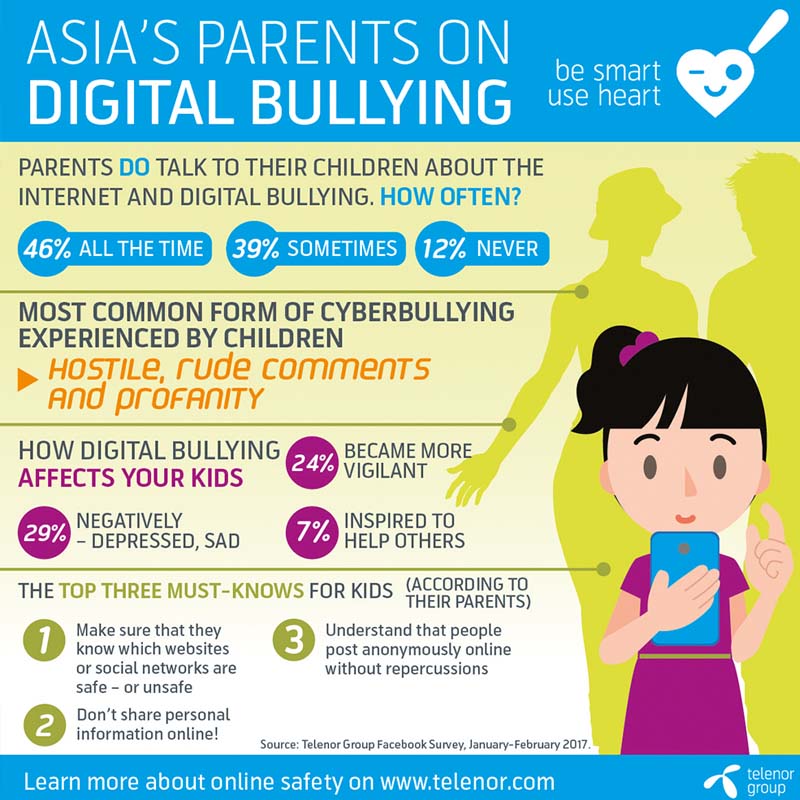
First things first: Parents say they do talk to their children about cyberbullying Dialogue is the first step in helping children understand how, why and on what channels online mistreatment can happen – and how to manage and report it. One of the first findings of this survey sheds a positive light on the situation. A majority of the respondents (46 per cent) say that they speak to their children ‘all the time’ about internet and online behavior, followed by 39 per cent who discussed this ‘sometimes’. Only 12 per cent said they had never spoken about this topic. A large segment of Asian adults feel empowered and aware enough to address online safety with youth.
Common experiences in cyberbullying
‘Being the target of hostile and rude comments and profanity online’ was the most common form of cyberbullying incidents that respondents’ children had experienced (22.5 per cent of respondents). The next largest group said they ‘did not know’ if any of the listed cyberbullying incidents had occurred to their child. The third largest group said their children had not experienced cyberbullying as they have been ‘trained how to respond and defend themselves’ against this type of activity.
Effects of cyberbullying vary
When asked how cyberbullying experiences affected the child, the answer was multi-layered with some surprises. They implied that Asia’s children are increasingly learning how to deal with bullying online, or actively were able to ignore the attacks with no effect on them. While 29 per cent of respondents said that being cyberbullied affected the child negatively and they were ‘depressed’ for a time period, 24 per cent said that the situation made the child more alert and able to defend themselves online. A further 24 per cent said the child did not seem to be affected, with seven per cent even saying the online bullying ‘inspired the child to then help other victims.’
Cyberbullying and online gaming
Those whose children play online games reported a higher rate of cyberbullying attacks than standard browsing activities. Of those surveyed, 79 per cent said their child or a child that they know has been threatened with physical harm while playing online games specifically on websites or on social media. This was followed by 41 per cent who said the child was the target of offensive comments including name calling, racist or sexist remarks.
Important: Education on appropriate websites
The reportedly most important online safety topic for children was to make sure that they know which websites or social networks are safe – or which should be kept out of bounds (27 per cent of respondents). This was followed closely by education about sharing personal information online (26 per cent), and knowing that people post anonymously online without repercussions (25 per cent).
Other risks: Sharing personal information and visiting forbidden websites
Cyberbullying formed part of the online concerns that adults hold for youth, but the responses of the survey point out that risky online actions in general need to be addressed through education. Of the respondents, 55 per cent said their child had given personal information to strangers online, followed by 51 per cent who said the child had visited websites they were not supposed to.
However, while online scams and social media platforms in an increasingly digital worldappear to be more prolific than ever, it was interesting to note that respondents said their child, or a child they knew, was least likely to experience email and social media account hacking, as well as sharing NSFW (Not Safe for Work) photos or videos.
Also Read:
YouTube Kids available for free on Google Play, App Store in India







Gaming
Nodwin Gaming partners with Runestone for esports data and integrity solutions
South Asian esports leader joins forces with Czech tech firm to enhance tournament operations.
MUMBAI: Nodwin Gaming has just levelled up its game by bringing in a specialist to keep the scoreboard honest and the fans fully engaged. The leading South Asian esports and gaming company has announced a strategic partnership with Runestone, a Prague-headquartered esports technology firm specialising in real-time data and engagement solutions for tournament organisers and publishers.
The collaboration aims to strengthen competitive integrity, improve operational oversight, and deliver more interactive viewing experiences across Nodwin’s properties. It will initially focus on the Nodwin Clutch Series for Counter-Strike 2, a Tier 2 tournament that provides emerging teams with consistent competitive opportunities and helps build the talent pipeline.
The latest edition of the series recently concluded with Big defeating ECSTATIC 2–1 in the grand final of the $50,000 online event.
Nodwin Gaming chief business officer at MENA and global head of data monetization Teemu Koski said, “Integrity and transparency are fundamental to sustainable esports ecosystems, especially in Tier 2 competition where the next generation of talent emerges. Runestone’s expertise complements our experience in building scalable esports IPs.”
Runestone head of partnerships Michael Schwartz added, “Nodwin Gaming has built one of the most dynamic esports ecosystems across emerging markets. We’re thrilled to collaborate on supporting tournaments with greater transparency, deeper fan interaction, and scalable tools.”
Both companies are exploring opportunities to extend the partnership across additional titles, including mobile-first competitive ecosystems, and to develop new products for publishers, tournament operators, and event promoters.
In the rapidly growing world of esports, where fair play and fan excitement are equally crucial, Nodwin Gaming and Runestone are teaming up to ensure every match is not only competitive but also transparent and engaging. This alliance could well become a game-changer for Tier 2 tournaments across South Asia and beyond.







