News Broadcasting
CTam studies TV viewing behaviour in US

MUMBAI: Advanced technologies are making the early-adopters happy but most US consumers still like the plain old TV. Appointment viewing is still very important.
This year colour TV marks its 50th birthday and America’s Cable & Telecommunications Association for Marketing (CTam) has come up with a report that attempts to clear up the hazy and sometimes contradictory picture of today’s media consumer.
The organisation and its research partner Lieberman Research Worldwide, have unveiled the first in a series of carefully-controlled looks at how US consumers watch TV and use new media. The aim was to set the stage for tracking and predicting changes in behaviour over the coming years.

The study Tracking the Evolving Use of Television and Its Content is positioning itself as an unbiased “screen grab designed to answer some of the most critical questions facing the cable business, as it wrestles with providing both traditional and new media services and content. A total of 1201 interviews were conducted from November – December.
When asked about all the TV-related activities they engaged in the previous night, 57 per cent reported having watched the scheduled TV programmes. Going online is the second most frequent activity (22 per cent). Consumers are also watching pre-recorded DVDs and videos. Around one in ten people surveyed engaged in each of these activities. Viewers still have favourites – and sit down to watch them at appointed times. 64 per cent of the viewers said that they knew what programme they were going to watch when they turned on the TV.
Viewers also stick with their favourite show. 53 per cent said that they preferred watching one show and not change the channel while the programme is on. However at the same time viewers like having more choice. They do check out and stay with new channels. Even though viewers report watching favourite channels most often, 50 per cent indicated that they had watched a new channel in the past year. One third said that they adopted two or more new television channels in the past year, while 17 per cent added one.
Another important issue relates to high definition television (HDTV). 45 per cent said that they were very or somewhat familiar with high-definition television. Two in 10 viewers say they’d like to buy an HD television set, and the majority of those expect to get their HDTV reception from cable (56 per cent) vs satellite TV (25 per cent), or local stations (nine per cent). 60 per cent of likely HDTV buyers are men. But the next wave of high-speed Internet customers includes more women (57 per cent) than men (43 per cent).
On the technology front, the interactive programming guide (IPG) is growing in importance. 46 per cent of viewers in digital cable and satellite homes think that it makes it easy to find something to watch. Adults 18-34, particularly the women are very positive about the IPG experience.
The benchmark wave of the study employed the methodology of talking to consumers about their most immediate, “last viewing” experiences. This led to in-depth insights into the complex relationship people have with both their TVs and the advanced technology-based services now coming to market.






News Broadcasting
UDF poised to return to power in Kerala, says Manorama-CVoter survey
Massive opinion poll projects shift in Kerala politics ahead of 2026 Assembly elections.
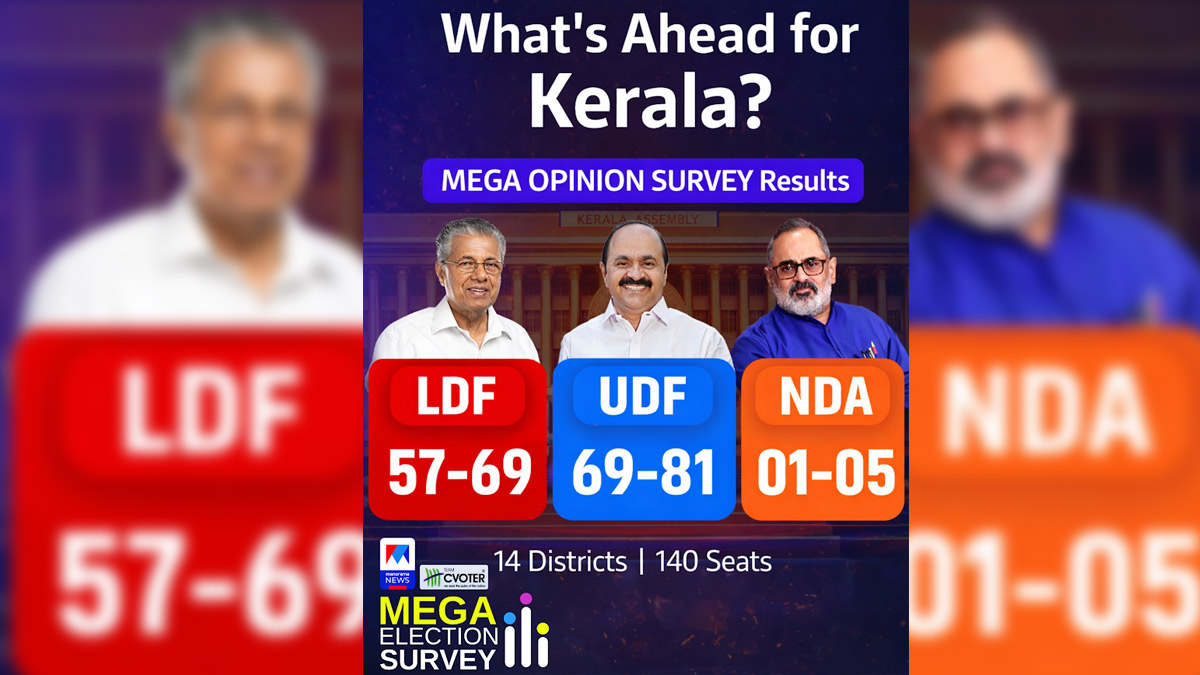
MUMBAI: The winds of change appear to be blowing through Kerala’s political landscape and this time, they seem to favour the United Democratic Front. A comprehensive mega opinion survey conducted by Manorama News in partnership with CVoter projects a potential comeback for the UDF in the upcoming Kerala Legislative Assembly Elections 2026. The survey, covering all 140 constituencies with a massive sample size of nearly 90,000 respondents, predicts the UDF could win between 69 and 81 seats.
The ruling Left Democratic Front (LDF) is expected to secure 57 to 69 seats, a significant drop from the 99 seats it won in the 2021 elections. This would mean the LDF losing 30 to 42 of its sitting seats. Meanwhile, the National Democratic Alliance (NDA), which drew a blank in 2021, is projected to open its account with 1 to 5 seats.
Region-wise, the UDF is expected to make strong gains in Malabar, winning 25 to 34 out of 48 seats, and in Central Kerala, where it could bag 29 to 33 out of 53 seats. In South Kerala, the LDF is likely to retain an edge with 21 to 25 seats, while the UDF may improve to 12 to 16 seats. The NDA could pick up 1 to 3 seats in the southern region.
The survey was conducted between 14 and 26 March 2026, with additional tracker and snap polls carried out from December 2025 to March 2026. A total of 89,693 respondents participated, ensuring representation across all demographics and social segments.
Manorama News has a strong track record of accuracy, with its previous projections closely matching the actual results of the 2019 and 2024 Lok Sabha elections as well as the 2021 Kerala Assembly polls.
In Kerala’s famously fierce political battles, this survey suggests the pendulum may be swinging back. Whether the final verdict matches these numbers or throws up another surprise, one thing is clear, the 2026 Assembly elections are shaping up to be one of the most keenly watched contests in the state’s history.






