Hindi
CSAFF kicks off with a star-studded and diverse line-up

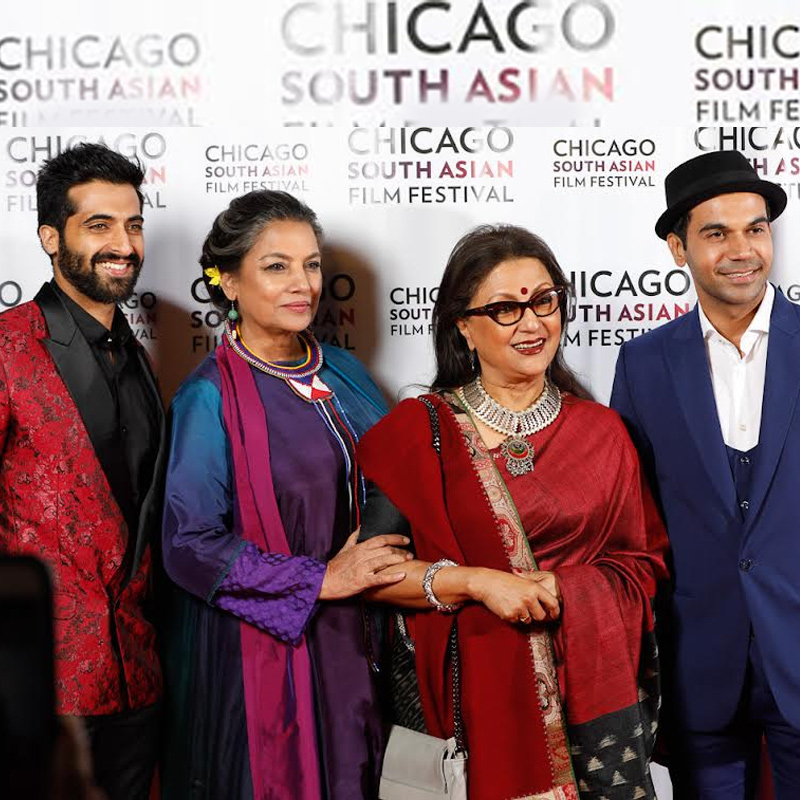
Mumbai: In its 13th edition, the Chicago South Asian Film Festival (CSAFF) opened on 22 September with a brilliant line-up of film and talent for the increasingly popular event to be held through 25 September. A kick-off curtain raiser for the festival took place on 16 and 17 September .
The festival, the largest of its kind in the Midwest, will present over 80 carefully curated independent films, shorts and documentaries in Downtown Chicago, at the Columbia Film Row and at DePaul University’s School of Cinematic Arts. Over 125 film makers and artists have made their way to Chicago for this annual event which will further showcase 27 World Premieres, 23 US Premieres and 30+ Chicago Premieres at this year’s festival.
“Chicago is developing as a big film production hub,” stated CSAFF festival director Jigar Shah. “Our festival is creating awareness of South Asian diversity here in the Midwest while also bringing this international talent to Chicago to produce this unique, exciting experience.”

A stellar grand opening to the festival took place on 23 September at the Columbia Film Row. Walking the red-carpet were renowned talents such as Yami Gautam Dhar and Rahul Khanna from India, director Aniruddha Roy Chowdhury, Mostofa Sarwar Farooki, Samiya Mumtaz, Dananeer, Jugal Hansraj along with numerous other filmmakers and talent.
The opening night feature film in its World Premiere was “Lost” by Aniruddha Roy Chowdhury, starring Yami Gautam and Rahul Khanna. Chowdhury’s previous film, “Pink”, with Amitabh Bachchan and Taapsee Pannu made a mark in Indian mainstream cinema and created discussions around women’s consent.
Additionally, Mostofa Sarwar Farooki was recognized and presented with the South Asian Film Award (SAFA), for his contribution to cinema. There was a special mention of the documentary “Barefoot Empress” by filmmaker and Michelin star chef, Vikas Khanna and Oscar-winning filmmaker, Doug Roland. The opening night also highlighted the short film, “Gray” by Sakshi Gurnani and Nikhil Taneja, starring actor Dia Mirza and Shreya Dhanwanthary.
The festival showcased the World Premiere of the Marathi film “Vaalvi” by Paresh Mokashi, and also screened “Powai” by Kuldip Patel and “Pedro” by Natesh Hegde. The kick-off curtain raiser held on 16 and 17 September featured “A Night of Knowing Nothing” by Payal Kapadia, which won the best documentary at Cannes Film Festival in 2021, “Awakash” by Chittaranjan Giri, “Manikbabur Megh (Cloud & the Man)” by Abhinandan Banerjee and Kekee Manzil, and “House of Art” by Dilesh Korya.
On Saturday, 24 September , there will be the Centerpiece film – “No Land’s Man”, by Mostofa Sarwar Farooki and Shrihari Sathe, starring Nawazuddin Siddiqui, Megan Mitchell and Eisha Chopra and music by A.R. Rahman.
“Four Samosas” by Ravi Kapoor will be the closing night film on Friday, 25 September, with the filmmakers in attendance. The film, which recently made a splash at the Tribeca Film Festival, features a popular and talented ensemble cast led by Venk Potula (“Veep”) and Karan Soni (“Deadpool”).
Also, featured will be the North America Premiere and Marquee film of the festival, Shiv Shastri Balboa followed by a Q&A session with director Ajayan Venugopalan and actor Jugal Hansraj along with legendary actors Anupam Kher and Neena Gupta. CSAFF will also showcase a heart-touching short film, “Perianayaki”, which centers round the story of a Sri Lankan woman in New Zealand, by Bala Murali Shingade.
The festival has an amazing collection of films from Pakistan too such as “Fatima Jinnah” by Danial Khan, “Stay Tuned” by Ali Ahmed and Dawa by Ariella Khan. It will showcase daring documentaries that will steer engaging conversation among the audience. There are several films and documentaries by upcoming women directors from Canada such as “Marginalizing Minorities” by Dipti Gupta, “Women Beyond Bollywood” by Rahila Bootwala and “This Stained Dawn” by Anam Abbas.
CSAFF will also showcase local Chicago filmmakers and their films – “Before After”, “Trek to the Top”, “Propinquity”, “Ozona”, the episodic “Stuck in Reality” and more. In addition, the festival will feature films which center on controversial issues of religious prejudices, sexual orientation and bullying. Featured is “Bully High”, written and directed by Bill McAdams Jr., a coming-of-age drama headlined by an exciting young cast of Hollywood newcomers, Aneesha Madhok, Joseph Baena (son of Arnold Schwarzenegger) among many other films.
“We are so proud of the caliber of the films and the diversity we will be presenting this year, and it is so powerful to be able to showcase it in the theaters,” pointed out Jigar.
CSAFF will close on Sunday, 25 September with a ceremony and awards given for best feature, best short, best documentary and documentary short as chosen by the audience. Throughout the festival there will be several event opportunities including discussions, the Filmmakers’ Lounge Series, a Bollywood dance night and Closing night after-party.





Hindi
India’s telecom subscribers cross 1.32 billion in February 2026
Broadband base swells past 1.06 billion as Jio and Airtel tighten grip on the market.
MUMBAI: India’s telecom sector is ringing in steady growth once again adding millions of new connections every month while the race for broadband supremacy continues to heat up like a fiercely contested cricket match. According to the latest data released by the Telecom Regulatory Authority of India (TRAI) on 1 April 2026, the total telephone subscriber base in the country reached 1,321.31 million at the end of February 2026. This marked a net addition of 7.31 million subscribers during the month, translating into a monthly growth rate of 0.56 per cent.
Wireless subscribers (including mobile and Fixed Wireless Access) stood at 1,273.31 million, registering a net addition of 6.97 million and a growth rate of 0.55 per cent. Within this, urban wireless connections grew to 730.75 million (growth 0.70 per cent), while rural wireless subscribers reached 542.56 million (growth 0.35 per cent).
Wireline subscribers, though much smaller in scale, showed slightly faster growth. The total wireline base increased to 47.99 million, with a net addition of 0.34 million and a monthly growth rate of 0.70 per cent. Urban areas continued to dominate wireline connections with a share of 89.41 per cent.
Overall tele-density in India improved to 92.66 per cent. Urban tele-density stood at 150.68 per cent, while rural tele-density edged up to 60.02 per cent.
The broadband subscriber base crossed a significant milestone, reaching 1,059.05 million at the end of February 2026. This reflected a healthy net addition of 6.33 million subscribers and a monthly growth rate of 0.60 per cent from January’s figure of 1,052.72 million.
Segment-wise, mobile wireless access continued to drive the majority of growth with 996.52 million subscribers. Fixed Wireless Access (including 5G FWA) added 16.51 million, while wired broadband stood at 46.02 million.
Reliance Jio Infocomm Ltd. maintained its commanding lead with 519.64 million broadband subscribers. Bharti Airtel Ltd. followed with 364.14 million, Vodafone Idea Ltd. with 129.36 million, Bharat Sanchar Nigam Ltd. with 28.70 million, and Atria Convergence Technologies Ltd. with 2.38 million.
Together, these top five players command a massive 98.60 per cent share of the total broadband market.
In the wireless (mobile) segment, private operators continued to dominate with 92.59 per cent market share, leaving public sector undertakings (BSNL and MTNL) with just 7.41 per cent.
Out of the total 1,257.29 million wireless (mobile) subscribers, 1,177.60 million were active on the peak Visitor Location Register (VLR) date, representing an impressive 93.66 per cent activity rate. Bharti Airtel led in this metric with 99.42 per cent of its subscribers active.
Meanwhile, 14.47 million subscribers submitted requests for Mobile Number Portability (MNP) in February, indicating healthy competition and customer churn across zones.
While urban areas still lead in absolute numbers, rural connectivity is slowly catching up. Rural wireless tele-density stood at 59.46 per cent, compared with the much higher urban figure of 142.32 per cent.
Fixed Wireless Access using 5G technology also showed promising traction, growing to 11.93 million subscribers. Reliance Jio and Bharti Airtel are the primary players driving this segment.
The data paints a picture of a maturing yet still rapidly expanding telecom ecosystem. With total telephone subscribers now well past the 1.32 billion mark and broadband users comfortably above 1.06 billion, India continues to solidify its position as one of the world’s largest and most dynamic digital markets.
From bustling city streets to remote villages, more Indians are staying connected than ever before proving that when it comes to telecom, the country’s appetite for growth shows no signs of hanging up anytime soon.






