I&B Ministry
Cross-media holding: Indian policymakers push for regulations

NEW DELHI: A section of policymakers in India is not in favour of market forces taking care of monopolistic trends in the increasingly converging print and electronic media. It has recommended government intervention—a thought-process that can have wide-ranging implications on activities of broadcasting companies, MSOs and even LCOs if put into action.
Stating that it cannot “ignore the concerns expressed by the industry,” parliament’s Standing Committee on Information Technology in its 44th report last week observed that issues related to vertical monopolies and cross-media holdings have “serious implications for the print and electronic media in India and cannot be simply left to the market forces… (and) need suitable intervention of government from time to time.”
In its submission before the committee, comprising members of parliament (MPs) from the upper and lower houses, TRAI made it clear that it had twice in the last six years submitted wide-ranging suggestions on media holdings and vertical monopoly that were not yet accepted by the Ministry of Information and Broadcasting (MIB) though it would be “desirable” to implement the recommendations on a “priority basis”.

MIB, however, told the parliamentary panel that it was not in favour of “too much control to restrict” the areas of operation of media entities and regulations should aim at preventing exploitation by any particular entity while leaving the remaining dynamics to the market forces.
Among the many suggestions made by the TRAI to calculate market dominance via a complex formula, the regulator had strongly advocated barring federal and state governments and organisations controlled by it from entering into the business of broadcasting and distribution of TV services while suggesting exit options for such organisations. Political parties, too, were isolated by the regulator from entering directly into the broadcasting and distribution business.
In India, quite a few broadcasting and distribution platforms, especially MSOs and LCOs, are directly or indirectly owned and controlled by political parties/politicians/MPs/state government(s). Tamil Nadu government-owned MSO Arasu—also discussed by the committee in its report—is one such example.
The committee directed the government to update it on the action taken on recommendations made by TRAI on issues of vertical monopolies and cross-media holdings.
Interestingly, the News Broadcasters Association or the NBA had strongly pleaded before the committee that vertical monopoly or integration of distribution platforms and broadcasting companies was “not healthy” for either the cable or the broadcasting sectors. Reason: such integration and interplay made room for “bias” and, more importantly, removed the concept of a level playing field. The NBA had also clarified its apprehensions saying vertical integration would affect consumer choice too.
“NBA has submitted that cross media ownership is not a healthy trend in media industry and has the potential of creating serious conflict of interest situation, which can stifle both the content side and business side of media companies,” the parliamentary panel in its report said.
ALSO READ:
TRAI managed to give broadcasting as much importance as telecom in 2014
Parliamentary panel pushes for TRAI’s empowerment
Parliamentary panel raps MIB on knuckles for DAS implementation
Column-Policy Cross-Connections






I&B Ministry
CBFC speeds up film certification; average approval time cut to 22 days
Over 71,900 films cleared in five years as digital system shortens approval timelines
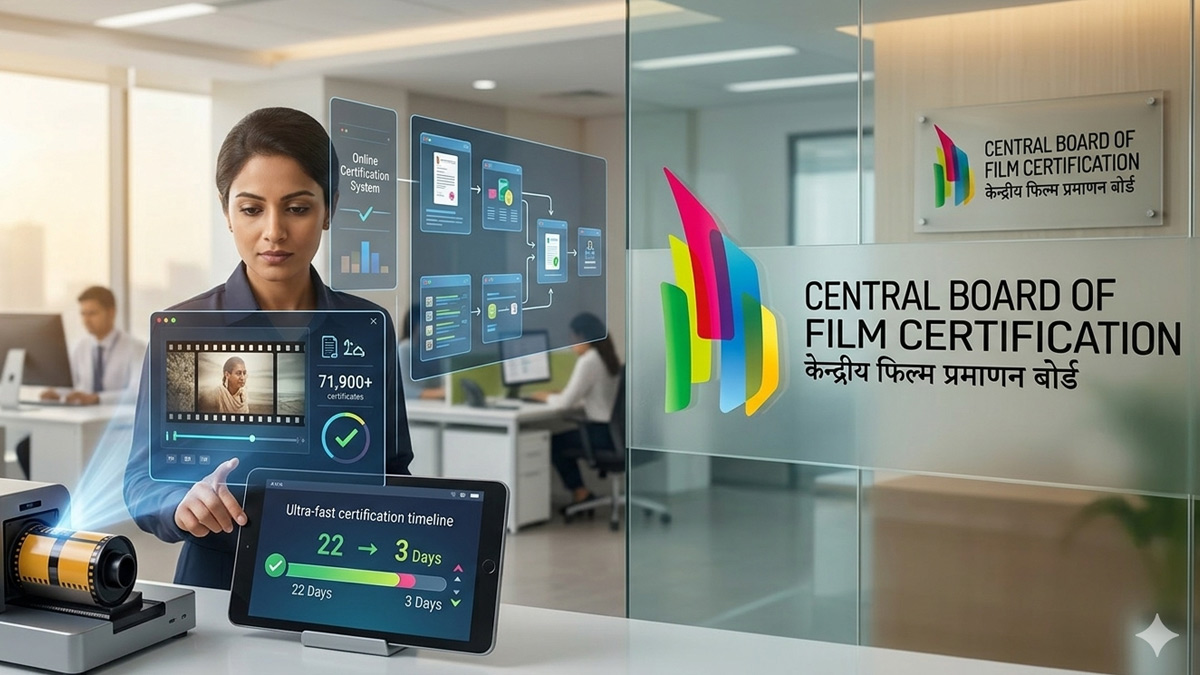
MUMBAI: The Central Board of Film Certification (CBFC) has significantly reduced the time taken to certify films, with the average approval timeline now down to 22 working days for feature films and just three days for short films.
Operating under the Ministry of Information and Broadcasting, the statutory body certifies films for public exhibition in line with the Cinematograph Act, 1952 and the Cinematograph (Certification) Rules, 2024. The rules prescribe a maximum certification period of 48 working days, though the adoption of the Online Certification System has sharply accelerated the process.
Over the past five years, from 2020-21 to 2024-25, the board certified a total of 71,963 films across formats. Of these, the majority fell under the U category with 41,817 titles, followed by UA with 28,268 films and A with 1,878 films. No films were certified under the S category during the period.
Film approvals have also steadily risen in recent years. The CBFC cleared 8,299 films in 2020-21, a figure that peaked at 18,070 in 2022-23 before settling at 15,444 films in 2024-25. During the same period, 11,064 films were certified with cuts or modifications.
Despite the high volume of certifications, outright refusals remain rare. Only three films were denied certification over the last five years, with one refusal recorded in 2022-23 and two in 2024-25.
The board may recommend cuts or modifications if a film violates statutory parameters relating to the sovereignty and integrity of India, security of the state, friendly relations with foreign states, public order, decency or morality, defamation, contempt of court or incitement to an offence.
Filmmakers can challenge CBFC decisions in court. Data shows that such disputes remain limited but have seen some fluctuation. Between 2021 and 2025, a total of 21 certification decisions were challenged before High Courts, with the number rising to 10 cases in 2025.
Responding to a question in the Rajya Sabha, minister of state for information and broadcasting L. Murugan shared the data. The question was raised by Mallikarjun Kharge.
With faster timelines and a largely digital workflow, the certification process appears to be moving at a far brisker pace, signalling a shift towards quicker clearances for India’s growing film output.