News Broadcasting
Cox Communications, Universal McCann to explore new advertising platforms together

MUMBAI: Cox Communications, Universal McCann to explore new advertising platforms together.
Cox Communications has announced a collaborative alliance with Universal McCann (UM), the media planning and buying arm of McCann-Erickson WorldGroup, one of the world’s largest advertising and marketing communications companies, to bring unique cable television advertising opportunities to Cox communities in the US.
The alliance between Cox and UM represents the first formal relationship of its kind between a cable multiple system operator (MSO) and a major advertising agency. This initiative will explore new advertising platforms appropriate for the broadband-enabled digital video realm, says a release

As Cox continues to develop and deploy new services supported by advanced technology platforms, new avenues are evolving for advertisers, the first among them being the Cox’s forthcoming FreeZone service in California where digital cable subscribers will have access to an advertising-supported video on demand channel – the FreeZone.
Launching in August, FreeZone will feature long format advertising (LFA) and other advertising-supported information and entertainment content such as sports programming. FreeZone will give Cox customers the opportunity to be entertained and to get more information about a product of interest to them than they would be able to from a traditional commercial. All Cox Digital Cable customers in the San Diego area will have access to this service at no additional cost. Among the UM clients confirmed to participate in the FreeZone at the time of launch are Coca-Cola and Epic Records, a division of Sony Music, says the release.
The release says Cox has the opportunity to diversify the sources of its advertising revenue. Advertisers can get their messages across in a more measurable way. The collaborative alliance was initially conceived by UM Futures, the Universal McCann unit that focuses on the evolving digital television landscape. The collaborative alliance with Cox provides UM and its clients with a living laboratory that will enable us to glean valuable insight into consumer reaction to the evolving on demand and interactive television universe, while developing and testing new models for advertiser supported home entertainment.
Cox Communications a Fortune 500 company, is a multi-service broadband communications company serving approximately 6.3 million customers in America.







News Broadcasting
UDF poised to return to power in Kerala, says Manorama-CVoter survey
Massive opinion poll projects shift in Kerala politics ahead of 2026 Assembly elections.
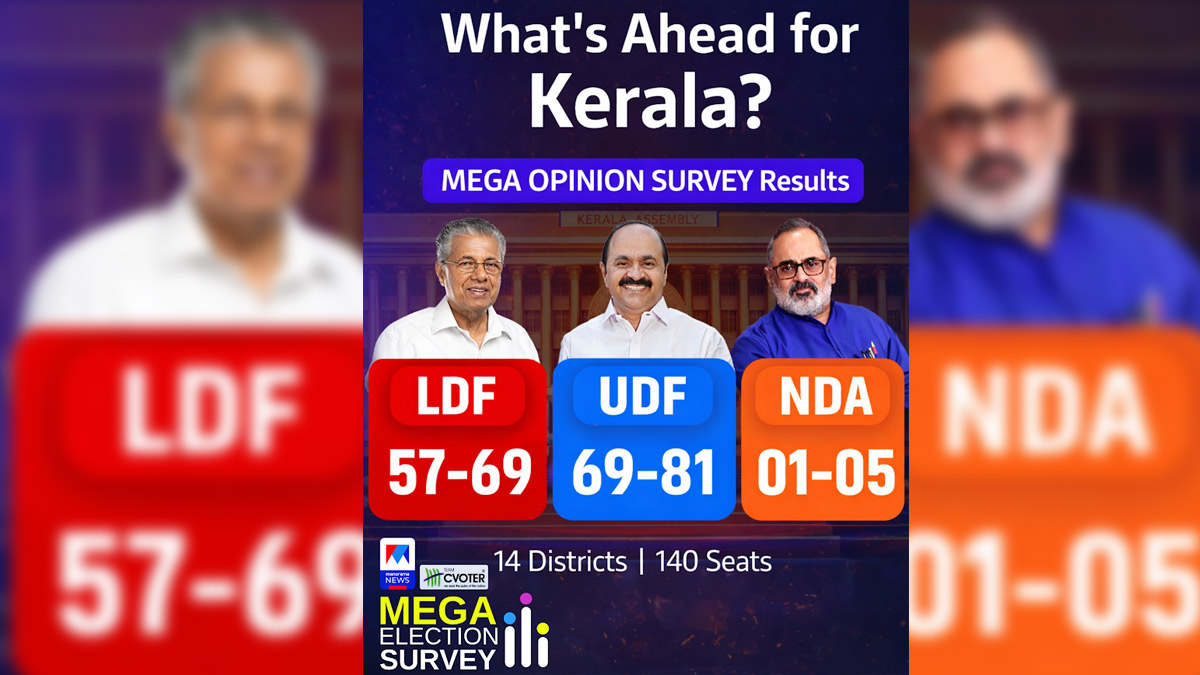
MUMBAI: The winds of change appear to be blowing through Kerala’s political landscape and this time, they seem to favour the United Democratic Front. A comprehensive mega opinion survey conducted by Manorama News in partnership with CVoter projects a potential comeback for the UDF in the upcoming Kerala Legislative Assembly Elections 2026. The survey, covering all 140 constituencies with a massive sample size of nearly 90,000 respondents, predicts the UDF could win between 69 and 81 seats.
The ruling Left Democratic Front (LDF) is expected to secure 57 to 69 seats, a significant drop from the 99 seats it won in the 2021 elections. This would mean the LDF losing 30 to 42 of its sitting seats. Meanwhile, the National Democratic Alliance (NDA), which drew a blank in 2021, is projected to open its account with 1 to 5 seats.
Region-wise, the UDF is expected to make strong gains in Malabar, winning 25 to 34 out of 48 seats, and in Central Kerala, where it could bag 29 to 33 out of 53 seats. In South Kerala, the LDF is likely to retain an edge with 21 to 25 seats, while the UDF may improve to 12 to 16 seats. The NDA could pick up 1 to 3 seats in the southern region.
The survey was conducted between 14 and 26 March 2026, with additional tracker and snap polls carried out from December 2025 to March 2026. A total of 89,693 respondents participated, ensuring representation across all demographics and social segments.
Manorama News has a strong track record of accuracy, with its previous projections closely matching the actual results of the 2019 and 2024 Lok Sabha elections as well as the 2021 Kerala Assembly polls.
In Kerala’s famously fierce political battles, this survey suggests the pendulum may be swinging back. Whether the final verdict matches these numbers or throws up another surprise, one thing is clear, the 2026 Assembly elections are shaping up to be one of the most keenly watched contests in the state’s history.






