News Broadcasting
Countdown begins for CommunicAsia2006 and EnterpriseIT2006


MUMBAI: CommunicAsia and Enterprise IT, the region’s foremost technology shows, will be returning once again to the Singapore Expo from the 20 to 23 June.
CommunicAsia, EnterpriseIT and BroadcastAsia are key components of the five-day Infocomm Media Business Exchange (imbX) which is held annually in Singapore in the month of June.
Reflecting the buoyant market and the latest trends, some of the key technologies addressed on the show floor include mobile entertainment, IPTV, 3G, VoIP, NGN, WiMAX, information security and embedded technologies, states an official release.

Visitors from India can expect to see the latest innovations from the most influential world vendors and operators, including Ericsson, Huawei, ZTE, NTT Docomo, Lucent, Motorola, Siemens, Sony Ericsson, Samsung and LG among many others. The event will also feature 21 international group pavilions including Thailand, US, Korea, the European Union and China among others, in addition to the ESC-led Indian pavilion.
India continues to have the fastest growing ICT market in the world, with a predicted combined annual growth rate (CAGR) of 19 percent from 2004 through 2008, according to research house Gartner. Gartner estimates that ICT spending in India will surpass US$54.8 billion by 2008, a rise from US$29.5 billion in 2004. Reflecting the surge in ICT demand in India, a total of 555 Indian visitors attended CommunicAsia and EnterpriseIT in 2005, posting a 25 per cent increase over 2004.
The focus of the high-powered CommunicAsia Summit this year turns towards mobile applications, broadband and next generation networks as the industry’s three key growth areas Some of the top-notch speakers include Andrew Sukawaty, CEO and chairman of Inmarsat, Joseph Anton Aliagas, CEO of Arena Mobile Music, Skuli Mogensen, CEO & founder of OZ, Craig Wilson, IBM’s Asia Pacific director for Digital Media and Telecommunications, Craig Farrill, CEO of Kodiak Networks and Thorsten Heinz, Siemens CTO.
Making its presence felt on the international market through CommunicAsia and EnterpriseIT are home-grown companies including Acceltree Software, Kaveri Telecom Products, Matrix Telecom and MRO-TEK, as well as companies under the Indian national pavilion led by the Electronics and Computer Software Export Promotion Council (ESC). These include BSMC Power Systems, Elitecore Technologies, Euclid Infotech, Lepton Software Export & Research, Svarn Telecom and Toshniwal Enterprises Controls. Indian telco giant Shyam Telecom will also be exhibiting at the event, the release adds.
Victor Wong, project director of CommunicAsia and EnterpriseIT said, “CommunicAsia, alongside EnterpriseIT, is the most established ICT show in Asia and the ideal platform to launch and showcase new technologies and services to the world that will transform the way we live. Not only is CommunicAsia a highly relevant event to the needs of Indian visitors to the event, it is an important platform for India to showcase its ICT capabilities to the world and to forge international business links.”
According to International Data Corp (IDC), new technologies entering the telecommunications marketplace are redefining the industry. The telecom services market in Asia Pacific (excluding Japan) is projected to exceed US$170 billion, posting a growth of seven percent compared to last year. This growth is likely to come from VoIP, broadband and 3G services.







News Broadcasting
Network18 channels lead YouTube news viewership in March 2026
CNN-News18, News18 India and CNBC channels top categories with record views
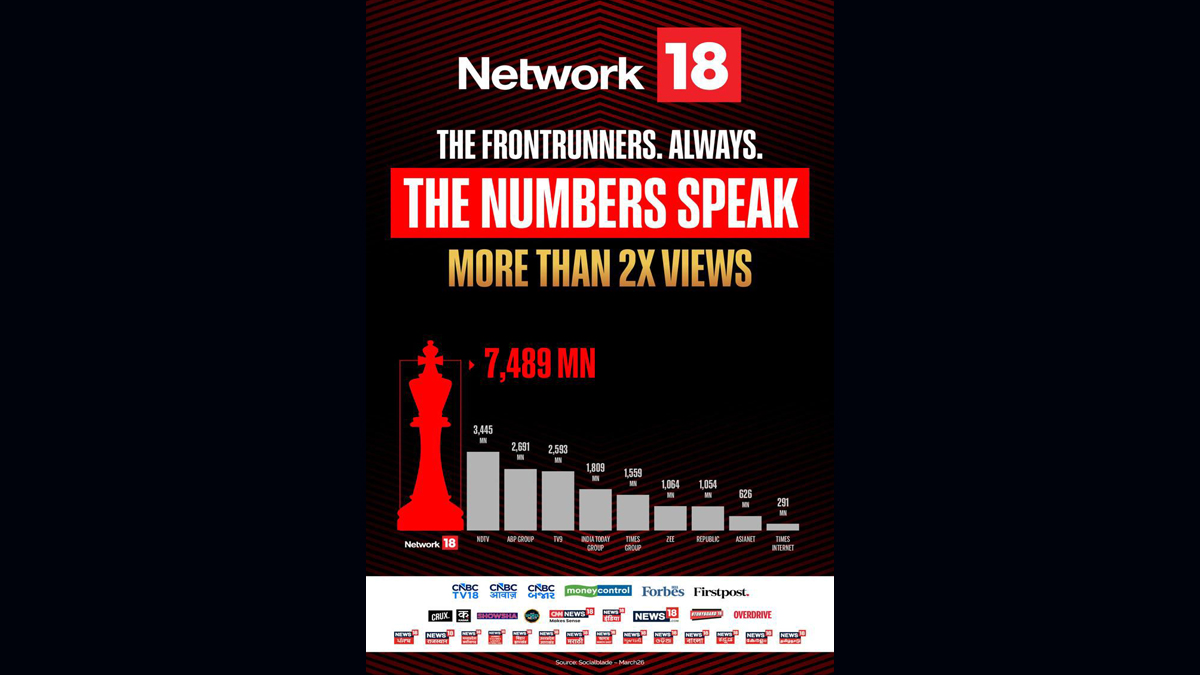
MUMBAI: When the world hit refresh on breaking news, Network18’s channels were already streaming ahead. As geopolitical tensions and war-driven headlines fuelled a surge in global news consumption, the network’s digital playbook delivered big clocking record Youtube viewership across English, Hindi and business news categories in March 2026.
At the forefront was CNN-News18, which emerged as the clear leader in the English news segment with 130 million live and video-on-demand views. The channel edged past competitors such as Times of India (126.5 million), Times Now (101.1 million), India Today (88.2 million) and NDTV (77.5 million), according to Databeings data for March.
In the Hindi news arena, News18 India delivered a commanding performance, racking up a staggering 3,297 million views on YouTube. The channel comfortably outpaced NDTV India, which recorded 3,119 million views, underlining its deep reach and consistent engagement with mass audiences, as per Playboard data.
The network’s dominance wasn’t confined to general news. In the Hindi business segment, CNBC Awaaz topped the charts with 92 million views, narrowly ahead of Zee Business (90 million) and well ahead of ET Now Swadesh (57 million). Meanwhile, its English counterpart CNBC-TV18 posted a strong 58 million views, reinforcing the network’s cross-category strength.
The spike in viewership reflects a broader shift in audience behaviour, with viewers increasingly turning to digital platforms particularly Youtube for real-time updates and in-depth coverage during high-intensity news cycles. For Network18, the numbers signal more than just scale; they underline the effectiveness of a multi-platform strategy that blends speed, credibility and continuous coverage.
In a month where the news never paused, it seems viewers chose to stay tuned where the stream never stopped.






