News Headline
Convenience & personalised content prompts 78% India’s TV viewers’ shift to OTT

MUMBAI: There has been a steep decline over the past year in the percentage of India’s consumers who prefer to view TV shows on TV sets. That percentage dropped 78 per cent, from 47 per cent to 10 per cent. In the United States, the number fell 57 per cent (from 59 per cent to 25 per cent), and the U.K. it dropped 55 per cent (from 56 per cent to 25 per cent).
Signaling an accelerating shift in the digital video market consumer behavior, the percentage of consumers who prefer watching TV shows on television sets plummeted by 55 per cent over the past year, from 52 per cent to 23 per cent, according to findings from the Accenture 2017 Digital Consumer Survey.
“The massive and accelerating push by communications and media companies to provide ubiquitous content – TV everywhere including over-the-top – has empowered consumers to access high-quality content across multiple devices.”

The global online survey of 26,000 consumers in 26 countries* reveals that consumers increasingly prefer to watch TV shows on (over the top or OTT) devices such as laptop and desktop personal computers and smartphones. More than four in 10 consumers (42 per cent) said they would rather view TV shows on a laptop or desktop, up from 32 per cent in last year’s survey. Thirteen per cent said they prefer watching TV shows on their smartphones, compared with 10 per cent last year.
The decline in TV viewing over the past year tracks with a four-year trend. As recently as 2014, the survey revealed that nearly two-thirds (65 per cent) of consumers preferred the TV set for viewing TV shows.
The most-recent findings, summarised in a new Accenture report titled Winning Experiences in the New Video World, show that only one in five consumers (19 per cent) now prefer to watch sports games on their TVs, down from 38 per cent in the prior-year survey.
“The dominance of the TV set as the undisputed go-to entertainment device is ending,” said Accenture’s broadcast business global managing director Gavin Mann. “While a great number of people still watch plenty of TV shows on TV sets, our research uncovers a rapid acceleration in their preference for viewing on other digital devices — especially laptops, desktops and smartphones.”
“Driving this rapid shift in consumer preferences is the growing convenience, availability and quality of more personalised and compelling content on laptop and desktop personal computers and smartphones,” Mann added. “The massive and accelerating push by communications and media companies to provide ubiquitous content – TV everywhere including over-the-top – has empowered consumers to access high-quality content across multiple devices.”
While consumers increasingly prefer to watch TV shows on laptops and desktops, the smartphone is becoming the preferred device for watching short video clips. In the most-recent survey, more than one-third (41 per cent) of consumers said they would rather view these clips on their mobile handsets, a substantial increase from 28 per cent last year. In contrast, the number of consumers who said they would rather watch video clips on their laptops and desktops dropped slightly, from 47 per cent to 44 per cent over the last year, while the number who said they prefer to view these clips on their TV sets dropped even more, from 16 per cent to only five per cent.
The report makes several recommendations for how media companies should respond to the shift in consumers’ video consumption habits from TV sets to other devices.
These include:
Identifying new ways to engage consumers with more-personalized video content across more types of screens; using more granular consumer data, segments and predictive analytics to help anticipate consumer preferences and find content they desire; and focusing more on their target audiences to identify exactly what content their viewers want to receive – and when, for how long and on what type of screen.
Methodology
Between October and November 2016, Accenture conducted an online survey with approximately 26,000 consumers in 26 countries: Australia, Brazil, Canada, China, Czech Republic, France, Germany, Hungary, India, Ireland, Italy, Japan, Mexico, Netherlands, Poland, Romania, Saudi Arabia, Singapore, Slovakia, South Africa, Spain, Sweden, Turkey, United Arab Emirates, the United Kingdom and the United States. The sample in each country was representative of the online population. Ages of respondents ranged from 14-to-55 and over. The survey and related data modelling quantify consumer perceptions of digital devices, content and services, purchasing patterns, preference and trust in service providers, and the future of their connected lifestyles.
(*These findings are derived from a multiple-choice question answered by survey participants: “Which types of device (s) do you prefer to use when accessing different types of content?” The options included ‘laptop and desktop personal computers,’ ‘smartphones,’ ‘tablets,’ ‘TV screens,’ ‘game consoles,’ ‘other’ and ‘none.)
Also Read :
Viacom Velocity: 68% millennials trust online pals more than news or govt





NEW DELHI: Hamdard Laboratories gathered a cross-section of India’s achievers in New Delhi on Friday, handing out the Hakeem Abdul Hameed Excellence Awards to figures who have left their mark across healthcare, education, sport, public service and the arts.
The ceremony, attended by minister of state for defence Sanjay Seth and senior officials from the ministry of Ayush, celebrated individuals whose work blends professional success with a sense of public purpose. It was as much a roll call of achievement as it was a reminder that influence is not measured only in profits or podiums, but in people reached and lives improved.
Among the headline awardees was Alakh Pandey, founder and chief executive of PhysicsWallah, recognised for turning affordable digital learning into a mass movement. On the sporting front, Arjuna Awardee and kabaddi player Sakshi Puniya was honoured for her contribution to the game and for pushing women’s participation onto bigger stages.
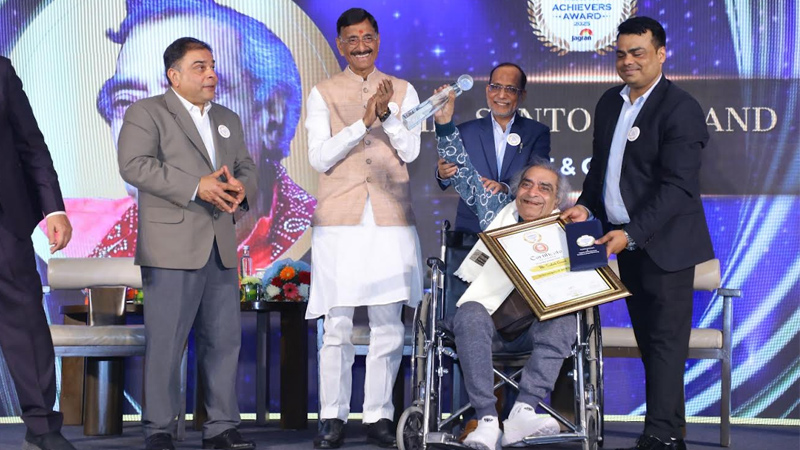
The cultural spotlight fell on veteran lyricist and poet Santosh Anand, whose songs have echoed across generations of Hindi cinema. At 97, Anand accepted the honour with characteristic humility, reflecting on a life shaped by perseverance and hope.
Healthcare honours spanned both modern and traditional systems. Manoj N. Nesari was recognised for strengthening Ayurveda’s place in national and global health frameworks. Padma shri Mohammed Abdul Waheed was honoured for his research-backed work in Unani medicine, while padma shri Mohsin Wali received recognition for his long-standing contribution to patient-centred care.
Education and social development also featured prominently. Padma shri Zahir Ishaq Kazi was honoured for decades of work in education, while former Meghalaya superintendent of Police T. C. Chacko was recognised for public service. Goonj founder Anshu Gupta received an award for his dignity-centred rural development initiatives, and the Hunar Shakti Foundation was honoured for empowering women and young girls through skill development.
The Lifetime Achievement Award went to former IAS officer Shailaja Chandra for her long career in public healthcare and governance, particularly in the traditional systems under Ayush.
Speaking at the event, Hamdard chairman Abdul Majeed said the awards were a tribute to those who combine excellence with empathy. “These awardees reflect Hakeem Sahib’s belief that healthcare, education and public service must ultimately serve humanity,” he said.
Minister Seth struck a forward-looking note, saying India’s young population gives the country a unique opportunity to become a global destination for learning, health and wellness by 2047.
The ceremony also featured the trailer launch of Unani Ki Kahaani, an upcoming documentary starring actor Jim Sarbh, set to premiere on Discovery on 11 February.
Instituted in memory of Unani scholar and educationist Hakeem Abdul Hameed, the awards have grown into a national platform that celebrates those building a more inclusive and resilient India. For one evening at least, the spotlight was not just on success, but on service with substance.