GECs
Consensus eludes CAS task force


NEW DELHI: As they say in cricket, something’s about to give way.
Either the Indian government will buckle under pressure from various factions of the broadcasting and cable industry on the issue of basic tier’s price, or it may just go ahead and declare the price. The likelihood of the latter happening on Tuesday is high.
The task force meet on conditional access held today, once again, failed to arrive at a consensus on the issue of pricing of the basic tier and the parameters taken to arrive at various figures being bandied around.

The chairman of the task force is understood to have conveyed to other members, specially cable ops, that if there is no unanimity on the pricing issue in the meet tomorrow, then the government would have no choice but to go ahead with the figure cobbled together by the finance ministry- Rs 45.90 (exclusive of local and entertainment taxes) — even if certain sections feel the figure is far removed from ground realities.
The government has also told all stakeholders that the details of costs, backed by relevant documents, should be submitted for a final round of hearing on the cost issue by 11 am tomorrow.
The frustration and confusion in the task force is evident from the fact that a survey undertaken by an independent body- Becil/ORG Marg- too has not been able to bring smiles on everybody’s face. Rather the report done at the behest of the government and the industry was today literally shredded to pieces by the cable operators in the task force.
According to Rakesh Dutta, an independent cable op and a task force member, “The way things are moving, it is becoming increasingly difficult to arrive at any consensus. The cost of the basic tier being suggested by the government and others would not be acceptable to cable ops who’ll have no option but to down shutters and suspend cable services.” Other cable operators also echoed similar sentiments.
Some of the figures and data presented in the survey are quite contrary to what the cable industry has been representing, it seems. For example, on the issue of cable ops use using standardised equipment, the report states that in cities like Delhi and Kolkata mostly local equipment sans the ISI mark are used, while in Mumbai in certain pockets branded products are used.
The survey, according to some figures made available to indiantelevision.com, states that a franchisee cable operator in Mumbai on an average has 2,555 subscribers per sq. km, while the corresponding figures in Delhi is 1031, Kolkata 1266 and Chennai 1383.
It seems the ORG-Marg conducted survey for Becil is highlighting the fact that cable operators do have large subscriber bases, but their cost is not much as being proclaimed. Reason: standardised equipment is not used by all. In case of Chennai, for example, the report states that no details were forthcoming where equipment and their standardisation was concerned.
Though some representatives of broadcasting organisations did raise doubts over the authenticity of the survey and its findings, the doubts were laid to rest quickly as the chairman is understood to have said that the terms of reference for the survey was limited and decided upon earlier.
Interestingly, the lone person representing free to air channels in the task force, Sahara TV president Mahesh Prasad, raised an important issue: carriage fee for free to air channels in the basic tier.
Prasad, rightly so, pointed out that post-CAS it should be ensured that free to air channels don’t have to pay carriage fees (mostly to MSOs) considering the minimum number of channels in the basic tier is being specified at 30.
Though the issue did not receive the attention it should have, in days to come carriage fee would rear its head as channels would jostle with one another to occupy limited bandwidth and capacity of an average TV set to receive the number of channels.




GECs
Asianet Television Awards 2026 celebrates women power in Malayalam TV
“She is the Colour” theme honours icons as ceremony airs on March 14 and 15 at 7 PM.
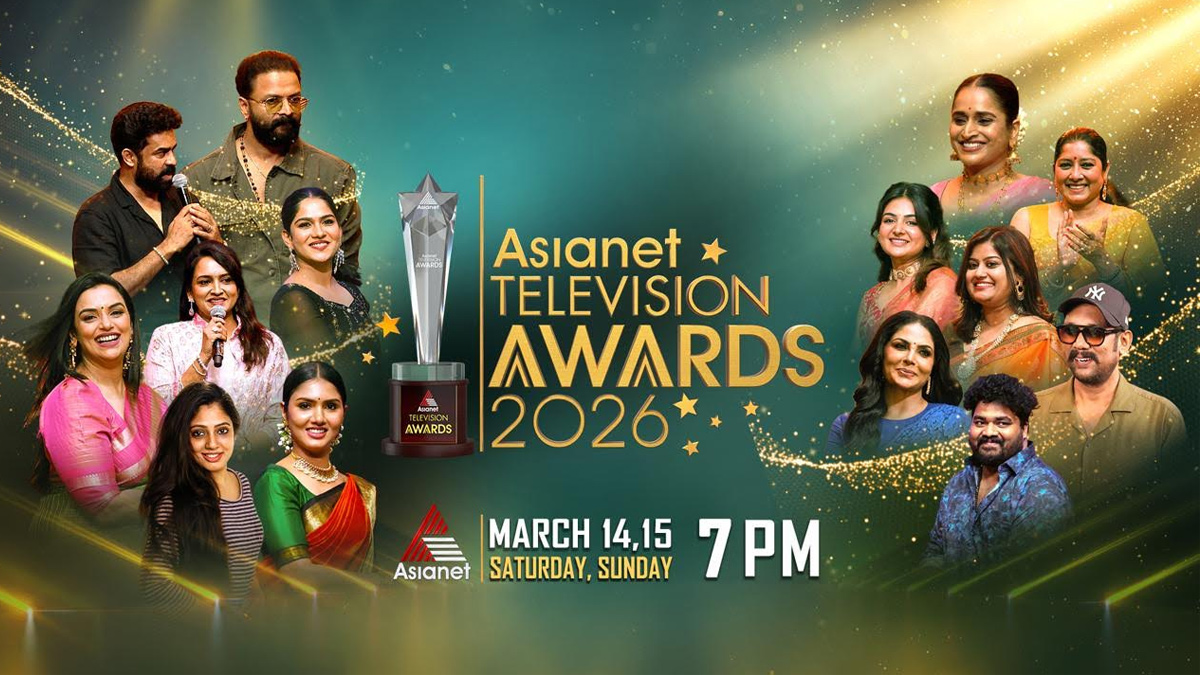
MUMBAI: If television lights up living rooms, this year Asianet decided to let women provide the colour. The Asianet Television Awards 2026 turned the spotlight firmly on women empowerment with the theme “She is the Colour”, celebrating the strength, resilience and achievements of women who continue to shape society and the Malayalam entertainment industry.
The ceremony honoured several distinguished personalities whose journeys have left a lasting cultural imprint. Among them was legendary playback singer Vimala Varma, widely recognised as the first Malayalam playback singer. The evening also paid tribute to Padma Shri awardees Devaki Amma and Vimala Menon for their exceptional contributions in their respective fields.
Leading women from the Malayalam film industry were also recognised during the event, including actor Shweta Menon, who currently serves as president of the Association of Malayalam Movie Artists, and National Award winning actor Surabhi Lakshmi.
The awards ceremony brought together a glittering lineup of actors and industry figures, including Jayasurya, Vijay Babu, Asha Sarath, Lena, Esther Anil, Anumol, Akhila Bhargavan, Sarayu Mohan, Prajod Kalabhavan, Gayathri Suresh, Sabumon Abdusamad, Swasika, Tini Tom, Sijoy Varghese, Kailash, Veena Nandakumar, Sabareesh Varma, Ansiba Hassan and Dinesh Prabhakar. Kishan Kumar, executive vice president Malayalam at JioStar, was also present at the event.
Beyond individual recognitions, the awards celebrated excellence across Malayalam television, acknowledging artists and technicians whose work continues to drive the industry forward.
The evening also offered plenty of spectacle, with elaborate dance performances, stunt acts and comedy skits performed by popular television and film personalities, turning the ceremony into a full fledged entertainment showcase.
Viewers will get to watch the celebrations when the Asianet Television Awards 2026 air on Asianet on March 14 and 15, Saturday and Sunday, from 7 pm onwards, bringing the star studded tribute to homes across Kerala and beyond.