News Broadcasting
CNN’s Q&A aims to become more hard-hitting, says host Zain Verjee


CNN International’s high profile interactive programme Q&A South Asia is in the middle of a positional shift. The focus is to make it harder hitting, with a stronger news focus and it appears to have found the right fit in Zain Verjee, who took over as anchor after Riz Khan quit the show in May.
Verjee was in Mumbai on Wednesday, and appeared to have still to fully recover from the high octane adrenaline rush that had constituted the four days that Pakistani leader Pervez Musharraf was in India for talks with Indian Prime Minister Atal Behari Vajpayee (Friday 13 July to Monday). She flew in from Delhi after wrapping up an extra post-summit Q&A special on Tuesday.

Q&A Summit Specials were originally scheduled to cover the four days of the summit but a further programme was added elicit reactions on the failure of the talks. There were also two online chat sessions scheduled for Saturday and Monday, but Monday’s session had to be abandoned because of a power breakdown at Hotel Nikko in New Delhi where a 22-strong CNN team had located their operations.
Speaking of her role in Q&A, Verjee sees her personality as quite suited to the changes taking place on the show. Verjee says her principal input is to make the programme more controversial, with subject choices that are more politically driven. If a confrontationist attitude has a physical expression, she suits the role. Verjee happens to be an expert kick boxer and fitness freak. Asked to give some examples where she has raised hackles on her shows, Verjee says she particularly rattled Kashmiri leader Farooq Abdullah during Saturday’s Q&A Summit Special.
The Vajpayee-Musharraf summit was a major operational exercise for the CNN team. Hotel Nikko was converted into a studio. It took one-and-a-half days to set up the control room in one of the hotel’s rooms, which includes panels needed for live transmission and over 1.5 tonnes of equipment was flown in, mainly from Hong Kong. Four international lines to the CNN centre in Atlanta, USA, were set up for the purpose.
The summit was the first time that Verjee has done Q&As outside Atlanta as well as her first visit to India. Queried as to whether her having had no hands-on experience of India wasn’t a detriment in terms of her understanding of issues, Verjee said she put a lot of effort into researching the topics she covered, but admitted that the show was a learning curve for her.
Asked to comment on whether CNN’s coverage of the summit was adequate, Verjee said: “We were all happy with our coverage. I hope it reflects CNN’s commitment to South Asia. Our aim was to give a balanced perspective to a global audience.”
As for the format of the programme, Verjee said the show was segmented into three blocks of between 12 to 15 minutes each. The “A” block was the most topical segment downwards to the “C” block which tended towards softer subjects, she said. Verjee clarified that this was very fluid, depending on the news of the day.
Queried whether there would be more episodes produced out of the subcontinent, Verjee said news events would decide that.
Q&A South Asia airs at 10 PM Monday to Wednesdays on CNN’s South Asia Channel which launched in June 2000. It is a half-hour interactive show and interviews leading politicians, celebrities and newsmakers.






News Broadcasting
UDF poised to return to power in Kerala, says Manorama-CVoter survey
Massive opinion poll projects shift in Kerala politics ahead of 2026 Assembly elections.
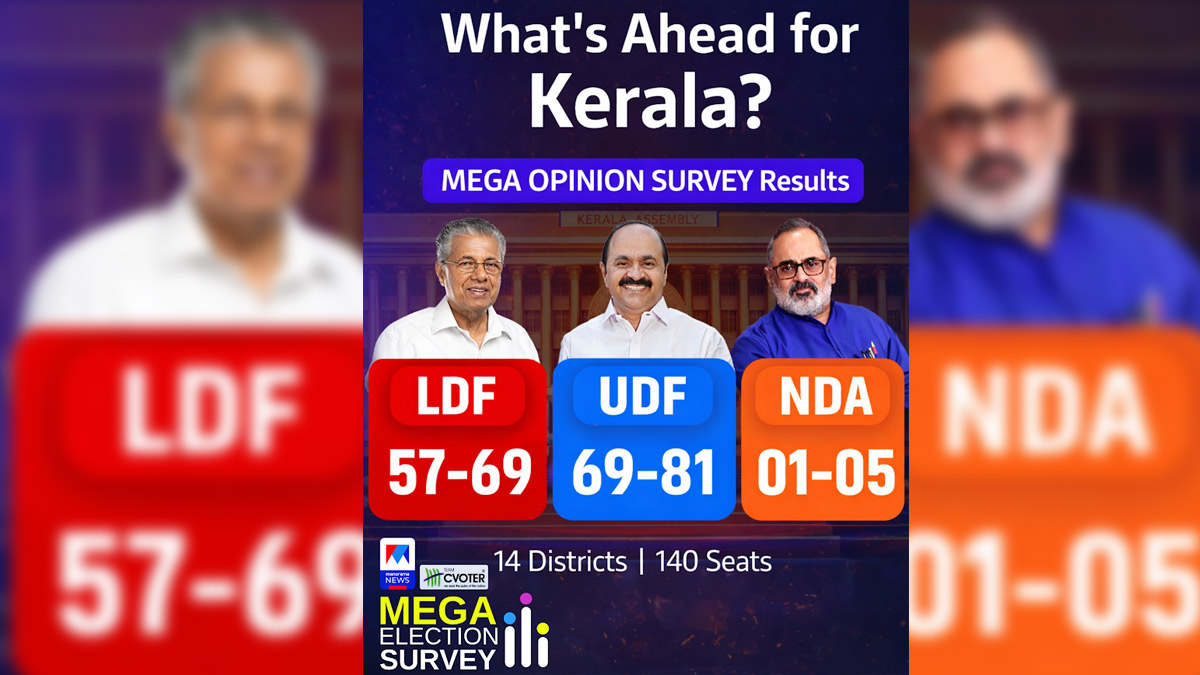
MUMBAI: The winds of change appear to be blowing through Kerala’s political landscape and this time, they seem to favour the United Democratic Front. A comprehensive mega opinion survey conducted by Manorama News in partnership with CVoter projects a potential comeback for the UDF in the upcoming Kerala Legislative Assembly Elections 2026. The survey, covering all 140 constituencies with a massive sample size of nearly 90,000 respondents, predicts the UDF could win between 69 and 81 seats.
The ruling Left Democratic Front (LDF) is expected to secure 57 to 69 seats, a significant drop from the 99 seats it won in the 2021 elections. This would mean the LDF losing 30 to 42 of its sitting seats. Meanwhile, the National Democratic Alliance (NDA), which drew a blank in 2021, is projected to open its account with 1 to 5 seats.
Region-wise, the UDF is expected to make strong gains in Malabar, winning 25 to 34 out of 48 seats, and in Central Kerala, where it could bag 29 to 33 out of 53 seats. In South Kerala, the LDF is likely to retain an edge with 21 to 25 seats, while the UDF may improve to 12 to 16 seats. The NDA could pick up 1 to 3 seats in the southern region.
The survey was conducted between 14 and 26 March 2026, with additional tracker and snap polls carried out from December 2025 to March 2026. A total of 89,693 respondents participated, ensuring representation across all demographics and social segments.
Manorama News has a strong track record of accuracy, with its previous projections closely matching the actual results of the 2019 and 2024 Lok Sabha elections as well as the 2021 Kerala Assembly polls.
In Kerala’s famously fierce political battles, this survey suggests the pendulum may be swinging back. Whether the final verdict matches these numbers or throws up another surprise, one thing is clear, the 2026 Assembly elections are shaping up to be one of the most keenly watched contests in the state’s history.






