News Broadcasting
CNBC may hold up to 15% stake in TV-18

NEW DELHI: CNBC Asia may hold up to 15 per cent equity stake in Television Eighteen Ltd., which also recently obtained a licence to uplink from India.
Though neither TV-18 nor CNBC Asia agreed to throw some official light on the issue, market analysts said that keeping CNBC Asia shareholding within the 15 per cent limit would help TV-18 not having to go in for an offer, a clause that would get triggered off if the percentage of the shareholding being offloaded by a listed company is more than 15 per cent.
“We are quite happy with a minority stake as it is more important to work with a good partner,” CNBC Asia Pacific president and CEO Alexander Brown told indiantelevision.com.
Moreover, the NBC and Dow Jones company CNBC Asia’s shareholding cannot be 26 per cent as till today evening, the existing foreign component in TV-18 already amounted to about 11 per cent — a figure that may vary from day to day — in the form of NRI/OCB/FII holdings.
This means that if today, CNBC Asia wanted to quantify its shareholding in the company, which has not happened officially anyway, then it would have amounted to just 15 per cent, while the total foreign holding in TV 18 would have amounted to 26 per cent.
“The existing foreign holding in the company would be a big factor in determining the other aspects of the agreement, including the valuation of the company,” Television Eighteen Ltd. MD Raghav Bahl told indiantelevision.com on the sidelines of a press conference organised here to announce the restructuring of the company as per Indian government rules that say total foreign shareholding in a company, desirous of uplinking news content from India, cannot be more than 26 per cent.
The TV-18 scrip today closed 3.7 per cent higher at Rs. 85 on the Bombay Stock Exchange, while the main index slipped 0.53 per cent.
The restructuring move comes ahead of the stipulated 90-day deadline given by the Indian government. After this, all eyes would be on Star News that also has to comply with rules within the stipulated period.
Pointing out that, in fact, the restructuring would amount to a demerger, Bahl said that it has to be examined whether a separate entity, like TV 18 Business News, for instance, needs to be created to complete a complex restructuring.
After the restructuring is complete, the business news channel would be rechristened CNBC India-TV 18 as part of a co-branding exercise.
“The Mauritus-registered CNBC India, a 51:49 joint venture between CNBC Asia and TV-18 that used to manage the affairs of the business news channel, would cease to operate,” Bahl said.
Since the valuation of TV-18 has not yet been undertaken — “the mandate for that will be given now,” according to Bahl — both CNBC Asia and TV-18 could not disclose the amount that CNBC would pay for the strategic equity stake in TV-18.
Earlier, Television Eighteen India informed the Bombay Stock Exchange that it will comply with the government order issued in mid-March restricting foreign equity investments in news and current affairs channels to 26 per cent or below. It sent a notice to the BSE stating the same early this morning.







News Broadcasting
Network18 channels lead YouTube news viewership in March 2026
CNN-News18, News18 India and CNBC channels top categories with record views
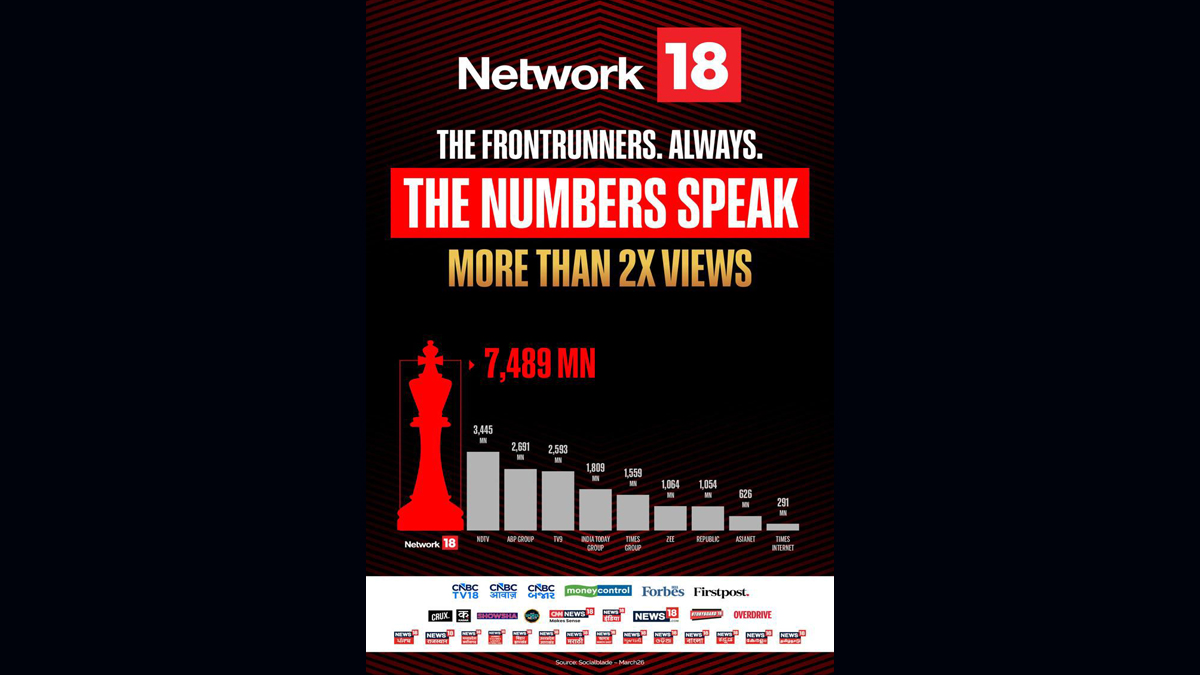
MUMBAI: When the world hit refresh on breaking news, Network18’s channels were already streaming ahead. As geopolitical tensions and war-driven headlines fuelled a surge in global news consumption, the network’s digital playbook delivered big clocking record Youtube viewership across English, Hindi and business news categories in March 2026.
At the forefront was CNN-News18, which emerged as the clear leader in the English news segment with 130 million live and video-on-demand views. The channel edged past competitors such as Times of India (126.5 million), Times Now (101.1 million), India Today (88.2 million) and NDTV (77.5 million), according to Databeings data for March.
In the Hindi news arena, News18 India delivered a commanding performance, racking up a staggering 3,297 million views on YouTube. The channel comfortably outpaced NDTV India, which recorded 3,119 million views, underlining its deep reach and consistent engagement with mass audiences, as per Playboard data.

The network’s dominance wasn’t confined to general news. In the Hindi business segment, CNBC Awaaz topped the charts with 92 million views, narrowly ahead of Zee Business (90 million) and well ahead of ET Now Swadesh (57 million). Meanwhile, its English counterpart CNBC-TV18 posted a strong 58 million views, reinforcing the network’s cross-category strength.
The spike in viewership reflects a broader shift in audience behaviour, with viewers increasingly turning to digital platforms particularly Youtube for real-time updates and in-depth coverage during high-intensity news cycles. For Network18, the numbers signal more than just scale; they underline the effectiveness of a multi-platform strategy that blends speed, credibility and continuous coverage.
In a month where the news never paused, it seems viewers chose to stay tuned where the stream never stopped.






