Hardware
Chip maker Broadcom gets chirpy about India


KOLKATA: It’s got India on its mind. Most Indian cable TV and DTH operators are pretty familiar with the US-headquartered Broadcom Corp. The company provides the chips that go into the set top boxes and also for enterprise networking and mobile connectivity functions. What they probably don’t know is that it has invested more than 15 per cent of its global R&D budget in its Indian R&D centre. And that its Indian MD Rajiv Kapur is extremely gung-ho about the potential in India as its television ecosystem digitises.
And that’s despite the fact that there’s not been a flood of orders from those wanting to supply STBs to Indian cable TV ops and MSOs.

Says he: “Right now activity is more on the technology front. The actual orders are expected to come before the end of the deadline (31 December 2014). And hence I can confidently say further growth will come. Even in the current situation, India’s revenue is being noticed from the global perspective.”
Surely. With India’s transition from analog to digital television service, many consumers need new, full-featured set-top boxes (STBs) for home viewing. This represents a major opportunity for regional operators and set-top box manufacturers, as only a portion of the roughly 100 million STBs in consumers’ homes have already been digitised according to published government figures. Adding to this potential for set-top box growth is the trend of consumers adding more than one television to their home, as well as natural consumer upgrade cycles from standard definition to high definition, and so on.
Meanwhile Kapur points out that the company has invested -and is continuing to invest – in India to develop complete solutions and also for support infrastructure. “Our core competency is in chip making. But we have walked the extra mile by designing the complete hardware and software part. We have put many more features in the chip,” says Kapur.
Demand for those chips will come in the not to distant future. For now, he says, “We see an immediate demand for standard definition STB “Zappers,” which are cost-effective and easy to deploy to new and current subscribers. In time, STBs with advanced features may either be imported or manufactured regionally due to their lower volume demand.”
Endorsing his view is Vadodara-based VKJ Advisory CEO Vinod K Jhaveri who adds that Broadcom could and should take advantage of the current government’s stated policy to encourage indigenous production of chips in order to save the nation precious forex and make the silicon affordable. “Companies like Broadcom Corp have a great future as they can – in the years to come – become a hub for Asia. They can use their facilities to export chips and semi conductors to countries like China and other Asian counterparts.”





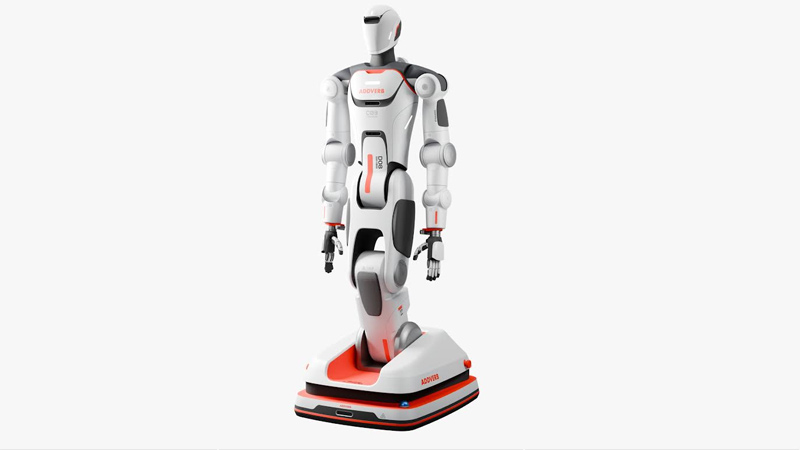
MUMBAI: Addverb has taken a decisive turn on the road to humanoid automation, unveiling its first wheeled humanoid robot, Elixis-W, at LogiMAT India 2026 in Mumbai. Built and manufactured in India, the robot signals the company’s push to make so-called physical AI a practical presence on the factory floor rather than a futuristic concept.
Unlike traditional fixed automation, Elixis-W is designed to move, think and work alongside people in dynamic industrial settings. The robot combines adaptive wheeled mobility with dual arms, each fitted with five-fingered dexterous hands, allowing it to handle tasks that demand precision as well as flexibility.
At its core sits a Physical AI-ready architecture, supported by dual Nvidia Jetson Orin and Thor computing units. This setup is intended to give the robot the ability to perceive, plan and adapt to changing environments, rather than simply follow pre-programmed routines.
According to Addverb CEO and co-founder Sangeet Kumar, the humanoid reflects the company’s long-standing belief in human-robot collaboration. He said the robot is designed to take on repetitive, risky or physically demanding tasks, freeing human workers to focus on higher-value decision-making roles.
Alongside the humanoid, Addverb also showcased two new intralogistics solutions. The Cruiser 360, a four-way pallet shuttle, is aimed at high-density storage environments where space and speed matter. The FlowT, an autonomous forklift, is designed to move materials safely in busy warehouses and factory spaces.
Visitors also saw Trakr, the company’s quadruped robot, navigating the exhibition floor, offering a glimpse of how legged machines could assist in future warehouse and industrial operations.
Addverb, which began as a warehouse automation specialist, has steadily expanded its global footprint across the United States, Europe, Australia and Asia. Its client list includes Reliance, HUL, PepsiCo, Maersk, Mondial Relay and DHL.
With the launch of Elixis-W, the company is steering towards a future where robots are not just bolted to the floor, but rolling, reasoning and working shoulder to shoulder with people on the shopfloor.