News Broadcasting
Chavan unfazed by EC Notice, says it vindicates his stand

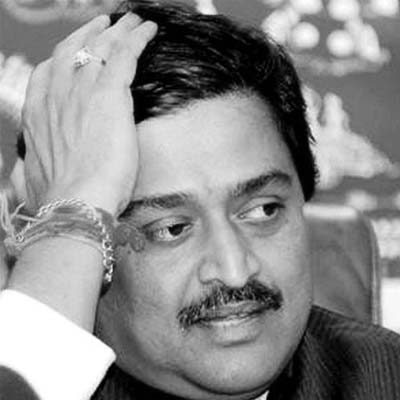
NEW DELHI: Former Maharashtra Chief Minister Ashok Chavan remains unfazed by the show cause notice issued to him by the Election Commission.
In fact, Chavan said this only vindicated his and the Congress’ stand that “there is no question of paid news.”

“Our stand on the paid news issue has been confirmed by the Election Commission. Even the High Court and Supreme Court had taken a similar stand when our opponents had filed a petition. The courts had rejected their petition. Now this (EC) order is also very clear. There is no question of paid news,” Chavan told Press Trust of India over phone.
Chavan claimed that he had himself pleaded with the Commission to give him an opportunity to file electoral expenses as required by law and he will now do this as notice has been issued to him.
“There is a provision under which a notice can be served to us. We will reply to that. I have not seen the order in detail yet. But the issue of paid news is ruled out totally,” Chavan said.
The notice relates to the election to the Maharashtra Legislative Assembly held in September-October 2009 wherein Chavan was the candidate from the Bhokar seat.
The complainants who include rival contestant Madhavrao Kinhalkar, Bharatiya Janata Party vice president Kirit Somaiya, BJP MP Mukhtar Abbas Naqvi and five others had alleged in their submission made before the Election Commission that Chavan got several advertisements published in various regional newspapers during the poll campaign.
The complainants had alleged that the advertisements which appeared in newspapers in the garb of news eulogising Chavan and his achievements as Chief Minister, were “paid news”.
It was alleged by them that a huge expenditure was incurred or authorised by Chavan for getting those advertisements and the articles published as news, and that the expenditure incurred or authorised on the publication of those paid news was not included by Chavan in his account of election expenses maintained under section 77 of the Representation of the People Act, 1951.







News Broadcasting
UDF poised to return to power in Kerala, says Manorama-CVoter survey
Massive opinion poll projects shift in Kerala politics ahead of 2026 Assembly elections.
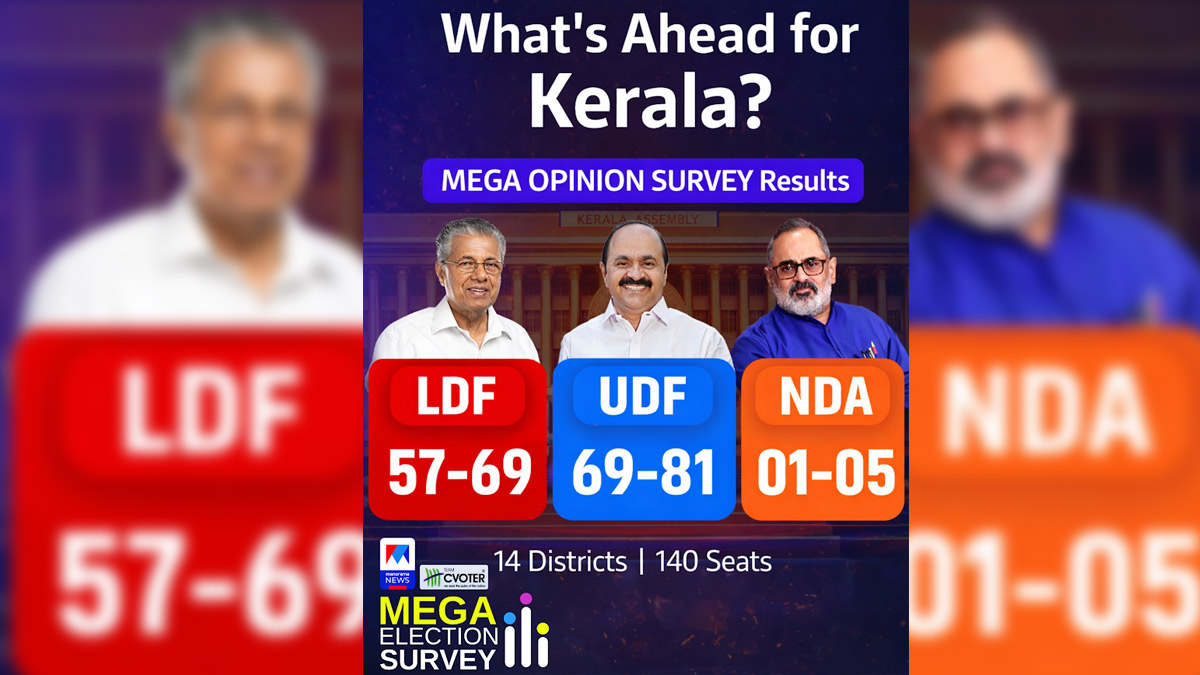
MUMBAI: The winds of change appear to be blowing through Kerala’s political landscape and this time, they seem to favour the United Democratic Front. A comprehensive mega opinion survey conducted by Manorama News in partnership with CVoter projects a potential comeback for the UDF in the upcoming Kerala Legislative Assembly Elections 2026. The survey, covering all 140 constituencies with a massive sample size of nearly 90,000 respondents, predicts the UDF could win between 69 and 81 seats.
The ruling Left Democratic Front (LDF) is expected to secure 57 to 69 seats, a significant drop from the 99 seats it won in the 2021 elections. This would mean the LDF losing 30 to 42 of its sitting seats. Meanwhile, the National Democratic Alliance (NDA), which drew a blank in 2021, is projected to open its account with 1 to 5 seats.
Region-wise, the UDF is expected to make strong gains in Malabar, winning 25 to 34 out of 48 seats, and in Central Kerala, where it could bag 29 to 33 out of 53 seats. In South Kerala, the LDF is likely to retain an edge with 21 to 25 seats, while the UDF may improve to 12 to 16 seats. The NDA could pick up 1 to 3 seats in the southern region.
The survey was conducted between 14 and 26 March 2026, with additional tracker and snap polls carried out from December 2025 to March 2026. A total of 89,693 respondents participated, ensuring representation across all demographics and social segments.
Manorama News has a strong track record of accuracy, with its previous projections closely matching the actual results of the 2019 and 2024 Lok Sabha elections as well as the 2021 Kerala Assembly polls.
In Kerala’s famously fierce political battles, this survey suggests the pendulum may be swinging back. Whether the final verdict matches these numbers or throws up another surprise, one thing is clear, the 2026 Assembly elections are shaping up to be one of the most keenly watched contests in the state’s history.






