News Broadcasting
Chandra exhorts industry to sink differences

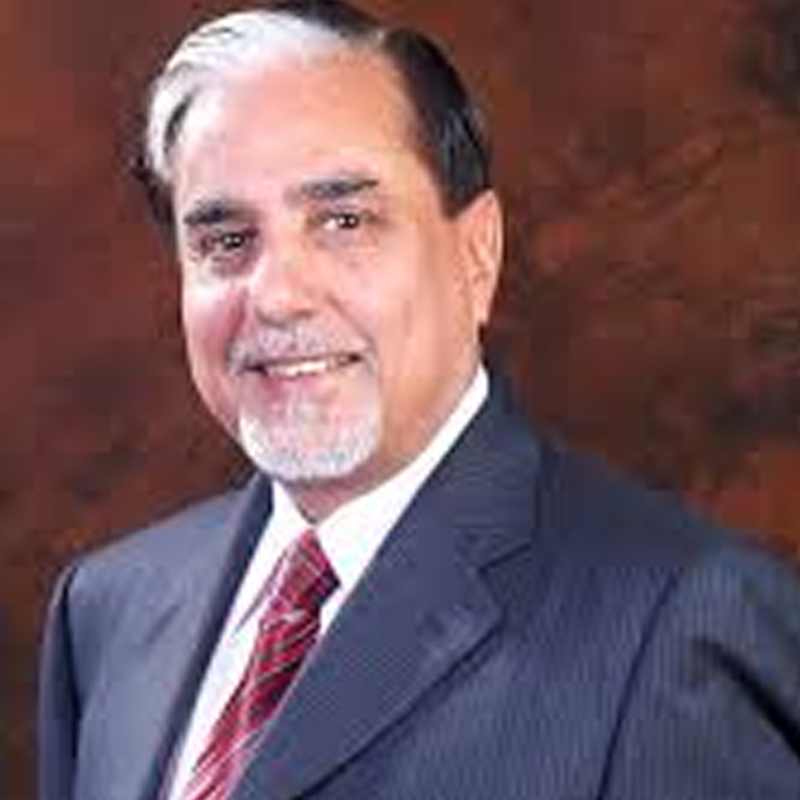
NEW DELHI: While exhorting broadcasting industry to sink differences for collective benefit, Zee Telefilms chairman and maverick media entrepreneur Subhash Chandra today posed several issues before the government and sector regulator, including level playing field vis-à-vis telecom companies.
“Let us all work together for long term benefits as blaming each other will not help. Let us work in partnership,” Chandra appealed to various constituents of the industry while delivering a keynote address at the India Broadband Digital Networks Forum organized here by Indiantelevision.com and Media Partners Asia.
Citing the example of CAS, Chandra wondered if all the stakeholders felt that addressability is good for the industry, how come it hasn’t yet become a reality in India.

“Simply because vested interests (including broadcasters and cable fraternity) worked against CAS’ implementation since 2003,” Chandra said.
Though he sought a more liberal regulatory regime both in terms of pricing and policies in the presence of I&B secretary and Trai chief , he agreed with both of them that comparison of the Indian market with the likes of US and UK is uncalled for as the former has its own needs and peculiarities.
“If we had followed the American model, it would have needed investments worth $ 150-200 billion to bring the cable TV market to a level it now enjoys in terms of penetration, revenue and employment generation in India,” Chandra said.
Earlier, information and broadcasting secretary SK Arora in his keynote address made a fervent pitch for digitalization of broadcasting services, which is imperative to keep pace with global trends and changing business models of media companies.
“In terms of size and magnitude, the potential of the Indian broadcasting industry remains…and it’s quite a challenge to identify the impact that emerging technologies would have on business models of companies,” Arora said.
Pointing out that India needs to design its own “solutions” keeping in mind the socio-economic scenario (read good services at low prices), Arora said regulations would be guided by the principle that “consumer is king.”
According to the government official, in the 11th Five-Year Plan, the work on which is presently underway, the government is attempting to address the issue of digitalisation through “public-private partnership.”
“We are encouraging and nudging them (the industry players) to move towards digitalisation,” Arora said, adding the first phase of it is expected to be completed by 2010 coinciding with Delhi playing host to the Commonwealth Games.
Concurring with Arora, Telecom Regulatory of India (Trai) chief Nripendra Misra said arrival of digital technology, which gives more choice to consumers, and rapid convergence of services like telecom, infotech and broadcasting were two major trends of the television industry.
However, Misra admitted that unregulated growth and lack of addressability had thrown up its own problems for the broadcast and cable industry.
In such a scenario, DTH and CAS will have far-reaching impact on the industry, Misra said.
Unfazed by widespread criticism of some pricing diktats of Trai earlier, Misra said that the regulator’s endeavour is to spread level playing field for all and formulate policies that are based to encourage efficiency, financing, development and equality.
Though he admitted various legal lacunae is hampering a move towards unified licencing (whereby one single licence would enable delivery of telecom and broadcast services) at present, he envisaged in future cable networks might provide telecom services and give competition to telecom companies.
“Convergence is being seen as an opportunity (in India)…but any development globally has to be seen in the Indian context,” Misra said, adding Trai will be coming out soon with a consultation paper on IPTV again.
Meanwhile, at the start of the event, Indiantelevision.com founder and editor-in-chief Anil Wanvari and MPA executive director Vivek Couto gave a snapshot of the Indian broadcast industry and the trends that have emerged over the last few years increasingly leading towards convergence.
The morning session was attended by industry luminaries and senior government officials, including John Malone-controlled Liberty Media board member Shane O’ Neil.





News Broadcasting
Network18 channels lead YouTube news viewership in March 2026
CNN-News18, News18 India and CNBC channels top categories with record views
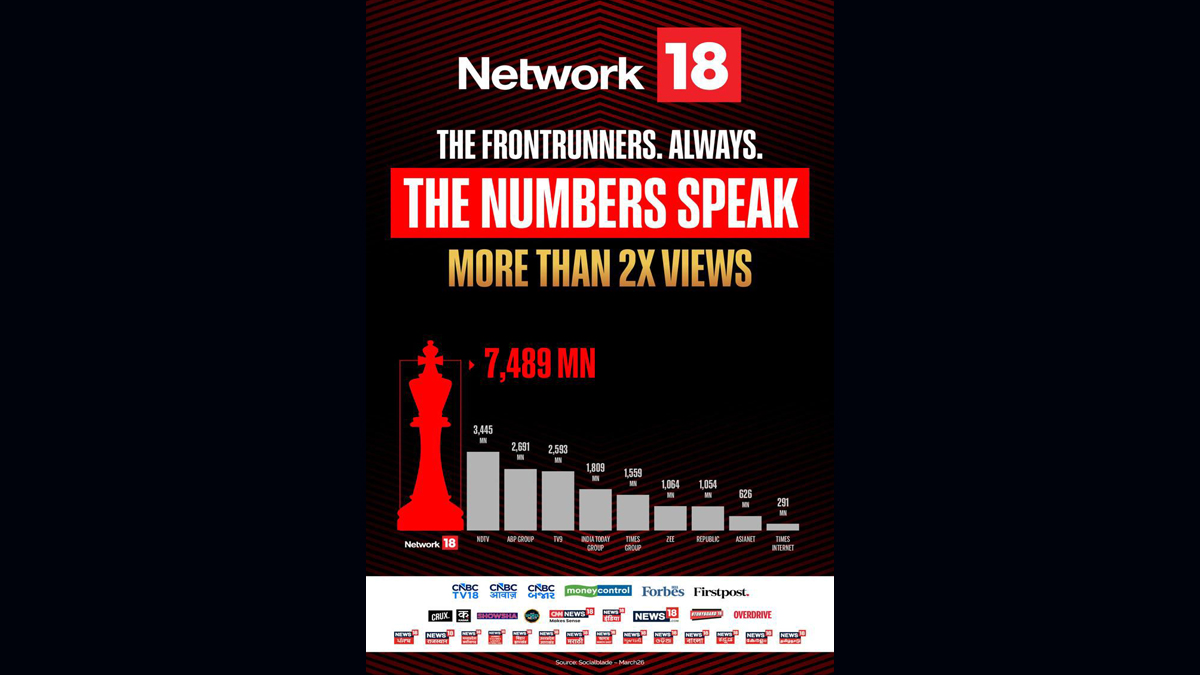
MUMBAI: When the world hit refresh on breaking news, Network18’s channels were already streaming ahead. As geopolitical tensions and war-driven headlines fuelled a surge in global news consumption, the network’s digital playbook delivered big clocking record Youtube viewership across English, Hindi and business news categories in March 2026.
At the forefront was CNN-News18, which emerged as the clear leader in the English news segment with 130 million live and video-on-demand views. The channel edged past competitors such as Times of India (126.5 million), Times Now (101.1 million), India Today (88.2 million) and NDTV (77.5 million), according to Databeings data for March.
In the Hindi news arena, News18 India delivered a commanding performance, racking up a staggering 3,297 million views on YouTube. The channel comfortably outpaced NDTV India, which recorded 3,119 million views, underlining its deep reach and consistent engagement with mass audiences, as per Playboard data.
The network’s dominance wasn’t confined to general news. In the Hindi business segment, CNBC Awaaz topped the charts with 92 million views, narrowly ahead of Zee Business (90 million) and well ahead of ET Now Swadesh (57 million). Meanwhile, its English counterpart CNBC-TV18 posted a strong 58 million views, reinforcing the network’s cross-category strength.
The spike in viewership reflects a broader shift in audience behaviour, with viewers increasingly turning to digital platforms particularly Youtube for real-time updates and in-depth coverage during high-intensity news cycles. For Network18, the numbers signal more than just scale; they underline the effectiveness of a multi-platform strategy that blends speed, credibility and continuous coverage.
In a month where the news never paused, it seems viewers chose to stay tuned where the stream never stopped.






