GECs
Censorship and extremism worry content creator even as tech helps: Uday Shankar

MUMBAI: Star India chief Uday Shankar today said while the distance that India has travelled in just one year in adopting internet based behavior is nothing short of remarkable, he was sad that ‘our censor authorities seem to be getting more and more conservative’ as the world gets bolder.
Speaking at the inauguration of the three-day FICCI FRAMES, Shankar said that “the openness of the internet was supposed to lead to greater plurality of opinions, instead it has created a violent polarity” and a “forced extremism on every matter that has made gray the least acceptable colour in all discourse. As a society we have raised the stakes of every argument to narrowly legal and brutally physical consequences. There seems to be no room left to have civil debates and no place for those who disagree.”
Clearly expressing a viewpoint that pained the creator of content, he asked: “But can we lay all the blame on the Censor Board itself? In my view the Board generally reflects the dominant consensus of our society and there are increasingly more bodies, mostly self-appointed, who have taken upon themselves the task of censoring media content. The refrain seems to be – I don’t like the legend or the myth on which your story is based, so I will burn down your sets. I don’t like a character, so I will not let you release your film. If you say you are going to do a show of busting fake godmen and gangsters, there is pre-emptive action. And what is becoming alarming now is that sometimes even the forums that you would seek redressal at are more inclined to bless the streetside censorship than speak for the freedom of expression.”

Extending his argument, he said: “Punishment for disagreement seems to have become the norm. The institutions tasked with protecting expression and plurality, seem to be at loggerheads with the objective itself. By creating elaborate formal ceremonies around it, are we taking the joy out of one of the most loved and celebrated lyrics in our country i.e. our National Anthem? What’s frightening is that the court order has just become yet another weapon in the hands of any goon who is keen to stamp his authority. We are rapidly descending into a mindset where the most critical objective of a work of art is to make sure that it offends nobody no matter how many thematic or creative compromises it has to make.”
He regretted that the “most worrying part” was that creative minds have begun to self-censor their thoughts and have started killing ideas before they germinate so as to avoid any conflict. “And that is really frightening. The advocates of this vandalism claim that unique measures must be taken to protect our unique culture.”
However, Shankar said India appeared to be moving fast towards a digital dividend rather than a digital divide. “Personally I find predicting the future to be a tricky business -especially when it involves adoption of new technology. Just a year ago, at this very venue, there was a lively discussion on digital adoption. In less than a year, we are past that tipping point in this country. The distance that India has travelled in adopting internet based behaviour is nothing short of remarkable.”
From buying goods and services to ordering in, India is now one of the largest markets for mobile applications – be it by volumes of downloads, consumption of video or e-commerce, for which it has already emerged as the next frontier.
On the other hand, he said the conversation last year was about how many more unicorn start-ups will we see; this year it is about how many lame horses will have to be put down. “Fortunately, the digital story for the M&E sector continues to look exciting and it is already the next big destination for the global digital giants like Netflix and Amazon Prime. The stories of bottomless war-chests may or may not be hyperbole, but, it does give us a sense of the competition that they see from home-grown digital enterprises like Hotstar, Voot and the others.”
He was confident that there will be a lot more lively activity on this front. The technology that has been introduced in this country is as good if not better than the best in the world. Combined with the reset in costs and quality benchmarks led by Reliance Jio, this has driven the adoption by the Indian consumer at a breathtaking pace.
But while we celebrate this rapid growth, he said that in 2015-16 the Central Board of Film Certification refused certification to 77 movies. This number was 47 in 2014-15 and only 23 in the year before.
As an example, he said the movie ‘Jolly LLB – 2’ had to be screened for a group of lawyers and medical professionals who were to decide whether the scenes were appropriate or whether they insulted any profession or institution. “This was despite the fact that the movie had been certified for universal release by the censor board.”
He said there was a long list of instances “where the creative community has been bullied into changing its output to suit the needs of someone or the other in India. It seems that there are always people lurking in the shadows. Their sole job is to stretch and explore every piece of content that could be potentially offensive to someone.”
He said the openness of the internet was supposed to lead to greater plurality of opinions, instead it has created a violent polarity.
Referring to extremist reactions to creative works, he said: “We seem to be following the script that Hollywood had written almost 100 years ago. In the early part of the 20th century, Hollywood had decided to self-regulate itself. It adopted a production code and insisted on its enforcement for almost 25 years. The code covered the use of profanity like hell and damn, any suggestive nudity, wilful offense of any nation, race or creed and any ridicule of the clergy among other things. Doesn’t it sound familiar? The similarity with our own moral code is striking to say the least. Interestingly, television that was just arriving in American homes then, emerged as the challenger to this regime. Along with European cinema that came into the US, television buried this regressive moral code. The question today is – will digital play the same role for our generation and our country? The role of a progressive challenger, the role of providing a bigger canvas to creativity and creating a space for dissenting points of view. This new medium has the ability to truly democratize broadcasting. It offers the creative community the rare opportunity to rethink from scratch their art and how it is communicated. Only when modern technology and contemporary creativity truly come together, will we create a compelling and powerful media and entertainment offering.
Those present included High Commissioner Nadir Patel and Mayor John Tory, Information and Broadcasting Secretary Ajay Mittal, and Department of Commerce Joint Secretary Sudhanshu Pandey,




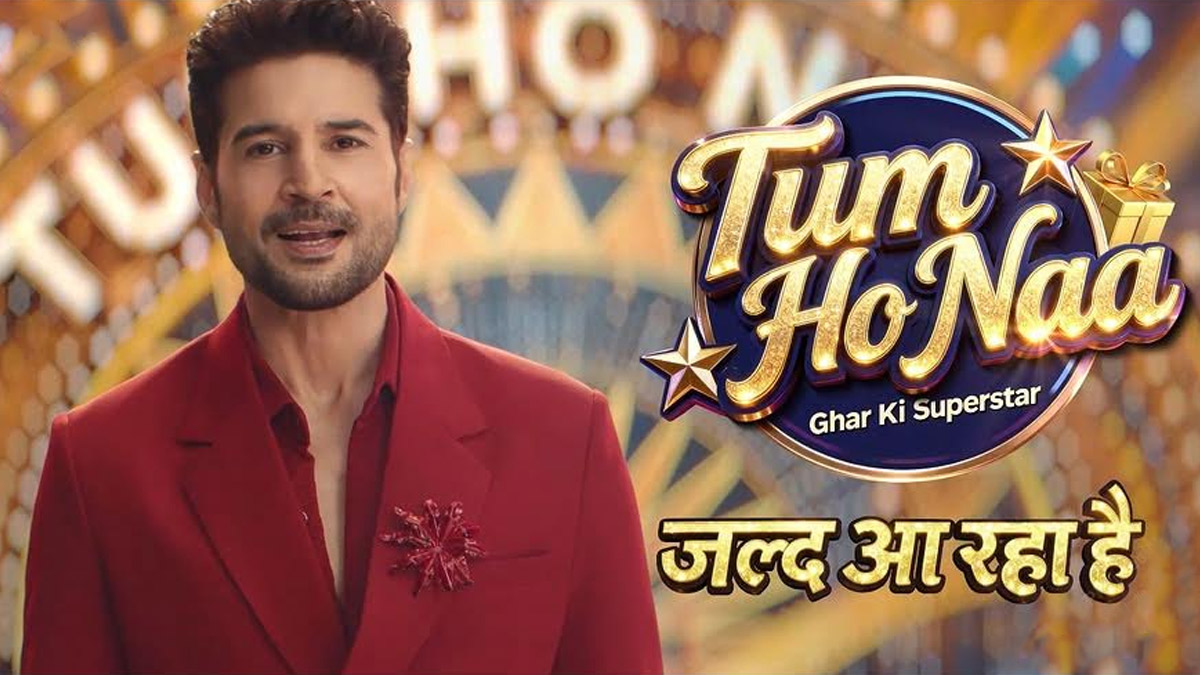
MUMBAI: Lights, camera… connection because this time, the game isn’t just about winning, it’s about who’s with you. Sony Pictures Networks India is gearing up to launch a new reality game show, Tum Ho Naa, expanding its unscripted slate with a format that promises both emotion and engagement.
The show will premiere soon on Sony Entertainment Television and stream on Sony LIV, with Rajeev Khandelwal stepping in as host. Known for his measured screen presence and selective choices, Khandelwal’s return to television adds a layer of familiarity and credibility to the upcoming format.
While specific details of the gameplay remain under wraps, the positioning suggests a reality format that leans as much on emotional resonance as it does on competition, an increasingly popular blend in Indian television, where audiences are gravitating towards content that offers both stakes and storytelling.
Khandelwal, reflecting on his return, noted that his choices have often been guided by instinct rather than convention, describing Tum Ho Naa as a project that feels “close to the heart”. His association also signals Sony’s continued focus on anchoring new formats with recognisable faces who bring both relatability and depth.
The launch comes at a time when broadcasters are doubling down on original non-fiction formats to drive appointment viewing, even as digital platforms expand parallel reach. By placing the show across both linear television and OTT, Sony appears to be aiming for a dual-audience strategy capturing traditional viewers while engaging digital-first consumers.
As the countdown to premiere begins, Tum Ho Naa positions itself not just as another game show, but as a reminder that sometimes, the biggest prize on screen isn’t the jackpot, it’s the journey shared along the way.






