High Court
CBFC has powers to issue multiple certificates on various versions of films

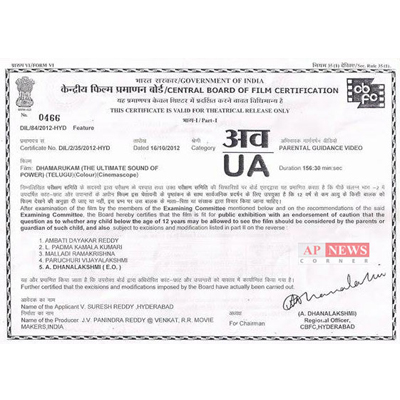
NEW DELHI: The Delhi High Court has been informed that the Central Board of Film Certification can issue multiple “certifications” with respect to various versions of a film.
In its affidavit filed before a bench of Chief Justice G Rohini and Justice R S Endlaw, the Information and Broadcasting Ministry said the certificate is issued on the content as and when it is changed while being shown on TV channels.

The submission was in reply to a public interest litigation opposing issuance of universal certificates to an adult movie after deletion of some contents. The petition was also against the practice of conversion of ‘A’ films into ‘U/A’ and ‘U’ to enable their telecast on TV channels.
“Provision of the Cinematograph Act and Rules clearly provide for multiple certifications being issued with respect to various versions of one particular film.
“Under the Cinematograph Act, the certification is done of the content and when there is change in content, recertification is required and is done,” the Ministry said.
The CBFC “has absolute power to certify films and it is also a competent authority to entertain applications seeking certificate of films which are altered by way of deletion/addition of certain scenes/dialogues.”
The plea was filed by Edara Gopi Chand, vice-president, Media Watch-India through advocate Gaurav Kumar Bansal.
The petitioner said children and adolescents are exposed to ‘adult’ film material like drug use, adultery, extramarital affairs, ribald comedy, intimate scenes of romance and sexuality, ‘item songs’ with vulgar lyrics and dance sequences, scenes involving rape and other heinous acts against women, films with extreme violence, films of horror and thriller genres etc.
“The adverse impact of such content on the impressionable minds of children and adolescents is well-established by various research studies at national and international levels. By such exposure, the due right of minors to be protected from harmful/age-inappropriate media content is being violated,” the plea said.







High Court
Delhi HC blocks illegal IPL 2026 streams, backs JioStar rights
Court orders swift takedowns, expands crackdown on piracy apps

NEW DELHI: In a timely move ahead of the cricketing season, the Delhi High Court has granted interim relief to JioStar India Private Limited, clamping down on illegal streaming of the TATA Indian Premier League 2026.
The court passed ex parte ad interim injunctions in two separate suits, restraining rogue websites and mobile applications from broadcasting IPL matches without authorisation. The tournament is set to begin on 28 March, making the timing of the order particularly significant.
Recognising JioStar’s exclusive digital and broadcast rights for the IPL cycle from 2023 to 2027, the court observed that unauthorised streaming would infringe its statutory and proprietary rights, potentially causing irreparable losses.
In one case, the court directed several identified websites to immediately stop hosting or streaming IPL content. It also issued a dynamic injunction, allowing JioStar to flag new infringing platforms in real time, which must then be blocked swiftly by domain registrars and internet service providers.
In a parallel order, the court turned its attention to piracy through mobile apps, particularly Android-based platforms distributing content via APK files. A broader dynamic+ injunction was granted, extending to future variants, mirror links and related interfaces, signalling a tougher stance on evolving piracy tactics.
The court also directed domain name registrars to suspend offending domains and share registrant details, including KYC and payment information. Internet service providers and telecom operators have been instructed to block access within strict timelines, in some instances within 36 hours. Both the Department of Telecommunications and the Ministry of Electronics and Information Technology have been asked to facilitate enforcement through necessary notifications.
Noting the fast-changing nature of digital piracy, the court emphasised the need for real-time enforcement tools to keep pace with anonymous and constantly shifting networks. It also underlined the commercial impact of piracy on legitimate rights holders.
The ruling reinforces the judiciary’s firm stance on protecting intellectual property in the digital age. For viewers, it is a reminder to stick to official platforms as the IPL season kicks off under tighter watch.






