Hardware
CastleMedia sets up Spyke for CPE and STBs repair


MUMBAI: Here’s some good news for the DTH Operators, MSOs and LCOs who used to get their STBs repaired from the neighborhood electrical shop at the hands of untrained, unqualified electricians.
Thanks to the government’s cable TV digitisation push, the population of STBs or consumer premise equipment swelled. With close to 174 million STBs or consumer premise equipment (CPE) of various types – digital, HD, Ultra HD, and a guesstimated failure rate of around five to eight per cent, Mumbai headquartered Spyke Technologies (SPYKE) has stepped into the STB servicing and repair game for distribution platforms.
Backing the new venture are broadcast technology vets Vynsley Fernandes and CEO Ru Ediriwira of CastleMedia which has worked with leading broadcast, networking & communications product manufacturers across their product lifecycle – right from R&D and field testing to improving “user experience.”

The company has set up service centers in Mumbai and New Delhi, and a countrywide faulty STB collection center network. The service centres are manned with about 30 tech engineers in Mumbai and 35 in New Delhi.
Presuming the STB failure rate at a conservative five per cent of the digital TV ecosystem in India (although actual ground information indicates failures at around 8-10 per cent), SpykeTech aims to capture between 12 per cent to 15 per cent of the market in the next four to five years. And, helping it get there will be the offices in Bengaluru, Hyderabad, Madras, Ahmedabad and Kolkata which will come up in over the next two to three years.
The company has invested more than Rs 35 million in Spyke on its 2500 sq foot Mumbai office located in Vile Parle and and its Delhi office being hosted over 7000 sq feet. Spyke will be in a position to fix at least 18,000 STBs every month in Mumbai, while the fixing figure for Delhi stands at 25,000 a month.
The company is being positioned as India’s first technology lifecycle management platform for CPE offering a single window and end-to-end service model which includes repairing of STBs, broadband and data communication equipment, home media gateways, networking equipment and VSAT modules.
Says Spyke Technologies director Sunil Ranadey: “There exists a demand-supply gap in the country when it comes to quality servicing of not only STBs but all CPEs. SpykeTech aims to bridge this gap. Our cloud-based proprietary software SPYKENET, is what we believe will separate the “men from the boys” in terms of CPE repairs in the country.”
“The proprietary software will empower the DTH operators/MSOs/LCOs not only with analytical tools to analyse the faults, but will provide complete transparency with logistic movement and accounting support for their CPs, something lacking in the present system,” Ranadey added.
Spyke is in its early setup stage but has already begun to have conversations with different distribution platforms. The sticker price for repairing an STB is being talked about as being between Rs 200 and Rs 450 which is quite an attractive option for all TV viewers. What’s unique about Spyke is its SpykeTech solutions which uses a powerful and collaborative software platform to support clients and customers across India.
“SpykeNet will be the difference between us and other repairers. The software is going to be the strong analytical tool which is applicable to all cable and DTH networks,” elaborates Ranadey.
Adds CastleMedia executive director Vynsley Fernandes: “CastleMedia has been very successful in identifying pain-points in the pay TV industry and developing solutions to address the problem. One such example was the development of a suite of mobile and on-line applications for cable TV customers to go prepaid – this was truly an innovative and pathbreaking initiative. Similarly, we see CPE management – irrespective of whether it’s STBs or other devices; continuing to impact the company bottom-lines – anywhere up to 30 per cent. Our significant investment in setting up SpykeTech is precisely based on addressing this pan-India issue.”
Also Read :
Airtel launches hybrid DTH STB, to have 500+ channels, Netflix & YouTube preloaded
DEN to launch 4k, ‘open’ STBs, give a leg-up to HD, b’band services
Dish TV & ALi tie up – chipset tech vital for secure VAS, enriched viewing
9 Indian companies to manufacture STBs; iCAS cost less than $0.5: Govt







Hardware
India clears Rs 1.6 lakh crore semiconductor projects under Semicon India
Ten projects cleared as production begins and design ecosystem gathers pace
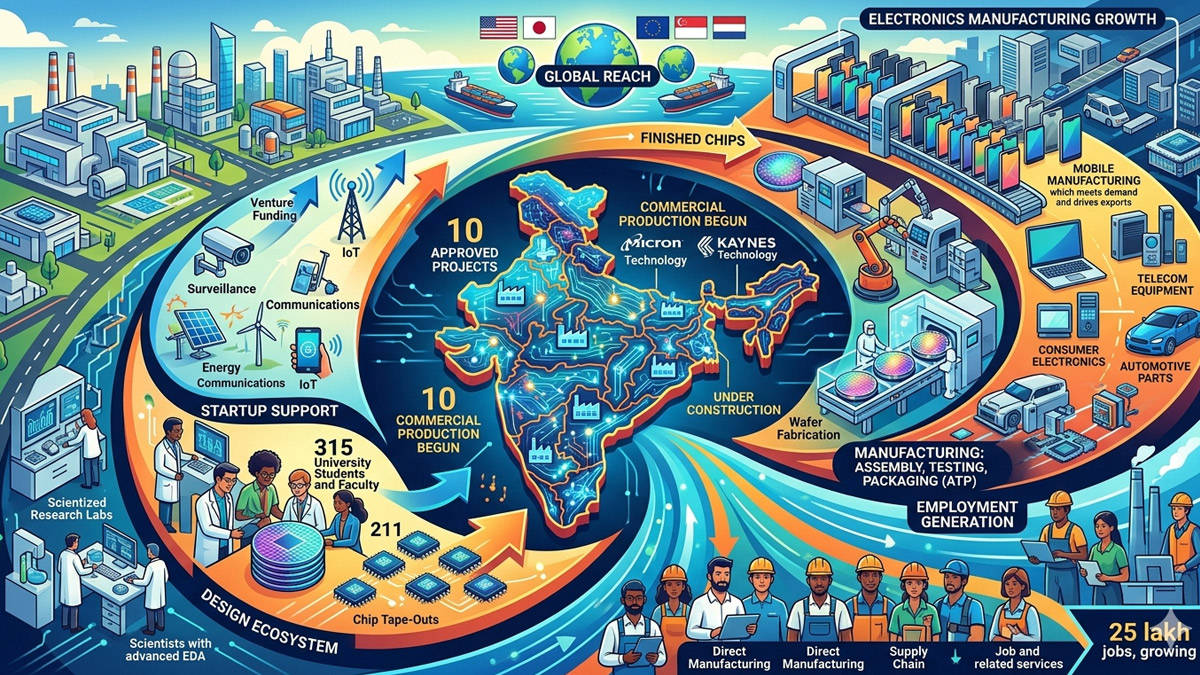
NEW DELHI: India’s push to become a global electronics powerhouse is gaining momentum, with the Semicon India Programme driving the creation of a full-fledged semiconductor ecosystem from design to manufacturing.
Launched in 2022, the programme aims to build capabilities across the entire value chain, including chip design, fabrication, assembly, testing and packaging. In just four years, the government has approved 10 semiconductor projects with a combined investment commitment of around Rs 1.6 lakh crore.
Two of these facilities have already begun commercial production, including units led by Micron Technology Inc. and Kaynes Technology India Limited. Two more plants are expected to go live later this year, signalling that India’s chip ambitions are moving from blueprint to factory floor.
The broader electronics manufacturing story has also seen sharp growth over the past decade. Production has jumped from roughly Rs 1.9 lakh crore in 2014-15 to about Rs 12 lakh crore in 2024-25, while exports have surged nearly eightfold. Mobile phone manufacturing, once heavily import-dependent, now meets almost all domestic demand and has become a major export driver.
Alongside manufacturing, the government is investing heavily in design capabilities. Through access to advanced chip design tools provided free to 315 universities, students and researchers have clocked over 200 lakh hours of usage. This effort has already resulted in 211 chip tape-outs from 75 institutions.
Support for startups is also picking up pace. Twenty-four chip design projects have been approved, targeting sectors such as surveillance, energy, communications and IoT. Of these, 14 companies have collectively raised over Rs 650 crore in venture funding, while several designs have progressed to fabrication, including at advanced nodes.
To strengthen supply chains, India has also signed semiconductor cooperation agreements with countries including the United States, Japan, the European Union, Singapore and the Netherlands. These partnerships aim to reduce global dependencies while boosting domestic capabilities.
The employment impact is equally significant. The electronics sector now supports an estimated 25 lakh jobs, with mobile manufacturing alone accounting for nearly half. As more semiconductor units come online under the India Semiconductor Mission, indirect job creation across supply chains is expected to rise further.
Sharing these updates in Parliament, Ministry of Electronics and Information Technology minister of state Jitin Prasada underscored the government’s focus on building a resilient, end-to-end semiconductor ecosystem.
With factories taking shape, designs moving to silicon and investments flowing in, India’s semiconductor story is steadily shifting gears from ambition to execution.






