News Headline
CAS in metros by Sep-Oct ’03: JP Morgan report

MUMBAI: The implementation of conditional access systems (CAS) in the metros, for which the government has mandated a 14 July deadline, will take about three months, a new report suggests.
According to the latest JP Morgan report on Indian media dated 19 March 2003, a copy of which is with indiantelevision.com, the CAS rollout process will be completed by September-October 2003. The CAS rollout plan, however, still leaves various questions unanswered in the minds of investors, the report says.
None of the three mainstream channels (Star, Zee, Sony) will be free-to-air, the report avers. Financing is not likely to be a problem area, though the monthly financial charge (depending on the price of the STB) will be a key determinant of CAS penetration, it states.
Other broad conclusions of the JP Morgan report are as follows:
o Free-to-air (FTA) bouquet price: The government appointed task force will likely release its FTA bouquet price soon but the other decisions are expected by mid to end-April.
o Headend in the sky (HITS): Multi-system operators (MSOs) are likely to adopt the HITS model in the long term, as it will enhance their reach. The local cable operators (LCOs) will also find the situation economical as they will not be required to invest in multiple encoders, which would otherwise be the case. Thus, HITS is a win-win situation for the MSO and the LCO.
o Set top box (STB): Nearly all MSOs are talking of adopting the digital STB (which is compatible with HITS). There are strong indications that the low feature digital STBs will initially be available for around Rs 5,000. These can later be upgraded to higher features if interactivity is desired.
o Pay channels: The subscription rates of the pay channels are likely to come down. However, the extent of price drop will likely depend on the FTA pricing and the offtake of the STBs. Broadcasters can continue to offer bouquets as long as they provide the individual channel prices. Their revenue share with the MSOs will likely be in the range of 50:50.
o Direct-to-home (DTH): DTH can suffer as CAS gets a headstart over it. Additionally, the FDI, cross-ownership issues and technical regulations will pose impediments to the usage of DTH.
o Impact on Zee: It is very difficult to assess the impact of CAS on Zee as its strategy might change with the offtake of encrypted signals. However, in a scenario where Zee (along with the other broadcasters, Star and Sony) remains pay, any downside to revenues is not expected. Additionally, Siticable revenues will get a boost from the revenue sharing with broadcasters, which should give a fillip to Zee’s earnings.
The JP Morgan report claims that its team of analysts has conducted a detailed study of the various issues involved and received feedback from several stakeholders in the cable industry, trying to understand the nuances of find the law and answers to unresolved issues.
Also read these related reports:
MSOs gear up for proposed CAS time frame
Financing of STBs not a problem area
HITS provides win-win situation
FTA price at Rs 70-80 per subscriber per month
Consumer adoption level at 25-30 per cent in 2003
DTH unlikely in medium term






NEW DELHI: Hamdard Laboratories gathered a cross-section of India’s achievers in New Delhi on Friday, handing out the Hakeem Abdul Hameed Excellence Awards to figures who have left their mark across healthcare, education, sport, public service and the arts.
The ceremony, attended by minister of state for defence Sanjay Seth and senior officials from the ministry of Ayush, celebrated individuals whose work blends professional success with a sense of public purpose. It was as much a roll call of achievement as it was a reminder that influence is not measured only in profits or podiums, but in people reached and lives improved.
Among the headline awardees was Alakh Pandey, founder and chief executive of PhysicsWallah, recognised for turning affordable digital learning into a mass movement. On the sporting front, Arjuna Awardee and kabaddi player Sakshi Puniya was honoured for her contribution to the game and for pushing women’s participation onto bigger stages.

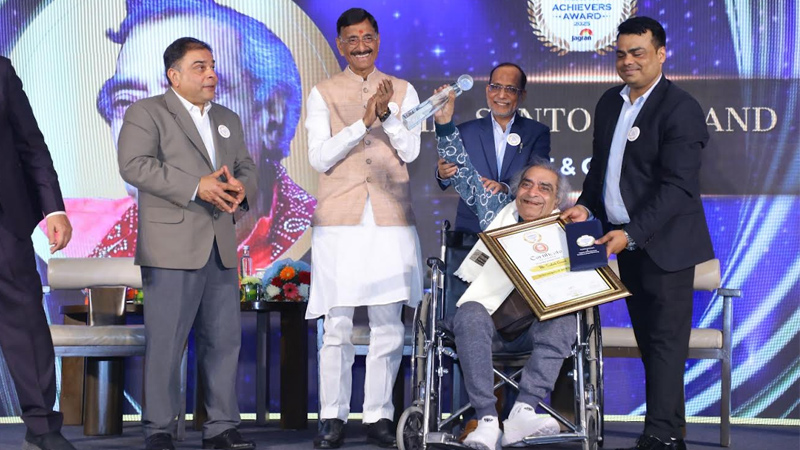
The cultural spotlight fell on veteran lyricist and poet Santosh Anand, whose songs have echoed across generations of Hindi cinema. At 97, Anand accepted the honour with characteristic humility, reflecting on a life shaped by perseverance and hope.
Healthcare honours spanned both modern and traditional systems. Manoj N. Nesari was recognised for strengthening Ayurveda’s place in national and global health frameworks. Padma shri Mohammed Abdul Waheed was honoured for his research-backed work in Unani medicine, while padma shri Mohsin Wali received recognition for his long-standing contribution to patient-centred care.
Education and social development also featured prominently. Padma shri Zahir Ishaq Kazi was honoured for decades of work in education, while former Meghalaya superintendent of Police T. C. Chacko was recognised for public service. Goonj founder Anshu Gupta received an award for his dignity-centred rural development initiatives, and the Hunar Shakti Foundation was honoured for empowering women and young girls through skill development.
The Lifetime Achievement Award went to former IAS officer Shailaja Chandra for her long career in public healthcare and governance, particularly in the traditional systems under Ayush.
Speaking at the event, Hamdard chairman Abdul Majeed said the awards were a tribute to those who combine excellence with empathy. “These awardees reflect Hakeem Sahib’s belief that healthcare, education and public service must ultimately serve humanity,” he said.
Minister Seth struck a forward-looking note, saying India’s young population gives the country a unique opportunity to become a global destination for learning, health and wellness by 2047.
The ceremony also featured the trailer launch of Unani Ki Kahaani, an upcoming documentary starring actor Jim Sarbh, set to premiere on Discovery on 11 February.
Instituted in memory of Unani scholar and educationist Hakeem Abdul Hameed, the awards have grown into a national platform that celebrates those building a more inclusive and resilient India. For one evening at least, the spotlight was not just on success, but on service with substance.







