Cable TV
Cable operators seek exemption in entertainment at par with fuel & medical services

MUMBAI: Although demonetisation of high-demonination currency is largely seen as a boon for a thriving economy marred by a legacy of unaccounted money and corruption, it is a proving to be a bane for the common man. The only basic entertainment that a layman has access to is television which is suffering owing to a severe shortfall of small denomination currency.
Though the government insists on having made arrangements for dispensing cash in new currency through ATMs and banks, the measures are inadequate for the serpentine queue-avoiding office-goer, a shop-keeper, a commoner and especially a ruralite who hardly has access to financial institutions/institutionalised lenders in India.
Seven Star Satellite Cable Network founder and chief Atul Saraf said they have been accepting cheques since a long time. However, some of their franchisees were facing difficulties in collecting cash from the subscribers owing to demontisation.

Generally, around 65-70 per cent of collection in the business is in cash, and the remainder is through cheque. Saraf said they have now made arrangements for online payments from 1 January, 2017.
Saraf lamented that there was a slowdown in collections owing to cash crunch due to demonetisation. The situation would take at least 3–4 months to come to normal.
To a question, Saraf said that installation of STBs had picked up pace as a natural progression of digitisation under Phase III and Phase IV in September and October, but it has slowed down again. “Customers are not willing to shell out whatever little cash they have for STBs; rather they would like to use it for buying essentials,” Saraf bemoaned.
“I have written to the prime minister Narendra Modi to extend the date of exchanging old currency with new by 2-3 months beyond the 31 December deadline,” said Gujarat Cable Operators Association president Pramod Pandya.
Pandya expects the government to be considerate with the plight of the common man especially in rural India. “Entertainment must also be exempt from immediate adherence to the new currency norms as in casewith fuel and emergency medical services,” said Pandya who is the honorary Gujarat state cable operators’ representative at the
information and broadcasting (I&B) ministry.
Customers in the rural areas under DAS Phase IV neither have cheques nor the new currency at all to pay the cable operators. “Approximately 4000 villages in Gujarat that fall under the purview of Phase IV digitisation do not have access to banks or ATMs; where would they fetch the new currency,” Pandya retorted.
Digicable Network (India) Pvt. Ltd CEO Jagjit Singh Kohli sought to put on record that they have been accepting cheques and online payments since a long time. MSOs have never been averse to receipt of cheques. However, as far as LCOs are concerned, only 20-25 per cent subscribers preferred paying their cable bills through cheques. He parried a question on the status and installations of STBs.
“We have been accepting cheques and issuing bills since CAS came into the picture around November 2012. But, lately, we have started issuing itemised bills,” said Maharashtra Cable Association Federation chief Arvind Prabhoo said, welcoming demonetisation during the period of transparency and digitisation. A majority of subscribers (around 70-80 per cent) living the areas serviced by operators who owe allegiance to MCOF have been paying trough cheques. “We also started accepting online payments last year,” Prabhoo said.
“Neither cheque nor cash, however, is a compulsion. We are not insisting on a particular mode of payment,” Prabhoo said. But, subscribers, of course, were facing a shortage of cash, and it would take around 10 more days for things to normalise, he added. To a question on digitization and installation of STBs, Prabhoo said that there had been some reports of increase in STB sale which could be due to good monsoon.
Since, there was a temporary shortage of cash, Prabhoo said, people were not too keen on buying a STB worth Rs 1500-2000. “The Phase III is stuck due to various court cases, and Phase IV could be delayed by a couple of months as it covers a vast geographical expanse. But, it (DAS III & IV) will happen for sure,” he remarked.
“The situation in Tamil Nadu is grave as subscribers are neither willing to pay through cheque nor do they have ready cash due to demonetisation,” said Chennai Metro Cable Operators Association general secretary MR Srinivasan.
The subscription rate is as low as Rs 100 per month in most of the areas (districts) in the state. But, owing to shortage of low-denomination notes, around 1.4 million subscribers in the state are not paying the cable operators.
“Subscribers offer us old notes of Rs 500, and expect Rs 400 change from us. So, even while we are willing to exchange old notes in the bank, where do we get the change from,” Srinivasan seemed puzzled. And, the subscribers are not willing to pay five months’ advance subscription to tide over the temporary problem.
“The central government is not effective on digitisation in Tamil Nadu as most of the state, except Chennai, is served by cable companies (directly or indirectly) owned by the incumbent government,” Srinivasan alleged.
In Chennai, he said, STBs have been installed only in around 10 per cent of the four million (40 lakh) households. Due to court cases against digitisation also, the progress of modernisation is stuck.
As in case of medical services and petrol pumps etc, Srinivasan expected the government to allow old Rs 500 notes for cable services as well. “At least, for the number of subscribers which have been accounted for, the operators should be allowed to accept that many (old) notes,” he said.
One may be happy about the cable modernisation and demonetisation to stem the economic decay in the larger interest of the country, there seems to be no denying the fact that it will cause of a lot of tug-of-wars, transition and loss of business and lives, heartburns, political upheavals, dilly-dallying and legal wrangles before we move ahead.





Cable TV
Hathway Cable appoints Gurjeev Singh Kapoor as CEO
Leadership change comes as cable TV faces shrinking subscriber base and modest earnings pressure
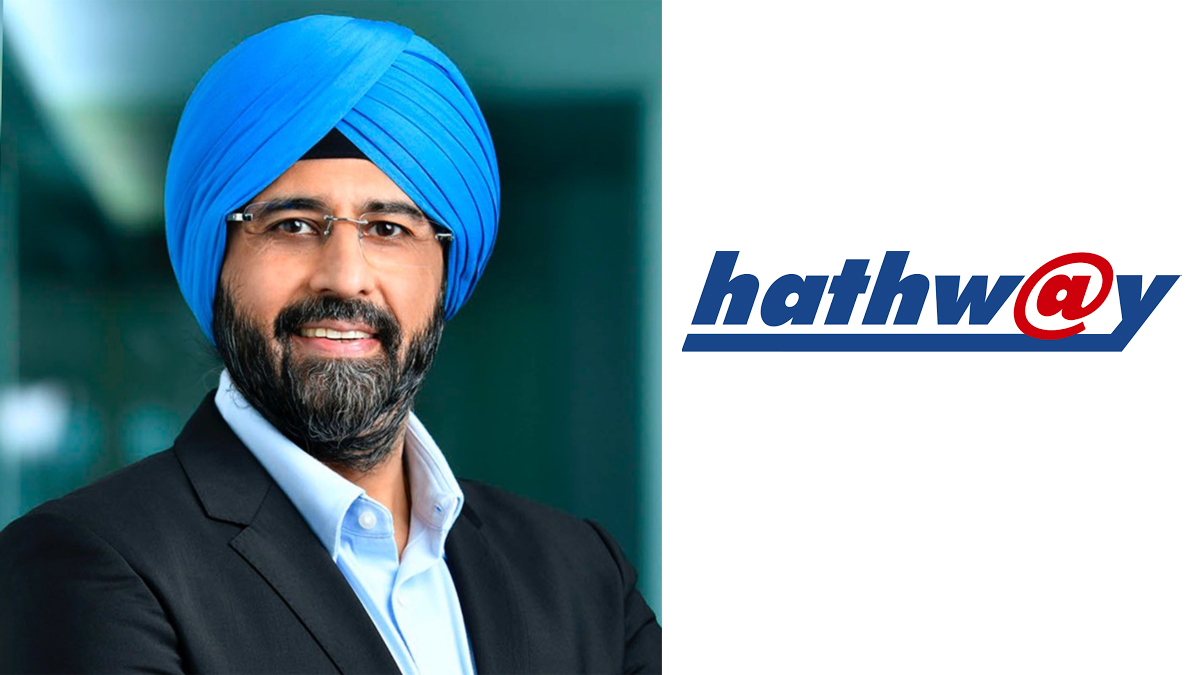
MUMBAI: Hathway Cable and Datacom has tapped industry veteran Gurjeev Singh Kapoor as chief executive officer, marking a leadership pivot at a time when India’s cable television business is under mounting strain.
Kapoor will take over from Tavinderjit Singh Panesar, who is set to retire in August after a long innings with the company. Panesar, chief executive since 2023, has held multiple leadership roles at Hathway, including his latest stint beginning in 2022.
Kapoor brings more than three decades of experience in media and entertainment. He most recently led distribution at The Walt Disney Company’s Star India business, now part of JioStar. His career spans television distribution and affiliate partnerships, with stints at Sony Pictures Networks India, Discovery Communications and Zee Entertainment.
Panesar, with over three decades in the industry, has worked across strategic planning, distribution and business development in media, broadcasting and manufacturing. His past associations include ESPN Star Sports, Star India, Apollo Tyres and JK Industries.
The transition lands as the cable sector grapples with structural disruption. Traditional operators are losing ground to streaming platforms, while telecom and broadband players tighten the squeeze with bundled offerings.
An EY report estimates India’s pay-TV base could shrink by a further 30 to 40 million households by 2030, taking the total down to 71 to 81 million. The slide follows a loss of nearly 40 million homes between 2018 and 2024, a contraction that has already wiped out more than 37,000 jobs in the local cable operator ecosystem.
Hathway’s numbers reflect the strain. The company reported a consolidated net profit of Rs 93 crore for FY25, down from Rs 99 crore a year earlier. Revenue inched up to Rs 2,040 crore from Rs 1,981 crore. As of December 2025, it had about 4.7 million cable TV subscribers and roughly 1.02 million broadband users.
Kapoor steps in with a familiar brief but a shrinking playbook. In a market where viewers are cutting cords faster than companies can reinvent them, the new chief executive inherits a business fighting to stay plugged in.







