News Broadcasting
Cable fraternity hits out at TRAI


NEW DELHI: And so the blame game goes on. First it was the government that was in the line of fire of the broadcast and cable industry stakeholders for favouring one segment or the other. Now, the regulator is coming under the same sort of criticism.
Miffed with Telecom Regulatory Authority of India (TRAI), the cable fraternity today hit out at the new industry sheriff as a clutch of cable operators from different parts of the country today expressed their ‘lack of faith’ in the regulator.
The bone of contention is not only TRAIs reluctance to regulate prices of pay channels, but also introduce a unified license scheme under which any company, including those operating in the field of telecom, can offer cable services.

“The attitude of TRAI is puzzling and is biased towards broadcasters. It cannot regulate the prices of (pay) channels, but is willing to put caps on cable rates,” Gujarat Cable Operators Association, vice-president, Nehal Parmir told indiantelevision.com today during an interaction with the media in the Capital.
According to Parmir, if this line of thinking is carried forward by TRAI, then it would be detrimental to the over Rs 150 billion cable industry as non-cable companies would muscle their way in to oust smaller cable ventures.
Usual suspects like COFI’s (Cable Operators Federation of India) Roop Sharma and National Cable & Telecom Association’s (NCTA) Vikki Chowdhry are of the opinion that the appointment of the regulator too, it seems, may not change the scenario for the better.
Sharma went to the extent of saying that TRAIs proposal to bring in a unified licensing scheme was aimed at favouring a particular corporate house that is very active in the field of telecom as it, through its telecom customers, wants to grab the whole world.
As if on cue, at todays press meet, the cable operators expressed concern over the possible entry of telecom companies like Reliance, Bharti and BSNL in the cable television distribution business in the “guise of convergence.”
Various cable operators associations from all parts of India, including Mumbai, Kolkata, Assam, Chennai, Bangalore, Gujarat, Hyderabad, Pondicherry and Punjab had yesterday apprised TRAI of their various problems during a meeting. And today they told the media of their encounter with TRAI.
Harping on same lines, the cable operators today said that foremost on their agenda was the vertical monopoly by broadcasters through their supported MSOs, which has resulted in the present chaotic situation in the cable TV industry.
A cable operator from Punjab said that TRAI has no hold over arbitrary increase in the rates by broadcasters and their continuous efforts to force increased connectivity on the cable operators.
Surprisingly, a representative from Chennai, where CAS has already implemented, informed the gathering that contrary to popular belief addressability was successful in the city
Whether anybody is listening or not, the cable operators have come up with a long list of suggestions for TRAI too. These include licensing of channels like any other service provider, having uniform channel prices all over the country, having the same pricing for channels for cable, DTH and other related mode of delivery and of course, cross service restrictions.
The big question: is TRAI willing to take a factionalism-ridden cable industry seriously?





News Broadcasting
UDF poised to return to power in Kerala, says Manorama-CVoter survey
Massive opinion poll projects shift in Kerala politics ahead of 2026 Assembly elections.
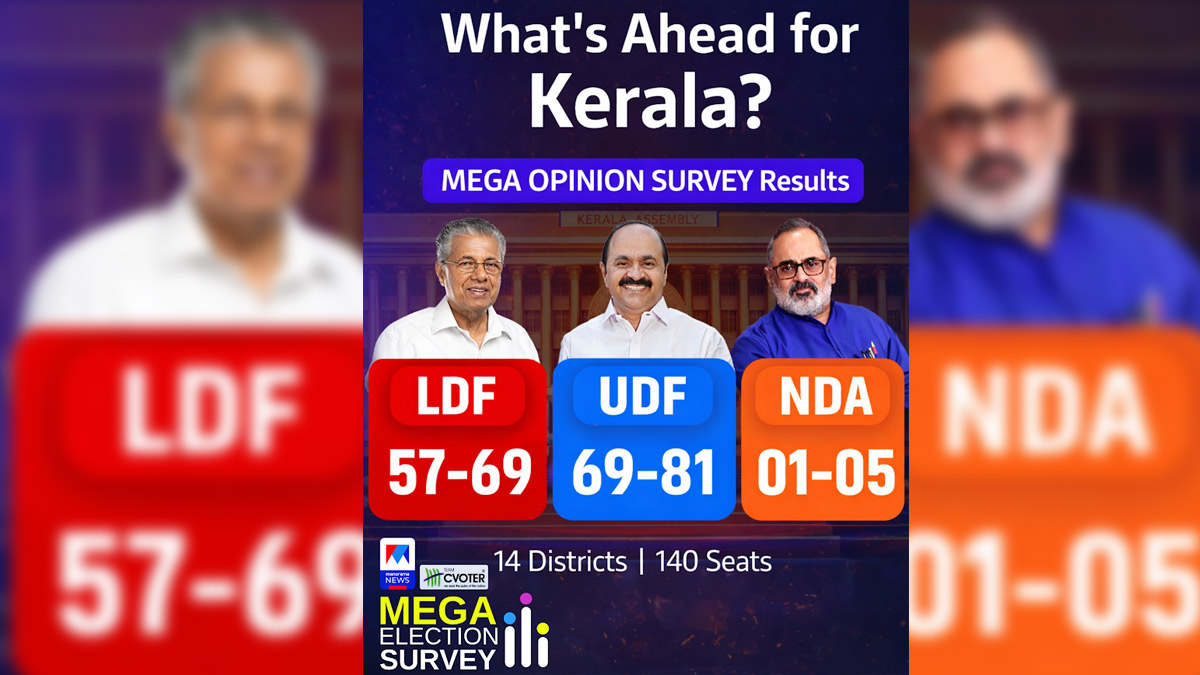
MUMBAI: The winds of change appear to be blowing through Kerala’s political landscape and this time, they seem to favour the United Democratic Front. A comprehensive mega opinion survey conducted by Manorama News in partnership with CVoter projects a potential comeback for the UDF in the upcoming Kerala Legislative Assembly Elections 2026. The survey, covering all 140 constituencies with a massive sample size of nearly 90,000 respondents, predicts the UDF could win between 69 and 81 seats.
The ruling Left Democratic Front (LDF) is expected to secure 57 to 69 seats, a significant drop from the 99 seats it won in the 2021 elections. This would mean the LDF losing 30 to 42 of its sitting seats. Meanwhile, the National Democratic Alliance (NDA), which drew a blank in 2021, is projected to open its account with 1 to 5 seats.
Region-wise, the UDF is expected to make strong gains in Malabar, winning 25 to 34 out of 48 seats, and in Central Kerala, where it could bag 29 to 33 out of 53 seats. In South Kerala, the LDF is likely to retain an edge with 21 to 25 seats, while the UDF may improve to 12 to 16 seats. The NDA could pick up 1 to 3 seats in the southern region.
The survey was conducted between 14 and 26 March 2026, with additional tracker and snap polls carried out from December 2025 to March 2026. A total of 89,693 respondents participated, ensuring representation across all demographics and social segments.
Manorama News has a strong track record of accuracy, with its previous projections closely matching the actual results of the 2019 and 2024 Lok Sabha elections as well as the 2021 Kerala Assembly polls.
In Kerala’s famously fierce political battles, this survey suggests the pendulum may be swinging back. Whether the final verdict matches these numbers or throws up another surprise, one thing is clear, the 2026 Assembly elections are shaping up to be one of the most keenly watched contests in the state’s history.






