iWorld
Bumble’s language badges enable users to make more meaningful connections

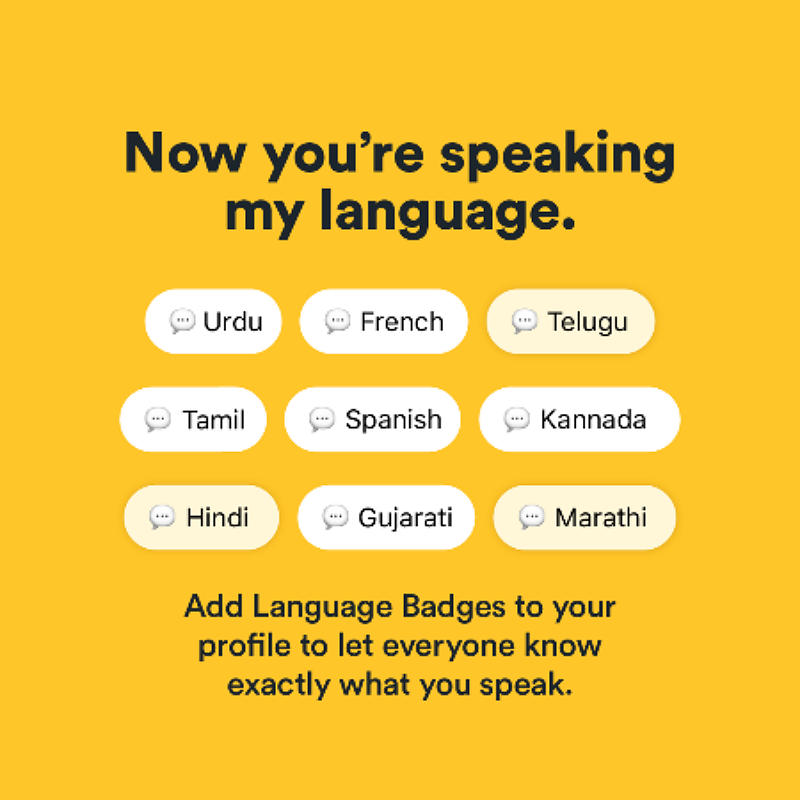
Mumbai: Bumble, the women-first dating and social networking app, has added Language Badges to help its community showcase which languages they speak on their profiles to make more meaningful connections. The dating app’s community of users can now select up to five badges from over 100 languages globally and over 30 languages in India.
As per Bumble’s internal study, people who have added at least one language badge witnessed 34 per cent increase in their matches than those who have not. Since the launch, in India, the top five most widely used language badges on Bumble profiles are English, Hindi, Marathi, Punjabi, and Tamil.
“With the launch of Language Badges single Indians will now be able to showcase their language preferences and communicate more easily with their potential matches. This is another way in which Bumble continues to offer single Indians opportunities to find people they are most compatible with, to make more meaningful connections,” shared Bumble India communications director Samarpita Samaddar.

Over the past year, Bumble has made several updates to its platform, including introducing 150 new interest badges in dating profiles and launching its ‘Night In’ feature, where two people can participate in an interactive game during a video chat. The company also recently launched Snap’s AR Lenses within Bumble video calls and launched video notes that utilise Snapchat’s technology.






iWorld
Meta warns 200 users after fake Whatsapp spyware attack
Italy-targeted campaign used unofficial app to deploy surveillance spyware.

MUMBAI: It looked like a message, but it behaved like a mole. Meta has warned around 200 users most of them in Italy after uncovering a targeted spyware campaign that weaponised a fake version of WhatsApp to infiltrate devices. The attack, first reported by Agenzia Nazionale Stampa Associata, relied on classic social engineering with a modern twist: persuading users to download an unofficial WhatsApp clone embedded with surveillance software. The malicious application, believed to be developed by Italian firm SIO through its subsidiary ASIGINT, was designed to mimic the real app closely enough to bypass suspicion.
Meta’s security teams identified roughly 200 individuals who may have installed the compromised version, triggering immediate countermeasures. Affected users were logged out of their accounts and issued alerts warning of potential privacy breaches, with the company describing the incident as a “targeted social engineering attempt” aimed at gaining device-level access.
The malicious app was not distributed via official app stores but circulated through third-party channels, where it was presented as a legitimate WhatsApp alternative. Once installed, it reportedly allowed external operators to access sensitive data stored on the device turning a simple download into a potential surveillance gateway.
According to Techcrunch, Meta is now preparing legal action against the spyware developers to curb further misuse. The company, however, has not disclosed details about the specific individuals targeted or the extent of data compromised.
A Whatsapp spokesperson reiterated that user safety remains the top priority, particularly for those misled into installing the fake iOS application. Meanwhile, reports from La Repubblica suggest the spyware may be linked to “Spyrtacus”, a strain previously associated with Android-based attacks that could intercept calls, activate microphones and even access cameras.
The episode underscores a growing reality in the digital age, the threat is no longer just what you download, but where you download it from. As unofficial apps become increasingly convincing, the line between communication tool and covert surveillance is getting harder to spot and far easier to exploit.






